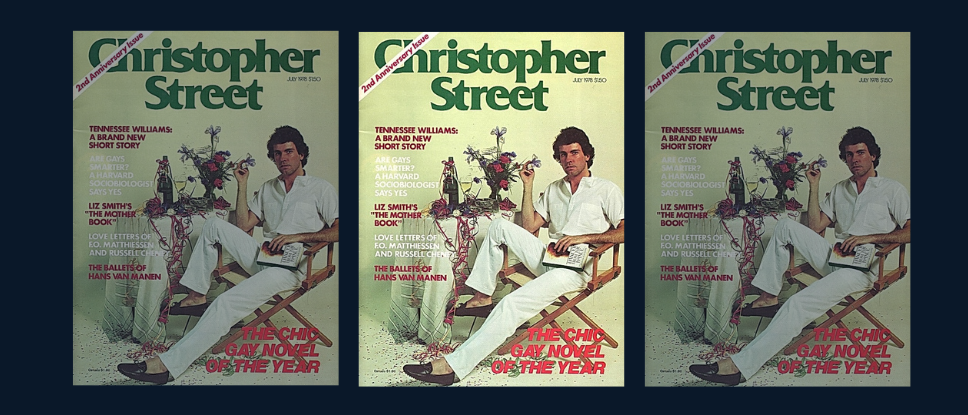



Off Christopher Street is available on Apple Podcasts, Spotify, Amazon Music, YouTube, Pocket Casts, and many more. (Click here to see all platforms).
We’re back from our summer vacation and ready, naturally, to talk about dicks.
In this episode we take on the strange, scandalous history of circumcision in America, the only culturally Christian nation to adopt cutting off the male foreskin as a routine medical practice. We’re joined by fellow French historian Ben Bernard, who has noticed how strange it is that this practice—a “gender unconfirming surgery” that “bears on one’s sexuality and masculinity,” as he puts it—remains overlooked by the history of sexuality and queer theory.
This topic came to our attention because of a conversation in Christopher Street between George Stambolian, who appeared in our very first episode, and Lawrence (Larry) Mass, a co-founder of Gay Men’s Health Crisis and one of the magazine’s resident medical experts who went on to write extensively about the AIDS epidemic. (Mass’ contributions to Christopher Street also included a review of Christopher Lasch’s The Culture of Narcissism that amusingly equated critiquing narcissism with homophobia.)
In their 1982 conversation, Stambolian and Mass discuss Edward Wallerstein’s pathbreaking 1980 book, Circumcision: An American Health Fallacy, which has a strange history of its own: written by a lay non-expert, it nonetheless played an important role in drawing attention to the fact that there was no real medical justification for circumcision, which Wallerstein famously called “a solution in search of a problem.”
We come to the subject from a bit of an odd slant: we’re both cut and have never had strong feelings about foreskins in either direction. So we have a lot to learn from Ben about how circumcision morphed from a moralizing anti-masturbation practice to a medical procedure with purported (but always dubious) health benefits. We contextualize Stambolian and Mass’s conversation in the post-Vietnam era collapse of faith in experts, the rise of “doing your own research,” and gay men’s distrust of the medical and psychiatric establishments. We talk about how our religious backgrounds (David and Blake as evangelicals in the South, Ben as a Jew in the suburbs of Boston) did and didn’t influence our understanding of our own circumcisions, and the ways that gay men eroticize both cut and uncut cocks.
This being our second consecutive episode with three French historians, we do finally get around to talking about France, which played a role in Ben and Blake’s awareness of different cultural paradigms about circumcision. France also figured in Christopher Street: Stambolian, a professor of French, was given to pontificating on French views of American gay culture and circumcised penises, both in this conversation with Mass and in his New York Native column “Paris and Poppers.”
We also explore why circumcision remains such a weird political issue, one that both seems morally straightforward and yet seems to only really activate eccentrics, and the broader of-the-moment issue of populist distrust of expertise. This is related to one of the subjects of Ben’s broader work: as a postdoctoral researcher at Yale, he worked on the university’s recent Report on Trust in Higher Education, which the New York Times called “a damning depiction of academia’s role in cultivating the political and cultural forces that are reshaping higher education’s place in American life.”
Sources
George Stambolian and Lawrence D. Mass, “The Unkindest Cut of All,” Christopher Street, May 1982.
Edward Wallerstein, Circumcision: An American Health Fallacy (1980).
Ben Bernard, “The University’s Never-Ending Crisis,” The Hedgehog Review, Summer 2026.
Lawrence D. Mass, “The New Narcissism and Homosexuality: The Psychiatric Connection,” Christopher Street, January 1980.
George Stambolian, “Paris and Poppers,” New York Native, 1983.
Todd Shepard, Sex, France and Arab Men, 1962-1979 (2017)
Todd Shepard, “Against Vanilla History: Why and How Histories of Sexual Acts Could Matter to Intellectual Historians,” The Routledge Handbook of the History and Sociology of Ideas (2023).
Danielle Spencer, Metagnosis: Revelatory Narratives of Health and Identity (2020).
Alan Hollinghurst, The Folding Star (1994).
John Powers, A Bull of a Man: Images of Masculinity, Sex, and the Body in Indian Buddhism (2012).
 David Sessions
 David Sessions