
This article originally appeared in the May 1982 issue of Christopher Street.
GEORGE STAMBOLIAN: I think many people do not know the facts about circumcision—for example, how many men are circumcised in this country, how this practice has evolved over the years, what justifications are given for it, and what kinds of consequences, both medical and personal, result from it.
LAWRENCE MASS: The book that you and I have both been reading, Circumcision: An American Health Fallacy by Edward Wallerstein (Springer, 1980), documents the alarming growth of this practice in the United States over the last hundred years. In 1870, only about 10% of male infants were routinely circumcised, but today 85% of them are. It has been suggested that circumcision may outrank abortion as the most frequently performed unnecessary surgery in America.
Are parents consulted on this matter beforehand, or is it just automatically done?
Legally, the parents must always be consulted. But in fact, the information is often presented to them in such a way that they are strongly urged to do what has become the norm rather than what is in the child’s best interests.
Well, I understand that if parents do not wish their son to be circumcised, it takes some effort to prevent the operation.
I think that in a growing but still small number of quality medical centers leading opinion against circumcision is now such that parents probably wouldn’t encounter much difficulty. However, if parents aren’t aware of at least some of the facts, their baby is far more likely to be circumcised.
What are the justifications offered by the medical profession for the operation?
For those who are informed, there are currently no medical or hygienic justifications of any kind. In the recent past the most potent justification had to do with the suspected relationship between smegma (from the secretions of the foreskin) and cancer of the cervix, which is one of the most commonly diagnosed cancers in America. But this supposition has never been ascertained. On the basis of less impressive, largely circumstantial evidence, cancers of the prostate and of the penis were also said to be risks for uncircumcised men.
I have read that when surveys were done regarding the connection between smegma and cervical cancer, many of the women who were interviewed didn’t know whether their husbands were circumcised or not. There are even men who are not sure of the difference.
I think this is part of the erotophobia that has characterized our culture specifically and patriarchal cultures in general. Religious fundamentalist attitudes continue to hide the most basic knowledge of sexual anatomy and functioning from our children. As Mary Calderone puts it, we are still a “nation of sexual stutterers.” In fact, the reason circumcision persists probably has less to do with the cancer associations than with masturbation and other manifestations of pre-pubescent eroticism which violate the sexual taboo. I think there is a kind of tacit understanding between medicine and the public that circumcision will prevent “precocious sexuality.”
So if the child doesn’t have a foreskin, he is less likely to be touching himself or playing with himself than if he does?
Yes. The uncircumcised boy must be taught to periodically retract his foreskin in order to clean the penis. During infancy the mother must do this, which means actual “incestuous” contact. In our culture the incest taboo is so hysterical that anything that would minimize even the potential for such contact would be seen as good. I personally believe that this factor beyond all others has made the practice of circumcision acceptable, even attractive to many individuals.
It is also believed that uncircumcised men are more likely to contract venereal disease, again because it is supposed that the foreskin will retain contagious organisms.
If an uncircumcised male never practices any hygiene, he may be more likely to develop certain infections, if he has been exposed to the organisms that cause them. By maintaining genital hygiene, however, he is at no more risk than someone who is circumcised.
There are many, especially within the gay community, who believe that the uncircumcised penis is more sensitive, and who are against circumcision for that reason. But there are also doctors who advocate circumcision because it supposedly prevents or reduces premature ejaculation.
This is part of the psychiatric thinking that is still so powerful in this country. It’s basically a kind of radical updating of the Old Testament. Like the Bible, psychoanalytic psychiatry recognizes the existence of childhood sexuality, but ultimately judges it, like all non-conjugal sexuality, to be undifferentiated, uncivilized, dangerous, abnormal. What contemporary sexology characterizes as the normal, developmental sex-rehearsal play of primates is still regarded by the Freudians as “polymorphous perversity.” What is really being said is that the uncircumcised penis is too sexual. With this logic premature ejaculation is seen to be a problem of “hypersexuality.” By similar reasoning, removing the foreskin will render the penis less “sensitive.”
Earlier you mentioned the incest taboo in our culture. But in Europe, the vast majority of men are not circumcised, and their mothers have taught them penile hygiene without any apparent ill results.
I suspect that in many European countries constriction of the foreskin, the condition we call phimosis, is more common than it should be—because these cultures are also anti-sexual. If a child is encouraged to regularly retract his foreskin, phimosis is far less likely to develop. European parents may be more successful in teaching genital hygiene to their children, but they probably don’t apply that hygiene very rigorously.
If these European cultures are so anti-sexual, and if circumcision is also anti-sexual and allegedly so effective in preventing various medical conditions and diseases, why haven’t these cultures promoted circumcision more than they have?
I think one answer is probably to be found in the historical European tendency to distinguish Christian from Jew. We know that although the Church has been doctrinally anti-sexual, it has also been virulently anti-Semitic during many periods of history, especially in Europe.
When I discuss the issue of circumcision in America with European friends, many of them propose that this is largely because a more significant and influential segment of the American medical establishment is Jewish.
That the significantly Jewish medical establishment of this country may have been consciously or unconsciously motivated to seek “scientific” justification for circumcision is awfully speculative at several levels, but it can’t be entirely ruled out. On the other hand, one can’t overlook the profit motive. Circumcision requires only a few minutes of the physician’s busy day and is a substantial source of income. But once again, what is certain is that there has been a preoccupation in American medicine and psychiatry with the idea that circumcision will prevent or at least inhibit the evil “self pollution” of masturbation.
Since the early nineteenth century Europeans have been obsessed by masturbation, but somehow in this country the idea that circumcision was going to reduce masturbation took hold in a way that it didn’t in Europe. Even then the reasoning is not clear. After all, circumcised boys masturbate all the time. As for the incest taboo, in my own life some of the most lovely moments I ever shared with my mother were in the bathroom when she was bathing me as a child and teaching me to wash my penis.
Incidentally, most nonhuman primates periodically inspect, lick, and play with the genitalia of their infants.
What can be traumatic in this country is when the child is not informed what it means to be uncircumcised. I remember there came a day when I looked around and saw that I wasn’t like everyone else, and this upset me very much. When I asked my parents why, they said, “The doctor asked us if we wanted it done, but we said no.” My uncle explained how he had had his penis circumcised when he was in his twenties because of a problem, but added that the operation was very painful, and that if my penis didn’t bother me, I should keep it the way it was.
Did those explanations dispel or strengthen your impression that the others were normal and maybe a little better than you?
I did feel “irregular” to a certain extent. The pressure toward conformity is an important factor. Parents usually want their sons to be like everyone else, or in some cases to be like the father.
My experience was corollary to that. As a Jew, I was circumcised during infancy in Macon, Georgia. You would think that there would be a lot of uncircumcised men in the South, and I suppose there were and are. But in fact, the majority of men and boys in my environment were also circumcised. Unlike you, I actually had a certain sense of being more normal and natural than my few uncircumcised friends. I didn’t really develop a conscious sense of regret about circumcision until much later.
There are men in this country who are not circumcised, and who probably wish they were. The other day at my gym where almost all the members are gay, I saw an attractive young man in the shower who made a point of carefully pulling back his foreskin so that it rested behind the glans and made it look as if he were circumcised. He seemed very self-conscious and probably thought that his foreskin would be a sexual turnoff to others, despite the fantasy material that has been published on uncut cocks.
I have a parallel story. A good friend with whom I went to medical school underwent circumcision several years ago because his lover preferred that he be circumcised. The irony is that the lover is himself uncircumcised. The lover came from a poor rural environment and had little education. For him circumcision apparently had powerful associations with many of the things he felt he wasn’t but wanted to be.
The question of erotic tastes and sensibilities is a complex one. I was recently in France and spoke to a friend who, unlike most of his compatriots, wishes he had been circumcised because, he says, it is “sexier, cleaner, nicer, better.”
But you’ve pointed out to me the great infatuation that many French gay men are currently having with what they perceive to be gay culture in America. Since so many Americans are circumcised, it may be that for some Frenchmen circumcision has acquired affirmative cultural associations.
 George Stambolian
I don’t know if that is so, but certainly a lot of one’s erotic sensibilities are determined by one’s culture. I recently looked at the personal ads in the Advocate and discovered that there were several men who were seeking men with uncut cocks. So this is a significant but still relatively minor “fetish,” as some would call it, in our culture. However, if you look at the personal ads in a French gay newspaper like Gai Pied, there is not a single mention of circumcision in any form whatsoever.
Yes, but I think that gay culture in San Francisco is far more into discussing and exploring every aspect of sexuality than are the gay cultures of Europe. It is also simplistic to stereotype gay Americans as “fetishistic” just because some of them are expressing an interest in aspects of sexual anatomy. It would be no more appropriate than describing American straight men as fetishists because of their hypereroticization of the female breast.
I agree, but the erotic always works in strange ways. I knew a man in the Midwest who was obsessed by foreskin and was ecstatic whenever he found a sexual partner who was uncircumcised. His friends often said to him, “Why don’t you go to Puerto Rico or to Europe?” And his answer was always, “I would go mad if I went there.” But that wasn’t what prevented him from going. He liked America precisely because he knew that the odds were against his finding uncircumcised men, and that made the hunt all the more exciting for him. I also met a man once who had a rather remarkable collection of pornographic photographs of uncircumcised men. Looking through these photos I found that the men who turned me on the most were not the European-looking ones whom one would expect to be uncircumcised, but the American-looking men. In fact, the more clean-cut and typically American the model looked, the more erotically exciting it was for me. “Clean-cut” is itself an interesting expression because although it does not refer specifically to circumcision, it does describe a total erotic image of which circumcision is a part. In these photos the cock was the exception and played against the rest of the image. That tension was very arousing.
Fascinating. So you think that the status quo is a bigger erotic factor than many of us have realized.
To be uncircumcised in this country is to be different, and any difference can be eroticized. Of course, differences that are attractive to some people are often repellent to others depending, as always, on circumstances. There’s no question that the foreskin is associated with those tastes and practices we call “dirty sex” as opposed to “clean sex.” Smell is an important factor here.
Freud agreed with his colleague, Wilhelm Fliess, that smells are important in the sexuality of many animals, including human infants. But he also believed that the achievement of “genital” (“mature,” “civilized”) sexuality in humans involved the transcendence of these “archaic” behaviors. In view of the recent discovery of human pheromones (hormones that, when smelled, are sexually arousing), Freud’s implicit denial of the importance of smells in “mature” sexuality seems manifestly erotophobic.
Of course, the vast majority of uncircumcised men bathe so regularly that there is no smell, but the erotic associations persist. One of the signs of contemporary sexual mores has been the rediscovery of the natural smells of the body. Today it is often gay men who eroticize such things. And in this respect, one of the dangers inherent in our talking about circumcision, and particularly against it, is that some people will think the subject is interesting only to gay men.
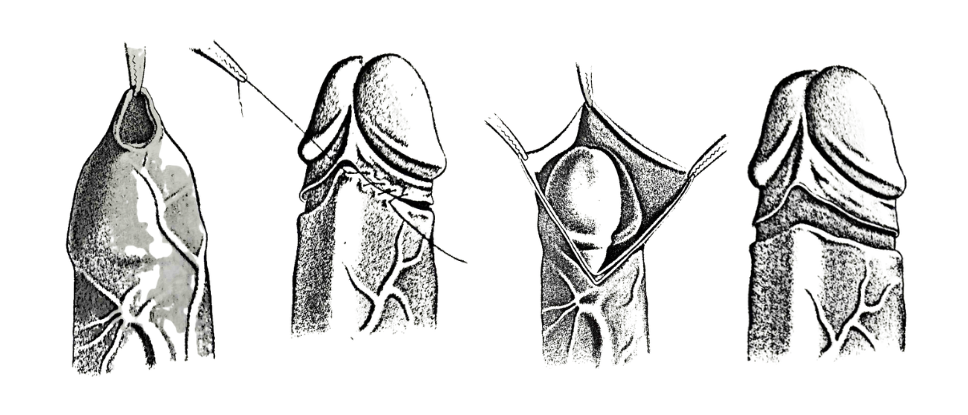
Of great importance here is a recent report called “Prepuce Restoration Seekers” (from The Archives of Sexual Behavior, 8/81). It describes the experiences of several American surgeons who were approached by a number of homosexual males requesting plastic surgery to create foreskins. Each of the patients had been circumcised during infancy and claimed a lifelong preoccupation with his absent foreskin. They complained of feeling “incomplete” or “mutilated.” What’s most intriguing is how much of this report is devoted to the question of “psychopathology.” It is suggested, for example, that many of the patients were “narcissistic” and suffering from “mothering deficits.” By contrast, if a woman requests an augmentation mammoplasty, psychopathology is almost never a question because the predominantly male surgical, medical, and psychiatric establishments respect the importance of big tits in women. In the Archives report, the authors mention the Uncircumcised Society of America, whose members are supposedly 80% homosexual and 65% uncircumcised. I think as the issue of circumcision becomes more public, gay men will be scapegoated. It will be said that being against circumcision is yet another example of gay narcissism, masochism, fetishism, and paranoia.
But the fact is that everyone—straight or gay, man or woman—has a self-image and a body-image to which reality, unfortunately, does not always conform. These men who sought to have their foreskins restored wanted to bring the reality of their bodies in line with the image of their bodies they had nurtured in their minds, and when they succeeded, they experienced great psychological satisfaction. The essential issue is the right that each of us has to have a choice in this matter.
For me that is by far the most objectionable aspect of routine circumcision—that it is done without the patient’s consent. I am a qualified believer in religious freedoms and parental prerogatives, but in the case of a sometimes dangerous, physically and psychologically traumatic, and medically unjustifiable ritual like circumcision, I believe that those freedoms and prerogatives need to be reevaluated and possibly redefined. What about the rights of children?
I agree. But we should recognize that by saying that we mean that a child will have to wait until he is older before making a decision, and how many young adults will then choose for circumcision given the painfulness of the operation?
If a young man, once he has reached legal adulthood, wants to undergo circumcision because of religious or other beliefs, that’s his business. He should certainly have that right.
I’m glad you mentioned mutilation again because although circumcision is widely performed in this country, it is not always done with great expertise. Sometimes underlings or people not very well trained are assigned this task, and we know that there are a significant number of cases each year where the circumcision is badly performed leading to infection and pain. There have been instances where the circumcision has led to a major infection resulting in the loss of the penis, and there have been legal suits brought by parents against hospitals. I believe there are also a certain number of deaths each year.
The upper estimates are that two hundred deaths result annually from complications of circumcision. Complications necessitating repeated plastic surgeries for reconstruction of the urethra and other sequellae have also been reported. But we don’t yet know what these rates are. That’s because, unlike tonsillectomy, hysterectomy, abortion, etc., there has never been a major study of circumcision. However, in recent years a number of leading medical organizations, journals, and spokespersons (many of them Jewish) have come out with strong statements against the routine practice of circumcision. These include the American Academy of Pediatrics and the American College of Obstetrics and Gynecology, among the most respected voices in neonatal medicine. On the other hand, there is almost no discussion of this subject in the psychiatric and psychoanalytic literatures. It seems mind-boggling that Freud, the great theorist of infantile sexuality and the conceptualizer of the Oedipus complex and of castration anxiety, never wrote a paper on circumcision. To my knowledge there is only one paper in the entire psychoanalytic literature that is devoted to “The Psychological Effects of Circumcision” (by Cansever, British Journal of Medical Psychology, 1965, 38, 321).
That paper is also interesting because it shows to what extent psychoanalysis enters an impasse when it discusses such questions. After studying a culture in which circumcision is performed during puberty rites, the author is uncertain whether this involves a healthy separation from the mother and an identification with the father leading to a heterosexual manhood, or whether the separation from the mother is so traumatic and the pain inflicted by the father so great that the circumcision in fact enforces homosexual tendencies in the child. There is the suggestion that circumcision expresses submission to the father, and that it was performed in the Jewish religion because it also meant submission to God. Christians supposedly rejected circumcision because Christianity is a religion of the son and therefore did not require submission to paternal authority. All that is fascinating, and one could even use such perceptions to support the idea of homosexual revolt against patriarchal society. But these ideas don’t change the fact that circumcision, like other sexual issues, is riddled with contradictions. What impressed me most in the Wallerstein book was a statement on circumcision by a Dr. Karen E. Paige, who said that when a custom persists after its original functions have died, it may be accorded the status of a ritual, particularly when it supports antithetical goals, such as repressing and liberating sexuality, making the penis more or less sensitive, etc. I think it is going to be much more difficult to get rid of something that has become ritualized to that extent. More is involved than ending a fallacious medical practice.
I couldn’t agree more. But I believe it is a worthy struggle. I don’t think we can retreat as physicians, as intellectuals, and as advocates of fundamental human rights who happen to be gay just because we may be more likely to become (once again) the scapegoats of those who endorse the perpetuation of such antisexual rituals. ❡