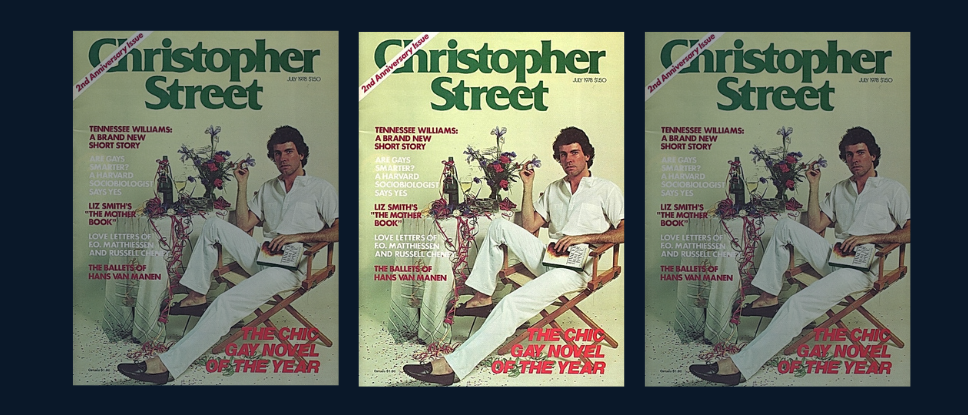
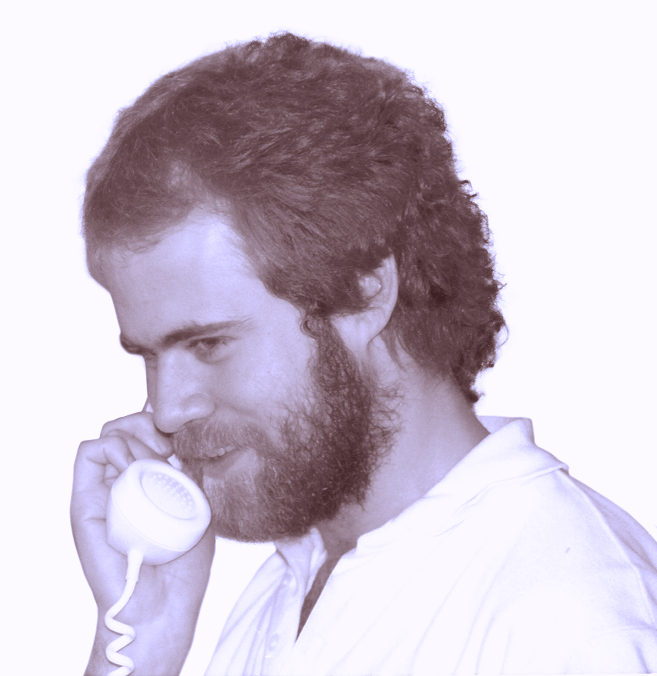
On the eve of the publication of Dancer from the Dance in September 1978, Andrew Holleran sat down with Christopher Street editor Charles Ortleb for his first interview as an author. Like many of Holleran's writings from the magazine, that interview has never been republished until now. We recently discussed the legacy of Dancer from the Dance on the Off Christopher Street podcast, which you can listen to here or watch on YouTube.
WHEN PAT LOUD—you remember her, Lance’s mother (and New York’s newest literary agent)—sent me a new book by one of her clients, describing it as “a gay novel that would be a treat to read,” I thought, Oh, happy discos, just what we need, another gay book. But after reading it I was, to say the least, mildly stunned. Here at last was the first novel of the first self-defined gay generation. I was especially attracted by its expansiveness, its lyrical prose, and its gutsy handling of the search for love in the gay world. (Let’s add two more adjectives: witty and intelligent.)
Andrew Holleran’s Dancer from the Dance, which will be published in September by William Morrow and Company and available in bookstores shortly before then, is one of those books that everyone will take a heated position on. It digs down deep and forces you to put your values, ethical and aesthetic, on the line. It should electrify the gay community, when it appears, in a way that few books have. And more, it may venture proudly into the straight world as well.
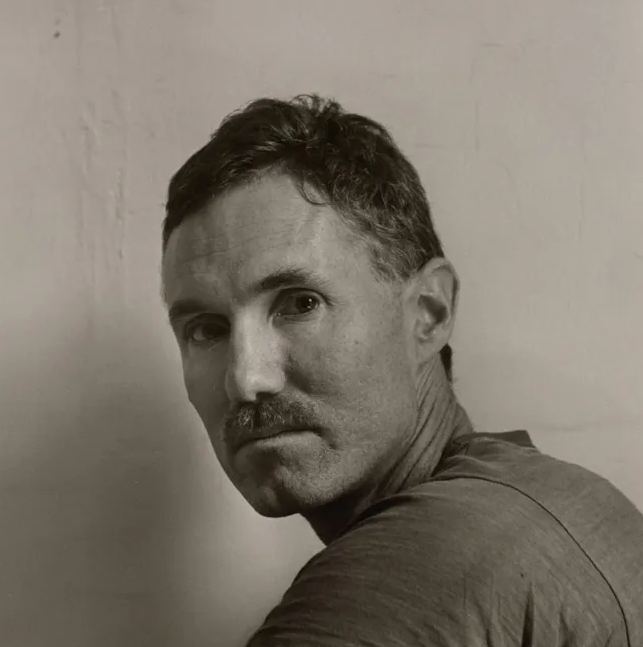
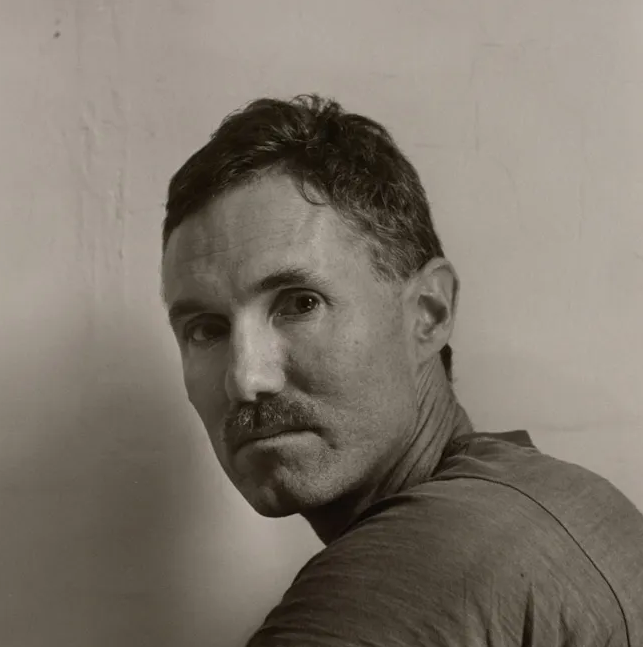
For those of us who have lived in New York City during the last ten years, Andrew Holleran’s was probably one of those faces we glimpsed in brief flashes at strobe-lit bars or when the lights came on full at four a.m., one of those bodies packed tightly into a taxi at Sayville and then lining the deck on the ferry to the Pines. One of them and all of them. He has written a novel both personal and collective, a novel about the gay “unknown soldier”—in the sense that the gay scene here is so full of mysterious anonymity. There is something valiant about Dancer from the Dance and something prepossessing about its author—qualities that became apparent during this, his first interview. —Charles Ortleb
Charles Ortleb: People are going to feel a great sense of relief when they read your book—that the period in history they lived through didn’t vanish in the Everard fire or in the waters off the Pines. Your record of it bestows a kind of permanence.
Andrew Holleran: I think that’s the only function of a writer. There will be people who think that the book is a slash against gay life. It’s not. It’s angry, but angry at things that should be put down. But it’s also laudatory about the wonderful things in gay life. I never want to write propaganda. I think that’s cheap.
Tell me a little about how the book came to be published.
I can’t wait to give credit for that. When I was at the lowest point in my life I wrote two books. I had been running around New York—mainly going to parties at Fire Island. After awhile I came to one of those conclusions that one shouldn’t have to admit to in life, but one that I see is true more and more. It really does matter in this life, in this game, what you’ve done. You have to have a tag for that cocktail party. It’s cold and brutal and mean. But it’s true.
I reached a point where I had no self-respect. I crawled back to my parents’ home in the South. I said, do it now or never, and I wrote Dancer and at the same time I wrote another book, not gay. I was so unsure about writing a gay book. I brought them both up to New York and a friend hated the conventional one and loved Dancer.
 David Sessions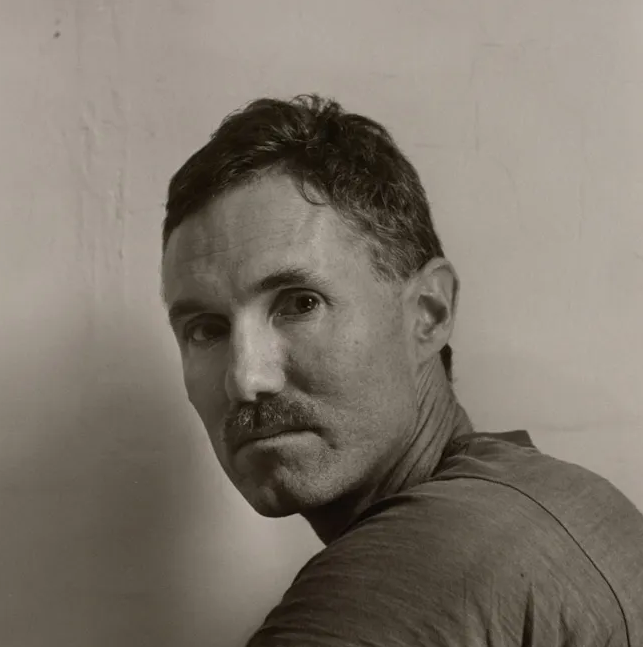
I ran into another friend, Larry Kramer [author of the screenplay for Women in Love and the upcoming novel Faggots], at the gym one day and he suggested that I show the book to his agent, Ron Bernstein. I’ll always be grateful for that. Ron Bernstein showed it to Pat Loud, who thought there was something there but not fully realized. She took me on as a client and I rewrote the book. After it was rejected by five publishers, Pat Golbitz at Morrow read it and loved it. Those two have been wonderful about the book. It’s been a dream working with them.
On the other hand I’m not going to get too secure about it. The book was rejected by those five houses, and the head of one of them said that it portrayed the life of a Forties kind of homosexual. Other people said it was a “down” book, that it was not a portrait of gay life that people would want to read. I’m sure it will get a lot of flack. But the satisfaction of writing the book was in portraying a past way of life so that it would not be lost. And that satisfaction is secure; nothing can alter that.
Watch the Off Christopher Street episode on Dancer from the Dance
Have you published anything else?
I had a conventional short story published by The New Yorker in 1971 and I thought they would publish me at least three times a year after that. But then I became “literary.” The literary mind always knows the epiphany before it occurs. It already has the material muted in a certain way. It’s so hard to get that out of you. So I had nothing published for seven years after that, until Dancer. It’s been a terrible struggle.
You may have written the big gay novel of the year. How will you cope with success?
I don’t know. You suspect everyone at first, you become paranoid. When someone tells you your book is great it’s almost the same as if you’re told it’s bad. I think the most wonderful reaction is the personal reaction—when someone reads it and says that it expressed something he felt.
How are you supporting yourself now?
I have a night job. I proofread promiscuity notes and a lot of documents. I find it necessary, because a writer can end up so easily a recluse.
Where did you go to school?
I studied American history and literature at Harvard. And I went through what college kids are going through now—the “get that job, keep that three-piece suit on” thing. You’ve got to make provisions for yourself for when you leave. So I went to law school. At the same time I was writing, writing all the time. When I would come back from class, instead of reading torts I would take a novel out of the drawer. So I said to myself, since you’re spending all your time writing, why don’t you admit what you’re doing and withdraw? I’m sure there are people who can have both careers, but mine is not a legal mind at all. So I made my decision and it’s been scary—living in roach-infested apartments, working as a bartender, as a typist. I did that for years.
And after dropping out of law school? What then?
The University of Iowa Writers’ Workshop. But the problem with writers’ workshops is that the people who go to them usually haven’t done anything. A few weeks ago someone said in the Times that writing comes easy when you have something to say. A teacher of mine at the workshop said, “You know how to write, you have a voice, but something has to happen to you.” I was a virgin and very self-conscious about it, and I thought he meant that I should go to a whorehouse and live for several days. At that time I was writing sensitive stories about women in laundromats—after having had a vision in a laundry room myself. It was “academic” material. And it was death.
How did you get out of that? What was the turning point?
Oddly enough, the Army. The Army which I resented because it symbolized to me the destruction of everything, was for me a liberating force. It pulled me out of the rut I was in of being “the man to whom nothing would happen.” I was Catholic, religious, very middle class, very genteel, and very cautious. The Army got me out of all that.
One night I was in an N.C.O. club in West Germany with this mad queen from Boston who had gotten me assigned to the town I was in just because he thought I was attractive. He got me drunk and put me on the train to Ludwigshafen and dragged me to my first gay bar. It was stunning. I saw a beautiful young man with no shirt on and I fell in love with him. I was vulnerable in that crazy way you’re vulnerable when you first come out. I had sex that night and came back to the post so depressed that I took a three-hour-long shower. I felt that I had violated myself.
Were you much removed from Catholicism at that point?
Pretty removed. On the other hand, even after you’ve lost your faith the imaginative structure is still there. A lot of the metaphors in Dancer come from Catholicism or religion in general. Catholicism and homosexuality seem to be a lethal combination. After that experience in Germany I went back into the closet for a year. I returned to the U.S., to Philadelphia, and went back to school. One night I was sitting in the dorm feeling lonely. I was going crazy. I felt that I was a cautious, compromising, easygoing person who would never take a stand. I walked downtown and bought a carton of orange juice and sat in a doorway. It turned out to be the gay block in Philadelphia. A group of people got out of a car and it was obvious that they were gay. That began my case of “Every Night Fever”—the thing you had an article on in your May issue. It was dreadful. It went on for four or five years. Bars seemed to me the most wondrous places on earth. I just had to walk into one to be in heaven. I would stand for hours. I was very shy and everyone seemed so glamorous. I feel sorry for people who are coming out. It’s a state of ignorance. You’re set down in this beautiful garden and you have to go through the forest until one day you find the road. It’s unavoidable.
And after you find the road? Where will you be going?
You’ll be going to marvelous places because you’ll know yourself more. You’ll know what to expect from people, know what you can ask of another person and what you can ask of yourself.
What I like about your book is that, in many ways, it shows what is inside gay life, what’s going on in people’s heads, the thoughts behind the smiles you see at discos, in the Pines, on the street. I think that your character Malone will symbolize to many gay people their own lives, or the lives of other gay people they know.
I do believe the search for love is there in gay people. It’s the key to Malone’s existence and the key to mine. As hard-boiled as most people appear, I do think that’s where most people are at. We’re obviously all looking for power and adulation and other things too, but there isn’t anyone not looking for love.
I know there’s a place for the zipless fuck, the anonymous person. That’s very thrilling. But to this day, after seven years of being out and going to the baths and tricking as much as anybody, I still cannot get over the fact that if I sleep with someone—even in the baths—that after I’ve kissed him and shared something so intimate with him we can then resume a relationship as strangers. So many gay people are able to live on that level alone. I don’t want to knock promiscuity. We all love to go to the bars, the pier, but my God, if there’s no hunger for any other thing . . .
I go to Fire Island, and as much as I respect those people for being hard-working, for taking care of themselves, for being intelligent, for being in the largest part decent people, it always perplexes me—and has from the minute I walked into that bar in Philadelphia to this day when I go to Fire Island—that we walk into environments with their own laws that nobody can counter, even with the best intentions. They are inherently paralyzing. And I’m angry with gay people who do nothing but that.
But in your novel you have affectionately created characters who somehow go beyond their stereotypes, who are larger than life. I think your two main characters, Sutherland and Malone, have brought together the extremes of the gay scene—romanticism and cynicism.
One can’t be an innocent, because that’s boring. And you can’t be a cynic. That’s also boring. But my God, to contain the two, that’s absolutely it. To have seen all the shit, to have seen all the rottenness, to have seen all the indignities and the selfishness and still to recognize a lover when he comes along, that he’s going to operate with you on another level, that’s wonderful.
In your novel you portray aging in the gay community as moving to a house in upstate New York. What about those gay men, those older gay men in upstate New York. What do you think of them?
I’m amazed by the admirable men who go right on keeping their bodies in shape, who keep running with the pack. There are a few in their late forties and fifties. They’re gray-haired, they’re trim. They’re well kept . . . they’re energetic.
Do you find that ridiculous?
Not at all. It’s admirable. I think it’s great when you choose to start spending your summers in that little town on the Hudson or in Europe instead of on Fire Island.
We’re changing. That’s the wonderful thing about life. Our sexuality is not what it was five years ago. Our compulsiveness is not what it was five years ago. We can turn people down, we can be relaxed. We can look at other things. Socrates said about old age that it frees you of the beast of sexual desire. Well, you get a presage of that before old age. You start diminishing a little.
When people whose physical beauty galvanizes you are seen years later you will be able to place it in perspective. I saw somebody a few nights ago at Studio 54 who is probably the most beautiful person I have ever seen. And I thought, This is what gives rise to the legends of gods. This person was physically prepossessing, so magnificent. I just kind of shamelessly wandered around and looked at him every time I could. The virtue of being gay for seven years is that I could make hypotheses as to what was going on in that man’s head—what he was doing at Studio 54, what he was looking for, what he wanted me to say to him, what he wanted me to do to him, and, thank God, I don’t feel I have to be that thing to him.
The first time I was galvanized that way and was rejected I went back to my room and said to myself, “I’m going to make up a questionnaire—was I not aggressive, or too aggressive; was I wearing the wrong shirt, would you rather see me in jeans.” I thought that there was so much pain and so much obscurity that I wanted to make it more rational.
When you first come out you don’t know why people reject you. You don’t know what’s wrong. You go to the gym, you run out and you cut your hair a different way, you grow a beard and you take a beard off, you wear tight clothes and then you think it’s loose clothes. Everybody’s doing that. We’re working so hard for each other. Then there’s that fascinating character in gay life, the guy who walks into the disco who just wants the moment of walking in and being looked at and certified and doesn’t really want to go to bed with anybody. That would make it too material. He just wants to know that he’s breaking hearts. When the weather turns warm there are five hundred boys in the city with one thing on their minds—what am I going to be wearing the night I walk up the steps of the Sand Piper and won’t those heads turn. Everybody on the deck of the Sand Piper is thinking that of himself. It’s quite a spectacle.
Years later you realize that the thing you were looking for was not the person who would respond to your body, but the person who would respond to your personality and that you never needed a perfect body for that.
One of the interesting facets of your book is the way you capture the sensuous presence of Puerto Ricans in the gay community.
I don’t know how to say this without sounding patronizing, but I can’t say enough in their favor. I didn’t understand the attraction when I first came to New York. I wonder whether I’m a victim of the classic homosexual neuroticism, which E. M. Forster captured in his book about the upperclass Englishman attracted to the gardener. I was afraid that I was giving them a bum rap in the book, so I wrote in a Puerto Rican doctor near the end. I didn’t want to portray all Puerto Ricans as kids standing on street corners. There are a lot of them, but there are obviously Puerto Rican doctors and dentists as well.
New York is a tropical city. We’re living in the Caribbean. It’s so striking. This is Rio, this is San Juan, this is Caracas. New York’s great glory is that it keeps absorbing populations. It gives the city flavor. You just have to walk into Central Park and before you get to Bethesda Fountain you hear those drums.
In the sense of being animaly alive, I will never forget a Sunday three summers ago when I did not go out to Fire Island. I soon realized that summers in the city are extremely romantic and voluptuous. It becomes much more exotic and wonderful than going out to Fire Island. I had met someone who was staying at a hotel and I ran through the park to tell my friends that I was leaving them. It was a misty humid afternoon, the bongo drums were beating. I had a cold beer that stung my hand and a box of poppers in my pocket. I felt like I was in a jungle painted by Rousseau. The new lover was waiting for me. This was what Keats must have meant by the pure life of the senses.
Another wonderful thing about New York, and I think this comes through in the novel, is that there’s somebody for everybody. The thing that perplexed me about gay life was that when I went to bed with someone I did not want to go to bed with it often turned out wonderfully, and when I went to bed with someone I wanted to go to bed with, it turned out disastrously. I threw up my hands one day and said, “My God, if your conscious mind and your critical faculty is leading you so wrong, if you don’t even know yourself, what you really want, then perhaps you should go to bed with people at random. I have never had the nerve to do it, because that would mean going to bed with someone who really doesn’t attract me.”
But we should do that.
That seems very Catholic of you. Be kind to everyone. Be charitable. Not to say no when someone is in need. Charity is so vulgar. So unattractive, so unromantic. But it’s what Christ was talking about when he said, “You gave me food when I was hungry, you clothed me when I was naked, you visited me when I was sick.” There’s very little outlet for charity in this life, particularly in gay life. We’re damned selfish people—because we’re single people, not because we’re gay. We have to worry about ourselves because when we’re sick, we’re sick by ourselves. We can’t have accidents—we have no wives, no children to rally around us. We’re on our own. You get very tough, very self-reliant. You’ve been hurt. People have walked out on you, people have turned out to be shits, people have not been interested in what you’re interested in.
The danger of that is in becoming so well defended that you lose your feeling. I’ve been through so many affairs that now falling in love for me is like getting a cold. I see the symptoms, I develop it, I know that eventually it will leave me. I know ways of warding off, ways of protecting myself. I know the emotional equivalents of taking a lot of vitamin C. You hope that someone will come along and shatter all your defenses, someone who will work on you in ways that you haven’t prepared for and give you that original experience. I am now in midpassage, and I really wonder what there is to do with the rest of my life. It comes down to what really is worth doing in life, what makes me feel the most alive. I can’t believe that it’s only going to be another series of erotic encounters. I wonder if that’s not it until age seventy-five. I don’t know what’s beyond gay life. I’ve no idea. But I think we’re all finding out together.
I think that your book implies that gay people are capable of being a lot more than the scene allows them to be.
You have to be serious about life to be worth loving, as Rilke stressed. That’s one of my big angers at gay life. Too many people behave as if they are shallow. I don’t think they really are. I think everyone out there has a certain distance, wandering the halls of the baths, or at a tea dance. They’ve got resonance, they’ve got emotions. I only want homosexuals to become more human. I think then they’ll be even sexier. But we’ve got to stop acting like we’re Annette Funicello in Beach Blanket Bingo. That’s fun for an age—when you come to New York for the first time and you’re young and dying for as much cock as you can get. My God, you can’t deny that to anybody because we all did that. But you want to shake some people by the shoulders and say, “Some day you’ve got to be a person.” ❡