

Off Christopher Street is available on Apple Podcasts, Spotify, Amazon Music, YouTube, Pocket Casts, and many more. (Click here to see all platforms). You can also follow us on Instagram, TikTok, and X.
Our reverence for Andrew Holleran is no secret, and the appointed hour has arrived to talk about his 1978 masterpiece Dancer from the Dance, not just, as we argue, the best gay novel of all time but one of the best American novels. Despite remaining untaught in universities, unlike other classics of minority literature, and really having no institutionalized means of transmission, gay men still discover it 50 years later and see themselves in it.
A lot of us initially read Dancer as a sociological account of how gay men were in the heyday of the 1970s, or even of how they are in some timeless, essential sense. But in this episode we try to sort out sociology from artistic invention, and argue for reading Dancer as a work of literature rather than either a journalistic report or a philosophical inquiry into the nature of gay men. We talk about how Holleran constructed the novel from his own experiences and dispositions, and how he sometimes projected his own big thoughts and emotions onto gay life. We piece together Dancer’s complex chronology and unique, elusive style of narration. We consider Holleran’s debts to Proust and Fitzgerald, the stylistic influence of his magazine writing, and the novel’s pervasive Catholic imagery.
Watch this episode on our YouTube channel
None of that, of course, diminishes the novel’s powerful themes, which seem to perennially activate new generations of gay men: promiscuity, love, male beauty, aging, friendship. We talk about how Holleran uses the novel form to pose—yearningly, romantically—the search for answers to the Big Questions of gay life through his character Malone, and also to satirize the myopia of that quest with camp humor in the figure of Sutherland. We talk about the way Dancer is fundamentally a novel of gossip, and how gossip is a community-forming activity that holds the web of gay society together. And we ask whether the perennial doubts, anxieties, and questions that lead so many gay men to connect with Dancer are really what it means to be gay, or what it means to be human.
SUPPORT THE POD
Your support helps us keep going. If you like the show, consider becoming a paid subscriber.
MENTIONED IN THIS EPISODE
 Andrew Holleran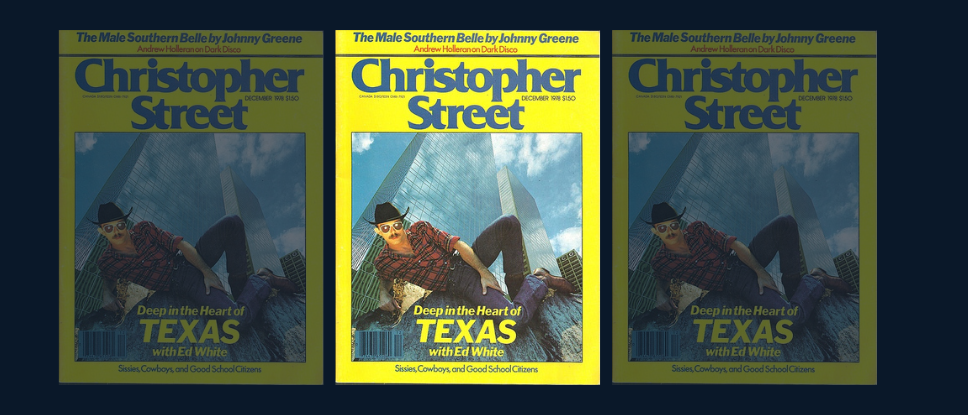
 Andrew Holleran
 Andrew Holleran
 Andrew Holleran
Also mentioned in this episode
- Blake Smith and Domenic DeSocio, “Errands of Love,” Romanticon, October 22, 2025:
- Blake Smith, “Tyler Anthony Smith,” June 29, 2026:
- Andrew Holleran’s interview on Emerald City (1978):
- Larry Kramer, Faggots (1978)
- Christopher Castiglia and Christopher Reeve, If Memory Serves: Gay Men, AIDS, and the Promise of the Queer Past (2011)
- Dennis Cooper, The Sluts (2005)
- Robert Ferro, The Family of Max Desir (1983)
- Robert Ferro and Michael Grumley, Atlantis: Autobiography of a Search (1970)
- Philip Gambone (novelist)