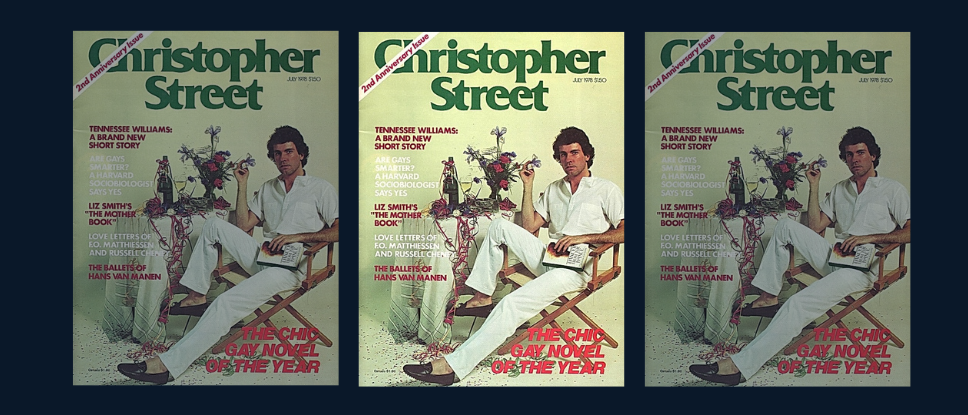
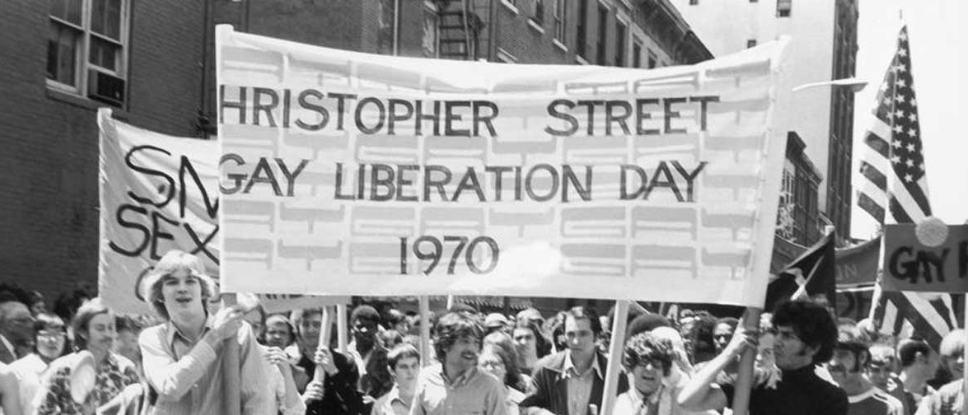
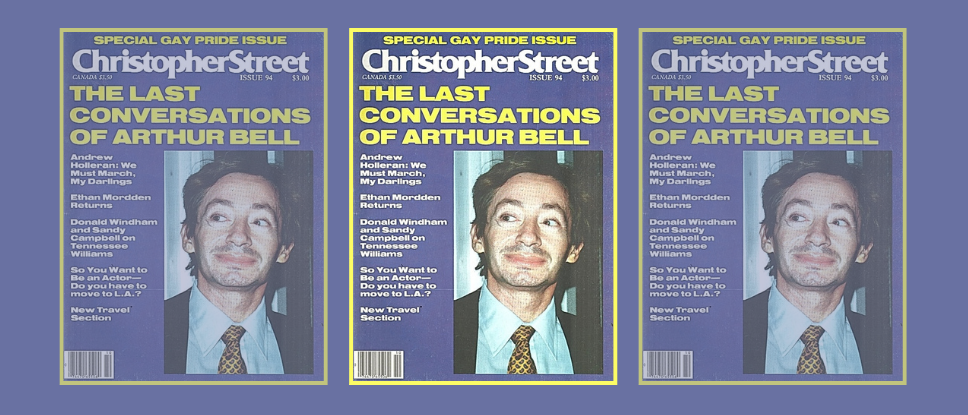
This article appeared in the November 1984 issue of Christopher Street.
SOMETIMES THE CROWDS beyond the door of my apartment building look so dense, driven, irritated and irritating, that before I leave, I have to stand in the hallway a while—like a man in a diving tank waiting for the pressure to match the weight of the sea he is about to enter—and watch people go by. It takes about fifteen minutes to get accustomed to all those strangers, and the idea of stepping out into the midst of their rushing indifference.
On one particular Sunday in June, however, it is never a problem. That Sunday begins when my roommate awakes and comes into the kitchen with a smile, and, in the very voice of Maggie Smith, says, “We must march, my darlings," as he gazes at his cat. That is exactly it—and when we burst out of our apartment, it is with an excitement, a sense of being quite special, that make the people between my building and our destination in Sheridan Square look languid and lost. In fact, in the old days—the thoughtless Seventies—I marched for no particular political purpose; I marched because it was fun. I got to see my friends, and enjoy the slight feeling of moral superiority which came from thinking about all the friends on Fire Island who had not come in for the march. Most of my friends were at the beach, and that made me all the happier to see the ones who were not, who were there in Sheridan Square when I arrived, the years the march began in the Village, and went up to Central Park. The nervousness we felt, the sense as we walked west from the East Village that we were different from all the others out for a Sunday stroll, reached a crescendo on seeing the crowd on Seventh Avenue. "God!" my roommate would say breathlessly. "Don't you love being gay! The only thing I'd rather be today is a lesbian!" Then he'd hit me on the shoulder with one hand, and wave with the other to friends leaning out the windows of the Sheridan Square Gym, and for a moment the thought of all that muscle in the shadowy room behind them gave me pause, as we stood in the dense, undifferentiated throng before—how, I cannot say—deciding this particular spot was the one we chose to enter the parade. Crossing that invisible line that separated spectator from marcher by merely stepping down off the sidewalk made me feel suddenly solemn: our banter stopped, we tried to compose an expression on our faces for all the people who were now (as we had only an instant before) looking at us. The Irish call it showing the green; we were simply showing ourselves—carrying no signs or placards—and that, it seemed to me then, was the point.
The self-consciousness always lasted at least past Washington Square, where one really had to contend with crowds of on-lookers, and the question "Why am I doing this?" But once the march turned up one of the loveliest stretches of New York City—lower Fifth Avenue—the day, and the march, spread out before us like a flag in the sunlight. The heart began to bob like a balloon. Somewhere seventy-six trombones were playing. The parade seemed to me an extraordinary gesture of civic generosity—even if the theme each year must necessarily be civic meanness. In my excitement I wished for a moment it was not so prosaic (this mob of pedestrians in jeans and T-shirts and baseball caps)—couldn't we have produced floats: a nine-foot penis composed entirely of gladiolas, a handsome man leading in chains a string of his tricks, or a flotilla of lesbians in sports cars like the one Candice Bergen drove in The Group, shifting gears in synchronization as they paused at Fourteenth Street to let the parade catch up with them. Instead the evening news always chose a dusty, hoarse, excited, bra-less woman with aviator glasses, an Afro, and a blue chambray work shirt. And we were offended. (Why show the militants? Why not us?) For that was the extent of my politics: the march was essentially a chance to show the folks in Kew Gardens and Kansas that there were thousands of us who looked just like them: ordinary—to a fault.
With this simplicity of purpose it was always possible to relax and enjoy the day: walking up Fifth Avenue in a mob of homosexuals was exciting. Most of us didn't care if the gay rights bill on which homosexual politicians seemed to stake everything (our status in society, our fortunes, our fate) passed. I wasn't even sure the bill mattered, or would make life any different for me if it did pass. It had something to do with landlords, employers, public places; it was what blacks had obtained because they were black; it was the sole concern of leftovers from the Movement who went down to City Hall each year—like swallows to Capistrano—and engaged in another shouting match with the horrendous Hassidim from Brooklyn and the prim Irish Catholics from Queens who had no lips. I wasn't really eager for those people's acceptance. I didn't go to their neighborhoods and I didn't see them in mine. Homosexuality was a private affair. I wasn't gay because I wanted the world to be, or the society in which I lived to officially recognize me; I was a homosexual because I desired men. I could not explain that to the Hassidim. I did not want to explain that to the Hassidim. Their annual shouting match—indeed, the bill the gay politicos were obsessed with—seemed to have more to do with America than with my sexual preference. Americans seemed bent on making demands: shattering the nation into ever more recherché interest groups. It made more sense the year Anita Bryant gave us a focus—her threat was real—but after she faded away, the political program seemed once again both hysterical and vague at the same time. Had someone asked me then if homosexuality could be the basis for a political party, I'd have kept quiet; for I wasn't sure at all that homosexuals had anything to offer the world in terms of a platform. I was marching those years for only one reason: to show the teen thug in Salinas, Kansas, or in Brooklyn, New York, who might otherwise consider homosexuals fags to be bashed that we were numerous, unafraid human beings. The year some friends made up placards of famous authors, I marched in a writer's contingent, and spontaneously stormed the steps of the Public Library; but other than this, our marches were merely Sundays on which we got to stroll up Fifth Avenue.
There were friends, for instance, I saw only once a year at the march, and on the subway intermittently throughout the year, and it was fun to schlep past Madison Square looking at architectural details from a unique vantage point, bunching together, then stringing out, passing the time as we moved into the Twenties with jokes and chit-chat. In the Twenties there was always a party in someone's loft that came to the window and scattered confetti or shredded newspaper down on us, to our applause. In the Thirties, the great department stores baked in the sun, and our feet began to hurt, our mouths to dry, and we entered the doldrums—something was holding us up, the Disco truck was far behind, no shade in sight. Hot, thirsty, dazed, on auto-pilot, squinting into the sun to see the reason for the delay, operating on several levels: wondering why everyone did not march, thinking unpolitically that the guy in front of me had a cute ass, congratulating myself on wearing a hat (the sun ages), wondering why lesbians always take over the ceremonies at the end of the march. (And asking: Why does the ivy twine?) The policemen at the intersection finally blows his whistle, and the parade heaves itself into forward motion again, as the face of Marcel Proust (dreamy, glazed, staring at the violinist playing for Comtesse Greffuhle and her guests) nearly collides with that of Henry James (dry as toast in a three-piece suit), and we trod past St. Patrick's and saw The Priest. The one on the cover of the six-hundred page paperback depicting a man torn between Christ and Moira O'Bannion. He stood by the barricade every year watching us. He had copper hair and green eyes; in his black coat and high collar, so romantic a figure, I was glad the parade got tangled up and my group came to a halt. In the novel his eyes met mine; and realizing he had no choice but to give up the Church, he pushed through the crowd and joined me in the parade—a block north we cut down a side-street, rushed to Penn Station and out to Fire Island to an empty house on the beach. In reality his eyes looked right over my head and I kept walking, knowing I would not see his face for another year. There are certain annual features of the parade: the Third World Lesbian on Channel Seven; the Disco Truck; the Gay Fathers; the Tourist on Thirty-seventh Street Who Came Into Town to Buy a Camera and Cannot Believe What She is Seeing Go By; and the Priest, followed by the world's most expensive real estate, whose side streets look ever cooler, shadier, inviting—with pubs you have never been to which could sell you a cold beer, an ice cream, a frappe. By the time we reached the park we were always bored. And exhausted. And the tinny voice haranguing us from a distant stage through the huge cloud of yellow dust was politics itself—irrelevant, hysterical, irritating. The question was not whether to pass a bill but whether to go to the Ferro-Grumley's for drinks. Eventually I went home with a certain post-parade depression.
For the march—while something I never missed—was never the answer to one's longings. Politics, I told myself, is not love. It's not even personal. It's a newscast, an article in the Times, a police estimate of the size of the crowd. It's numbers. (The other kind.) Going down on the IRT there was always the let-down of being just another zombie on the subway again; it was hard to adjust to a group of three after an army of camaradoes in the noonday sun. On Christopher Street in the hope of prolonging the fraternal warmth, one had to conclude, after a while, that it was still Christopher Street, with the same tired men in the same bleached dungarees. And going back home was as peculiar as going over that morning: a strange self-consciousness returned as I walked east through the dark, windy streets, like a guest who slips out of a party without saying goodbye to his host, for leaving the parade was as delicate, as odd a moment, as entering it. It left me lonely. Later that night I would go to my local park and watch the men on the benches and think: These are my politics. And sometimes meet a man who had marched himself, and if I was lucky, end the long, dusty day with the unspoken agenda of that army of men: a kiss on the lips.
This year of course all is changed, including—especially—the fade-out. For one thing, the march goes in the other direction. For another, we have a rallying point again: an issue that makes all others minor, the way war throws domestic politics into limbo. And besides that, something happened to me these past few years. It happened listening one evening to Pat Buchanan's voice rise hysterically as he interviewed a homosexual on CNN's Crossfire; watching him turn into a kind of dumb, rabid dog when faced with the very idea. It happened reading the column in which he said the poor homosexuals had made war on Nature, and now Nature was taking its retribution, and all those who might infect the public in schools and restaurants should be quarantined. It happened learning that TV crews had refused to film interviews with people with AIDS, and others had called in to ask if it was safe to ride the subway. It happened reading the Post after the Vesti murder, knowing that though we know we're doctors, writers, priests, businessmen, sons, brothers, friends, lovers, to part of the public we will always be child molesters and sickos. It happened when it became apparent that to many people the epidemic that has arisen among us is exactly what they feel we deserve—a Biblical plague in its Old Testament, punishing sense.
It happened when an acquaintance down south was shot in the head eight times by a youth for suggesting something that the youth did not like, and the killer was completely acquitted. It happened when they threw the young man off the bridge in Portland, Maine. It happened one year coming back from the parade when a ten-year-old boy on the curb looked up and said: “Today is Queer Day!” It happened watching Dan White get out of jail. It happened when I found myself near cities down south one year which had no parade at all—but only a list of special events in the bars to commemorate Gay Pride Week—and it dawned on me (who had come so close in New York to saying: “I don't think I'll march this year, I've done it enough”) that the walk on Fifth Avenue is extraordinary. It happened one night at the circus in New York when the Mayor appeared at a Gay Men's Health Crisis fundraiser and I tasted, looking down at him in the spotlight, hearing the applause around me, a new substance—as palpable as food on my tongue: the satisfaction that comes from our city's recognition that we exist. It happened on realizing that San Francisco had been much more enlightened, forthcoming, in its support of people with AIDS. It happened when reading the countless news stories of people ready to treat homosexuals as lepers the minute they had the pretext which AIDS offered them. It happened when I saw the work of homosexuals in helping their own. It happened when Archbishop O'Connor appeared on the scene, and the meanness of those who are Irish and Catholic surpassed the thinness of their lips. It happened when Pat Buchanan became Communications Director at the White House. It happened when Castro announced he intended to quarantine the Marielitos returned from American prisons on the suspicion they might have AIDS. It happened watching The Normal Heart this spring. What happened? A certain disgust built up. I'm marching this year not merely for the friends who have died in their prime but for all the people who are ready to see us perish—I'm marching because I can't stand that tone in Pat Buchanan's voice. I'm marching because my roommate was right when he told the cat: “We must march, my darlings.” ❡
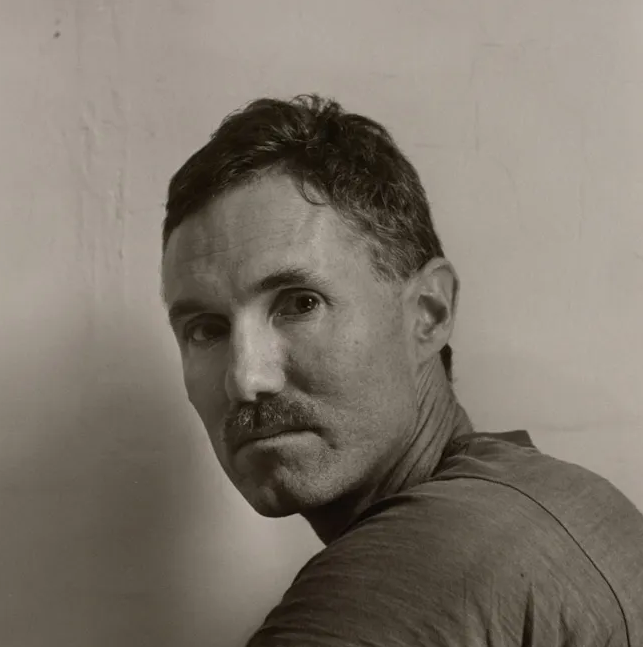
Andrew Holleran is the author of the celebrated novel Dancer from the Dance (1978) and, most recently, The Kingdom of Sand (2022). He wrote a regular column for Christopher Street from the late 1970s through the early 1990s. [Andrew Holleran on Wikipedia]