

Off Christopher Street is available on Apple Podcasts, Spotify, Amazon Music, YouTube, Pocket Casts, and many more. (Click here to see all platforms). If you’re enjoying the show, please consider a paid subscription to help us cover our the cost of digitizing the magazine and producing the podcast.
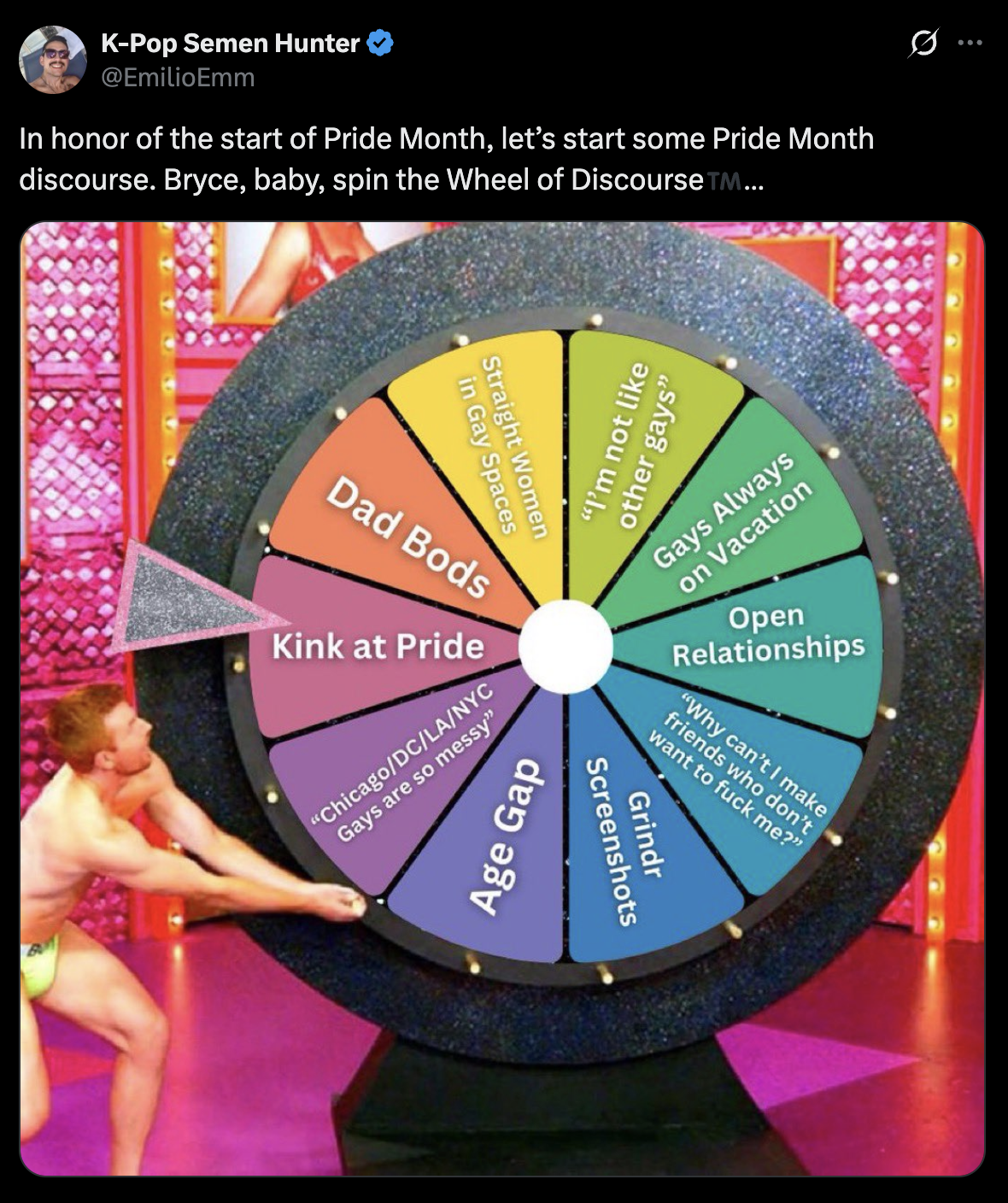
Social media has turned Pride month, like everything else, into a discourse machine—so much so that we now have memes making fun of it before it even begins. “Each year like clockwork,” James Factora wrote last year, “the LGBTQ+ community comes together to argue online pointlessly about truly the most unnecessary topics imaginable.”
And the past few years, in our dark days at the end of history, we’ve often been exhorted to resist so-called “corporate Pride” and get back in touch with Pride’s radical roots. In 2020, in particular, the media elevated an existing gay left critique of Pride into something like an official new narrative: Pride is a protest, not a party. Stonewall was a riot. Cis white gay men turned the legacy of Pride into a centrist rights movement that only benefits a narrow elite. Even if the vibes have shifted—the New York Times opinion page went from publishing radical queer manifestos in 2020 to Andrew Sullivan in 2025—one still hears the echoes of this new (or new old) rhetoric.
In this episode, we try to go beyond posturing slogans and history-distorting morality tales and confront the many meanings of Pride, the complicated and sometimes ambivalent feelings many of us have about this annual pseudo-ethnic ritual. Blake talks about his Pride experiences in Paris and Chicago with friends who were considering coming out, and David tells the stories of his ex-wife taking his first Pride photos and how his political crisis after Bernie Sanders’ loss in 2020 made him skeptical of what passes for leftist gay thought.
 Andrew Holleran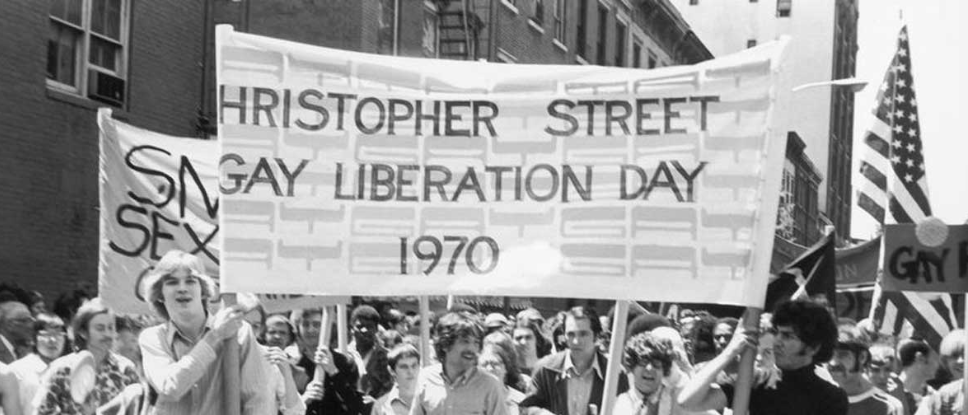
As always, we frame our discussion with a piece from Christopher Street, one decidedly unlike the tenured-radical Pride manifestos of the past decade: Andrew Holleran’s 1984 “We Must March My Darlings,” which distills the conflicting emotions one might have in the course of a Pride march and surveys the shifting audiences and political valences Pride can have over time. Holleran appears rather detached from the gay politics of the early 80s, perhaps not surprisingly considering that the energies of Stonewall had dwindled into an increasingly quixotic effort to pass an anti-discrimination ordinance in New York:
Most of us didn’t care if the gay rights bill on which homosexual politicians seemed to stake everything (our status in society, our fortunes, our fate) passed. I wasn’t even sure the bill mattered, or would make life any different for me if it did pass. It had something to do with landlords, employers, public places; it was what blacks had obtained because they were black; it was the sole concern of leftovers from the Movement who went down to City Hall each year—like swallows to Capistrano—and engaged in another shouting match with the horrendous Hassidim from Brooklyn and the prim Irish Catholics from Queens who had no lips. I wasn’t really eager for those people’s acceptance. I didn’t go to their neighborhoods and I didn’t see them in mine. Homosexuality was a private affair. I wasn’t gay because I wanted the world to be, or the society in which I lived to officially recognize me; I was a homosexual because I desired men.
Despite this apparent disengagement, Holleran nevertheless suggests a cultural politics of Pride that preserves it as an annual ritual with shifting audiences and meanings, one that need not always be stridently political but which can gather a solidaristic charge in particular political moments, as it did for him with the onset of the AIDS crisis:
Something happened to me these past few years. It happened listening one evening to Pat Buchanan’s voice rise hysterically as he interviewed a homosexual on CNN’s Crossfire; watching him turn into a kind of dumb, rabid dog when faced with the very idea. It happened reading the column in which he said the poor homosexuals had made war on Nature, and now Nature was taking its retribution, and all those who might infect the public in schools and restaurants should be quarantined. It happened learning that TV crews had refused to film interviews with people with AIDS, and others had called in to ask if it was safe to ride the subway. It happened reading the Post after the Vesti murder, knowing that though we know we’re doctors, writers, priests, businessmen, sons, brothers, friends, lovers, to part of the public we will always be child molesters and sickos. It happened when it became apparent that to many people the epidemic that has arisen among us is exactly what they feel we deserve—a Biblical plague in its Old Testament, punishing sense.
Blake connects Holleran’s essay to a moment at the very end of Dancer from the Dance, a fleeting paragraph that gives the novel a possible political edge:
And even so, do you realize what a tiny fraction of the mass of homosexuals we were? That day we marched to Central Park and found ourselves in a sea of humanity, how stunned I was to recognize no more than four or five faces? (Of course our friends were all at the beach, darling; they couldn’t be bothered to come in and make a political statement.) I used to say there were only seventeen homosexuals in New York, and we knew every one of them; but there were tons of men in that city who weren’t on the circuit, who didn’t dance, didn’t cruise, didn’t fall in love with Malone, who stayed home and went to the country in the summer. We never saw them. We were addicted to something else: something I lived with so long it had become a technique, a routine. That was the real sin.
Also discussed in this episode:
- How gays and lesbians are benefitting from heteropessimism
- Holleran’s style and literary influences, including Proust and Whitman
- The ways Bernie Sanders figured in our intellectual and personal lives
- How Holleran is a deeply political writer despite hardly ever writing about politics
- Why fighting for basic liberal rights wasn’t “centrist” in the context of the Stonewall-era police state
- The assumption that being marginal and having radical politics is the morally correct way of being gay, and why we should be happy that gays can be basic bitches
Recent episodes of Off Christopher Street
 David Sessions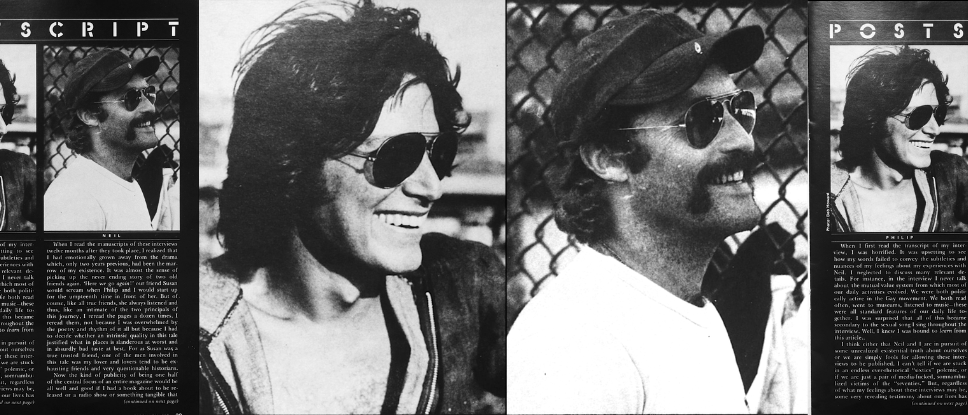
 David Sessions