


Off Christopher Street is available on Apple Podcasts, Spotify, Amazon Music, YouTube, and more. (Click here to see all platforms).
In the summer of 1979, Village Voice columnist Arthur Bell received a leaked script for William Friedkin’s Cruising, a would-be police thriller set in New York’s burgeoning gay leather scene. Based on a novel by New York Times Magazine editor Gerald Walker and starring Al Pacino, the film also echoed real events of the 1970s, notably the “bag murders” in which gay men were dismembered and thrown in bags into the Hudson River.
Using his Voice column as a megaphone, Bell catalyzed a campaign of protest against the shooting of the film, which led to shops on Christopher Street placing signs in their windows and refusing to be filming locations. The film, Bell wrote, “in effect says that murder is the result of gay sex.” In a strange essay, Christopher Street editor Charles Ortleb tried to transform the crusade into an experiment in avant-garde theory (“If Adorno had done it, everybody would be talking about it,” Blake says.) “The Context of Cruising” castigated gay men who were indifferent to the film—or worse, starred in it as extras—as “Performing Homosexuals” who “acted like small grateful puppies at the master’s table.” Ortleb suggested that Cruising was part of a “superstructure strategy” through which the powers that be were laying the groundwork for a Nazi-style extermination of gays in America.
When Cruising comes out in theaters you may find yourself having to explain (like pre-Holocaust Jews) that you are “respectable,” that you aren’t an uncouth ghetto homosexual, that you are an exception. In her essay “We Refugees” Hannah Arendt describes certain tendencies among Jews in the death camps “to interpret the whole accident as personal and individual bad luck.” You may find yourself having to make mystical statements about anti-gay violence when it happens to you. You may be forced to view history as a matter of fate. You may or may not be one of the lucky homosexuals who escapes. Statistically, you are safe. Everyone cannot be attacked on the same night.
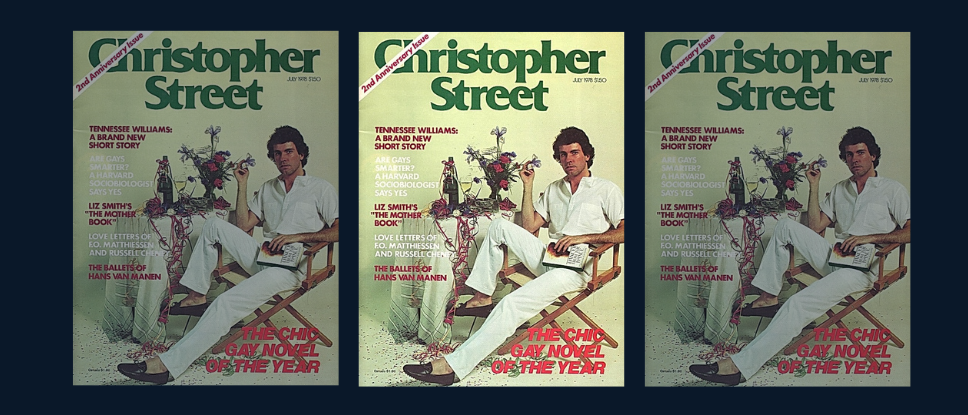
In this episode of Off Christopher Street, we’re joined by Domenic DeSocio to talk about the way this controversy foreshadowed the contemporary parsing of popular entertainment for harmful political messages and “problematic” portrayals of minority identities. In anticipation of Christopher Street’s fiftieth anniversary this summer, Domenic has published a history of the magazine in the Gay & Lesbian Review, which explains how these early glimmers of conspiracy came to define Ortleb’s thinking and the magazine as a whole:
By 1983 Ortleb began to doubt that HIV caused AIDS and was publishing articles from medical professionals and journalists who claimed that other infectious agents, such as the African swine fever virus, were the true causes and part of a genocidal campaign against gay men undertaken by the White House and CIA. This shift did irrevocable harm to the magazine. It took attention away from its literary mission and repelled readers and contributors due to what White called Ortleb’s “villainous, denialist, and antiscientific” attitudes.
But in 1980 Christopher Street’s conspiratorial turn on AIDS was still in the future, and here we do our best to give Ortleb credit for his central importance in the history of gay intellectual life. His essay on Cruising was perhaps less about the film itself and more about the kind of politics that opposition to it could bring into being. “The demonstrations this summer were politically important: The protest created a counter-image of connectedness in the gay community,” Ortleb wrote. “While William Friedkin and Jerry Weintraub ran around the city this summer trying to humiliate the gay community, I could have sworn I saw the framework of a people more clearly than ever before.”
Despite an execution simultaneously flat-footed and overwrought, Ortleb’s references to gay men as a “people” points to his importance not only as an organizing figure of post-Stonewall gay literature, but also as an intellectual force in the ideas that shaped Christopher Street’s politics. In the context of Anita Bryant’s campaign to brand gay men as groomers and pedophiles, widespread violence against gay men in the news, and a broader right-wing turn many gay activists analogized to fascism, Ortleb peppered his essay with quotes from Susan Sontag and Hannah Arendt. We discuss the magazine’s Arendt-influenced conception of a “gay world” as a pseudo-ethnic community with its own collective identity and public sphere, which Ortleb and others, despite their relative political moderation, defined against a universalist, identity-blind liberalism.
Also discussed in this episode:
- How Cruising elided the anxieties about race and masculinity in the original novel
- William Friedkin’s strange connection to an actual serial killer who was an extra in his earlier film, The Exorcist
- Christopher Street’s cultural politics and relative neglect of the material realities of New York City and the broader U.S.
- The veterans of the crusade against Cruising went on to found GLAAD
- The extensive use of analogies to the Jews and fascism in gay politics
- Why the Holocaust anxiety was a better for the AIDS crisis
- Interior. Leather Bar, James Franco’s embarrassing homage to Cruising
- The “normal gays” who had no problem with Cruising and were baffled by the controversy
- Gay defenders of Cruising like Jack Fritscher and John Rechy
- Why art that depicts minority groups doesn’t need permission from them