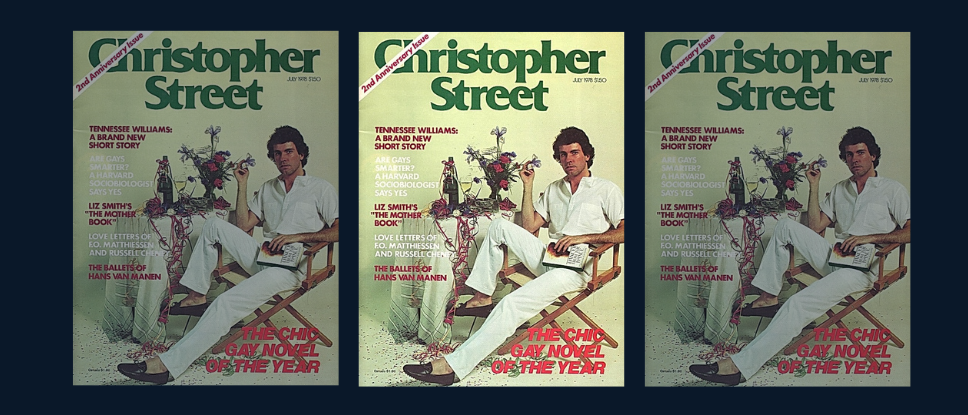
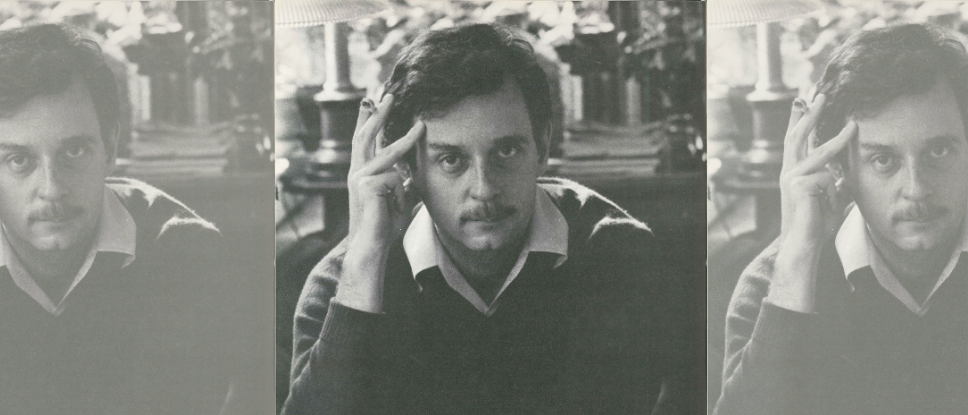

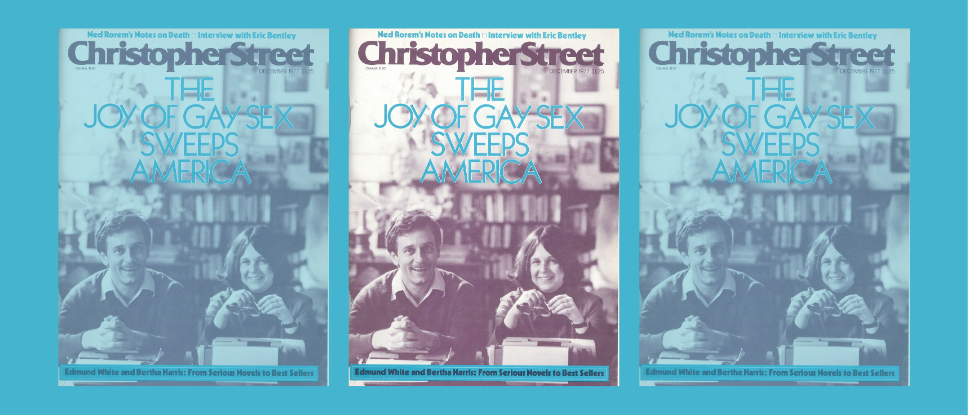
This article appeared in the December 1977 issue of Christopher Street.
Did you and Bertha Harris consult each other while you were writing the books?
Bertha and I had several late night talks, usually about whether doing these books was going to ruin our reputations as serious writers or not. We would agonize over that. I was the one who recommended Bertha for this and I was very glad that she did it because I feel she’s such a good writer. She made the whole project more worthwhile.
We didn’t look at each other’s books. I tried not to look at her book. I was afraid I might copy it—and I thought it would be more amusing if we each waited to see how the other team had invented sex.
Did you both take the same time to finish the books?
They actually wrote faster than we did, because Bertha and Emily divided up the entries; Bertha wrote half and Emily did the other half. With Chuck and me, every word that shows up in The Joy of Gay Sex I actually wrote—Chuck would do the first draft and I’d turn out a second. In other words, each of us wrote something on every item.
What did you finally decide the book would do to your literary reputation?
I can’t speak for Bertha, but I think we both said that we were so broke that we could use the money. Emily has a daughter and I was supporting my nephew, so we agreed we’d tell Johnny Carson that we’d written our gay sex books for the sake of our children. We both decided that the books might hurt us, not because they were gay, but because they were so commercial. The real snobbism of literary people is against bestsellers. On the other hand, I’ve had very little success in getting my work published and so I felt that things couldn’t be worse, and they might be better if I were known to have been the co-author of a very successful book. It might make people pay attention.
Did you enjoy writing it?
I did get a kick out of writing it. I wrote it very quickly. I say things in it that I never get a chance to say in fiction. Fiction, it turns out, is not gossip or advice. Ann Landers is not a novelist.
What was it like working on the book day by day?
A sort of delirium. I wrote it so quickly—sometimes my sleeves were soaked in ink. And then it made me so horny. I’d pace my study looking out the window at all those lucky people cruising on the street, about to taste the pleasures I was condemned merely to describe. I became a new kind of Sisyphus.
 Bertha Harris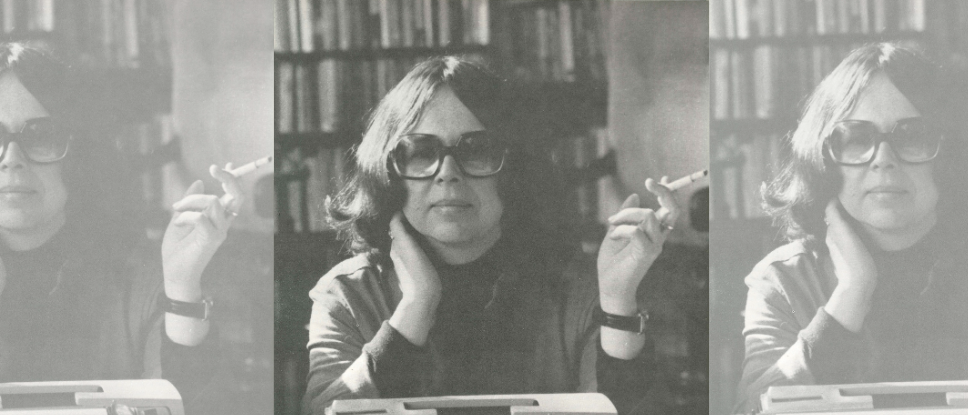
Did you know so much about sex just from your own experiences?
Well, I have been around. I’m 37 and I came out at twelve in Acapulco where I seduced the hotel pianist at the Club de Pesca. I was buying hustlers when I was sixteen (they were often twice my age), cruising the public library in my hometown, experimenting with eyeshadow in the privacy of the streets. When I was 22 I contracted my first lover, settled down and became innocent.
But there were many things I knew nothing about. The desperate midnight calls! “Jack,” I’d say, “tell me again about that time someone bound and blindfolded you and coaxed you to climax with nothing but dirty talk.” No one was safe. A perfect stranger would call one of my roommates and next thing he knew he’d be telling me about his technique in the tub—or tubs.
It must have been like writing a lot of bedroom scenes. Did you have a theme that you wanted to carry through the entire book?
I was very impressed by Dr. Comfort’s book. He has this very sophisticated, funny, frankly idiosyncratic approach. He obviously adores bondage, for instance. I thought it would be fun to write a book about gay sex in those terms. Most things I’ve read about gay sex are either apologetic or political or clinical. I thought it would be a liberating act for me, and possibly for the reader, to write in a sort of worldly, urban, funny tone as though it were perfectly acceptable to be gay. I thought it might help to make it acceptable.
Who had the final say on the illustrations?
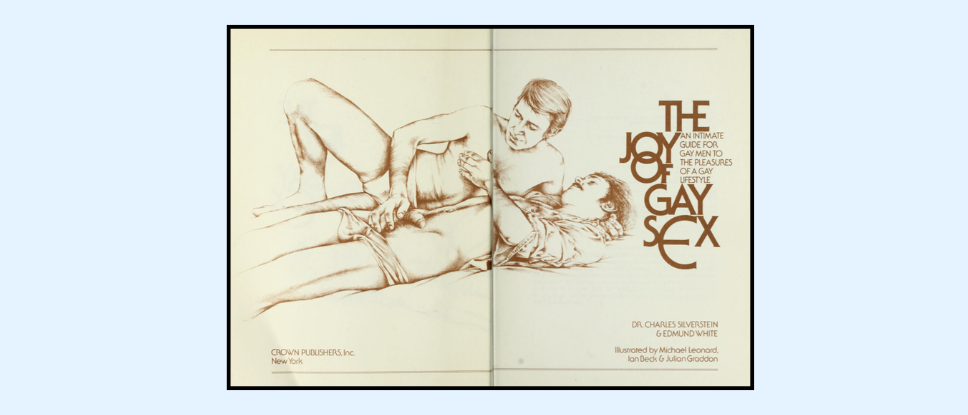
Charles Silverstein and I got to see them. But they were done in England. We were consulted in the search for illustrators. But we weren’t able to come up with anybody that we liked. We saw some of the illustrations. Everything was done in a rush. They also asked us which of the items we had written would be illustratable. Then when we saw the final illustrations we made a tremendous fuss because we thought a number were both sexist and ageist in that the older partner was always shown in the more aggressive position. The other person was always boyish, and was the one getting fucked. That may be the Greek ideal, but it’s not the American reality.
In the Soho Weekly News, Robert Patrick said that your book is anti-relationship. Do you have that kind of bias?
No, not at all. There’s a long section on lovers in the book. I think we simply wanted to acknowledge what actually exists in gay life. There are many people who don’t have lovers, or if they have lovers they still trick a lot. We didn’t want to pretend that that is bad. We have an entry on promiscuity in which we say that it’s a word which really doesn’t make sense in the gay life. It’s always pejorative to say that someone’s promiscuous. The way we feel is that if you have a contract with your lover in which you both agree to be faithful, then to play around on the side is not a matter of promiscuity but of dishonesty. And no relationship in which you are dishonest can work. But if you both have agreed to trick, then why not? It seems to me, the more sex you have the better, all other things being equal.
And they never are.
But you see, essays give the rules, novels the exceptions.
If you could have used a word other than “Joy” in the title, what would you have chosen?
There was a time when we considered calling it something else. The publisher was willing, but I wanted to call it The Joy of Gay Sex because I wanted to be able to talk about gay life in terms of a well established predecessor, The Joy of Sex. It seemed to me a good idea. We hoped that the very title of the book would indicate to people in bookstores that homosexuality is comparable to and just as acceptable as straight sex. I think that a handsome book like this selling over the counter in bookstores all across the country with an easily recognized title has a certain kind of liberating influence.
How do you respond to people who say that you’re part of a phenomenon of exploitation of the gay market?
Frankly, I don’t understand what it means. It’s not as though I became gay in order to write this book and make money. I’ve always been gay, I’ve always been a writer. And now I’m a part of a book that is obviously designed to reach a lot of people. And I will make some money. But where does the exploitation come in?
Well, I think that some people would aim their criticism at the publishing community.
Well, then you could say that Random House, by bringing out Toni Morrison’s book, is exploiting the black market. I suppose if there was a gay male book publisher, I would certainly take my books there, rather than, say, to Random House. In fact, some of the people that we worked with at Crown and the English publisher, Mitchell Beazley, are gay.
Have you had any negative reactions from friends?
Oh, no, I have the sweetest, most long-suffering friends in the world. One of them, a book critic who advised me not to do the book under my own name, told me I’d be ruined. Ruin, of course, is something I might fear but I’d never resist. Now he’s read the book and decided it’s interesting and serves a useful function.
Another friend, a literary critic, wrote me this: “How clever of you to have done a novel in the format of a sex manual—though the Borgesian logic of it all does come clear. I adore the mélange of fantasy-narrative, of autobiography coded as ‘advice,’ of sentimental educations and double-dealing reflection. Of course, the pictures are too reminiscent of Barthelme, and I almost tense, not to say Joycey array of literary allusions gives this book a rather higher, more cultivated tone than your others. Even those dim bulbs who don’t see the light, who will persist in thinking of the book as a how-to, why-not book, have the consolation of a witty, humane treatment of the subject.”
Will there be a “More Joy of Gay Sex”?
No one has mentioned it. But I, at least, am collecting notes. If nothing else, that’s a good line to use on dates, don’t you think?
How do you feel about some of C. A. Tripp’s ideas about conflict, or a certain amount of tension in a relationship?
Doesn’t he believe that love requires mystery, Otherness? I would say that for me personally, that is true. I don’t know if it’s true for everyone. It seems to me that there are many people who like a kind of coziness, and for them sex doesn’t necessarily feed on conflict. There is the appeal of having a lover who looks like you, who is your same age, has a similar background, maybe even the same religion. There’s almost a kind of brotherly joy about being gay. It’s one of the great attractions of homosexuality for some people.
Personally, I’ve often been attracted to people who are mysterious to me, people of a different race, or a different age, or a different background, or foreigners, or people whose psychology is so different from mine that I’m very mystified by them. Most of the time I fall in love with people who are quite different from me and I have a hard time understanding them.
You have a section on guilt, which I don’t think Bertha has. Does guilt also make sex more exciting?
I think it might for people who grew up, as I did, in the fifties and sixties, particularly those who came out in the fifties. If a lot of your early sex experiences were in a context in which you felt guilty, then guilt later adds a sauce piquante to the home cooking of sex. But that’s a sorry situation in the best light—a bit like the building’s owners thanking Nixon for publicizing the Watergate. I think that someone coming out now, however, with relatively little guilt, could have terrific sex without guilt. And yet friends of mine who work on gay hotlines tell me that there still are many teenagers who call up and say they’re gay and are full of guilt. I think we all may have a rather superficial view of things today in assuming that young people coming out are doing so with great freedom. I think that for many teenagers, it is probably as difficult as it ever was.
Bertha points out in her book that men are not multi-orgasmic and that to be a man is to feel a limit on one’s sexual energy. What do you think the implications are of men not being multi-orgasmic?
First of all, I think it’s a darn shame. I guess there are gay chauvinists who would say that sex between men is better than sex between men and women because men are stronger physically. It’s much rougher sex.
I would say that since we don’t know what it’s like to be the other sex, it’s very hard to talk about it. We don’t really know what the subjective sexual experience is. It’s certainly true that women can have many orgasms and men fewer and with a longer refractory period. That seems inarguable. I happen to like fucking as much as coming; as the airlines tell us, “Getting there is half the fun.”
Bertha implies that a lot of things grow out of women’s sexuality in general, and potentially out of lesbian sexuality in particular. What grows out of gay sex between men? What could gay male sex be the foundation of? What kind of world does it imply?
I think it could have larger implications. I’m not sure that they arise specifically from gay sex as much as from being a member of a particular kind of subculture—a social experience rather than a sexual one. Many people disagree with me, but I happen to feel that gay men are less competitive with one another than straight men are. Two straight men can be rather good friends, and yet they appear to me to be competing with one another in a bloodthirsty way—for the same woman, the same job, or for higher status. In the job world it seems that in general gay men are not as competitive. Many people do disagree with me, of course, and I know there are many exceptions. But all in all, I feel that there is a kind of sweetness about gay men that just doesn’t exist among straight men. There’s a kind of friendship, for instance, between gay men and gay women, gay men and straight women, gay men and gay men, which is not so involved with worldly competitiveness. Such friendships seem to be positive things that grow out of being members of this particular minority. Why gay men should be less competitive than straight men, I don’t know.
What about the butch image now current in the gay world? In a world in which gay men are often physically taunted, isn’t machoization possibly a good thing?
I have conflicting feelings about it. I happen to find butchness rather sexy. But politically, it seems suspect to me. One of the advantages of gay life was that it was a place where you could be a sissy and that it wasn’t necessarily a bad thing to be one. It may not be so good in the job world, and it may not be so good when you have to have a physical fight with somebody. But it seems that in working with other people—for instance, I’ve worked on magazines where there is the kind of straight man who comes in, pounds the table and tries to throw his weight around, and is mainly interested in his title and where his name is on the masthead, who consumes a lot of energy which is pointless and destroys the feeling of collaboration.
I think a certain amount of androgyny in your inner life is attractive and good, especially for an artist.
All I can say is I do have conflicting feelings about it. I’m usually attracted to butch people sexually, but I feel that the tendency in gay life today not to allow anybody to be a sissy is unfortunate.
You make a connection between cities and modern homosexuality.
Cities are more sexual. There’s room for many subcultures within a city, whereas in a small town the two or three homosexuals there cannot have a gay society. They can only be covertly gay. In the city, although as a percentage the odds are the same, the actual numbers are greater. So gays can really develop a whole subculture. As long as people were tied to the soil and to a traditional static morality, and to relationships that were determined primarily by economics rather than by desire, no one could experiment with sex. It might be depressing to cruise the cattle from your tractor, and the phrase “chicken hawk” would take on certain ambiguities. It’s only as we become urbanized that we break away from traditional morality, and individual need, caprice even, becomes important.
Do you feel the book represents all gay people?
We tried not to take a judgmental standpoint on anything. The Joy of Gay Sex is accepting of all aspects of homosexuality. It doesn’t put down transvestites or S&M people or other groups. We wanted to be accepting of everyone practicing homosexuality. And it wasn’t an effort to do that, because Chuck and I happen to have that kind of temperament.
The ironic thing is that twenty years from now people might think this is the really good book I wrote, not my novels. And it sometimes seems to me that when people write in a genre like this sex manual, they don’t feel so intimidated by literary standards. They write more freely and easily and maybe more humanely than they do in their so-called more serious works. I wholeheartedly recommend sex to anyone suffering a writer’s block. ❡