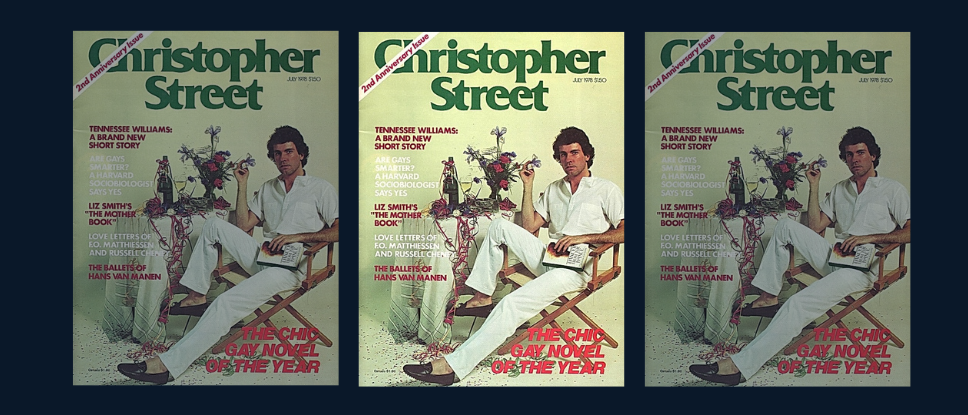

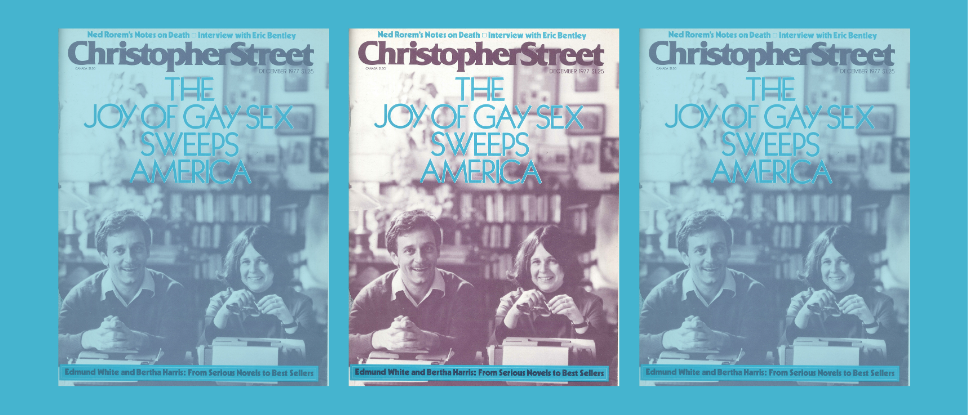
This article appeared in the December 1977 issue of Christopher Street.
I knew you didn’t give The Joy of Lesbian Sex its title, but did you subtitle it “A tender and liberated guide to the pleasures and problems of a lesbian lifestyle”?
We didn’t write the subtitle. I hate the word “lifestyle.” The phrase “the Total Lesbian” popped into mind, but it has implications of Marabel Morgan.
Why did you turn the book into something more than a sex manual?
I didn’t want to write a sex manual. From my own experience I knew that you can’t reduce sexuality to something that happens between the legs. It happens in the mind, the imagination. Emily and I had to stay in the format that they had indicated, but we wanted to cover as much about what a lesbian is as possible—not just in bed, but in the rest of her life—things like jealousy, where she goes to socialize, how she meets women, possessiveness, all those kinds of things. And still the book is incomplete. I think of things now I would like to add—but that’s true of every book.
You think of changes and additions after it’s published. What kind of lesbian will buy this book?
I try, when I write anything, to imagine an ideal reader and I couldn’t really keep in mind an ideal reader for this book. From what I’ve heard, the lesbians who are buying this book come in all sizes and colors. A bookstore owner in Houston I know said she really didn’t know whether she should order any copies of the book because she couldn’t believe people would have the guts to buy it. But she said she sold out within a day—and all the buyers were women. She didn’t know if they were all lesbians—but they were all women.
 Edmund White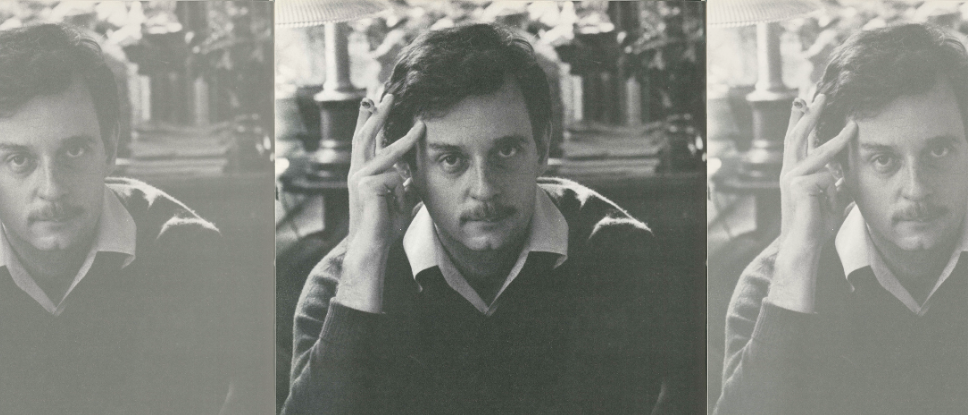
What do you think the impact is going to be on the world in general?
I’m unacquainted with the world in general. I live a very cloistered life. I hang out with lesbians, book people, literary types, artists and scholars. I hardly watch television and rarely go to movies. I forget that there are people who still associate lesbian experience with sin, perversion and severe problems. It has amused me, though, to see people surreptitiously circling the books in Brentano’s. I wonder what goes on in people’s heads?
It’s a strange project for both you and Ed White to take on. You’re both serious novelists. What did you finally decide it would do to your careers?
Ed and I have many points of reference in common. Neither of us, in any way, could be considered bestsellers. We write fiction that is “arcane,” that has a very small audience, that while it does not receive critical acclaim receives critical attention. But people simply do not rush to the stores and knock each other down to buy our books. We wondered together, and separately I’m sure, whether the people who have praised our novels will suddenly change their minds about our fiction. If we wrote something that they disapproved of—not on moral grounds, but in terms of commercialism. So I spent several dark nights of the soul thinking about that.
Did you get final approval of the illustrations? Do you like the illustrations?
Emily and I originally urged the publishers to include in the illustrations as many diverse types of women as possible—physically diverse in age, race, etc., and they listened to us. But since all the illustrations were done in England, listening was as far as they went. They did what I suspected they would, which was to get very young, lithe, conventionally pretty women, with a sort of bow to the third world with one woman who was also under thirty. But since we do have a section on sex in old age, insisting that sex doesn’t have to end at forty, we had hoped very much that they would have older women—not just older, but old, to point out the fact, which we know is true, that old people are sexual people.
Why did they do that?
I have no idea, except the obvious one that the more conventionally pretty the models, the more movie starish, the more people will buy the book. I think it’s a mistake.
Are men going to buy this book just to look at the illustrations?
Yes. Straight men. It’s fairly common knowledge that lesbians play a part in men’s pornographic imaginations and literature. I think they may buy the book to feed those fantasies or to have them confirmed. That troubled me before I agreed to write the book, but I realized that lesbianism is no secret, really. If you look at any porn movie or any sex book—the ways and means of the flesh are well known. The thing that worried me more than anything else is losing the respect of people I admire who have been kind to my work. Then I began to talk to Ed, and we said, “Well we need the money to pursue fiction. Nobody is willing to give us this kind of money for our fiction, so why not write a sex book and make it decent and hope for the best.” A lot of people in a lot of places assured us that it wasn’t going to undercut our other work. And as I started writing it, it began to feel like writing anything else. When I write about sex in fiction, I’m using it metaphorically. Writing The Joy of Lesbian Sex taught me something about writing, about literalness. No metaphors. I didn’t have to get a character from one place to another through a sexual situation.
I think that is what we began to do after a while—or at least in the part I wrote. Gradually, as I wrote from A to B to C, I tried to form a picture of a lesbian, or lesbianism, or lesbian sensibility that could be approached from various orifices of the body, or various parts of her imagination so that I could see perhaps what a lesbian is. What I hoped eventually was that the whole would be equal to the parts.
So in the long run you enjoyed writing the book?
I did not enjoy, in the long run, writing highly technical material. Fortunately I could rely on Emily to write a lot of that.
Ed wrote every final word in The Joy of Gay Sex. Is the same true for you?
We split up the book in half. The only thing I wrote independently of Emily is the intro—and checked each other’s. Emily was much better than I in writing about situations which I write best, and I took the parts that I thought I could write best. We would exchange copy and check each others. Emily was much better than I in writing about situations which dealt with non-romantic areas. Like mastectomy, surgical procedures, infection, etc. She was able to breathe life into that kind of thing. So it was basically a half and half proposition.
Already your book has gotten some criticism. You saw the SoHo Weekly News review. What do you say about Lee Lehman’s charge that it’s recycled lesbian feminist schlock?
Well, she’s wrong, of course. I think she misrepresented the book. By quoting page numbers, she gives the impression she’s quoting the text when, in reality, she’s extrapolating and interpreting. And nobody takes the SoHo Weekly News seriously anyway.
When you were writing the book, didn’t you sense there would be attacks? After all, a lot of people must have been envious that you were chosen to write it, and not them. And it’s the biggest commercial effort this year so far as publishing goes.
I’ve run into very little so far. There have been a couple of obscene phone calls. One thing that has happened that is quite amusing is that one woman, who by inheritance is probably one of the richest lesbians in the U.S., came up to me (she’s also very radical politically) and said, “How could you possibly write such a thing?” And I said the only better way I know to make a living is by inheriting a lot of money from a rich father. That’s my line for certain people.
Among certain lesbians, it is felt that lesbians aren’t supposed to make money. They’re not supposed to go commercial. How do you deal with that?
I think it’s some of the most outrageous nonsense I’ve heard in my life. Lesbians have been at the bottom of the economic ladder in white society. There’s a standard, very worn out line that money is bad for you, that it somehow will ruin you. That if you’re an artist you should starve in a garret and that somehow suffering improves your work, or suffering improves your politics. I can’t stand that. Virginia Woolf in A Room of One’s Own proved conclusively, to me at least, that the more you have to eat, then the better you work. I don’t expect to make that much money off this book. What I hoped to do was buy myself, for the first time in my life, a year off to write.
Whenever these charges about making money off gay people are made, somewhere in the air is the notion that lesbians and gay men are supposed to be tied into some socialist change in the society—but it has never really come out into the open for a direct confrontation. There are gay men and lesbians who are not for a Marxist revamping of this country and there are those who are. Do you think that’s a part of it?
I’m a feminist. That’s my political ideology, and that’s the way I try to live my life.
How does money relate to that?
It seems to me, from what I’ve read and experienced, that no Marxist or socialist society has, beyond a miniscule amount, improved the lot of women. And some of those countries that are Marxist or socialist act against homosexuals very severely. I am a realist. I come from extreme poverty. My father had a seventh-grade education. My mother was raised in an orphanage. My grandparents were Irish Catholic immigrants. I’m the first person in my family to get a college education, to rise above a subsistance level, and I find personally offensive a lot of the rhetoric that comes out of middle-class mouths in terms of money and what should be done with it. I do not believe in the capitalist system. It is wrong and it’s brutal and it’s immoral. But I don’t think a Marxist ideology is a replacement for it and will make life any better for gays or women. I don’t think that homosexuals or women have reached any sort of political analysis that can substantially replace in all points Marxist and capitalist ideologies. Admittedly, there are people working on that. Until we can do an analysis, we can’t do a synthesis. The trouble with most of us is that “revolution” has happened for too long in our heads, and we feel unaccomplished.
The new French philosophy seems to be that even after you do the analysis, there is no synthesis.
Lesbians by and large are still on a day-to-day survival level, continually threatened, continually in a position to lose their jobs. And if they have children, lose their children, and so forth. They can be attacked by their neighbors—especially at this time when the right wing is increasing its fervor. We who live in New York in a more liberal environment tend to forget that the majority of us still live outside somewhere and that to talk to them about the revolution around the corner is not pertinent and is indeed cruel. I tend to believe, however, that simply being a lesbian is to exist as both analysis and synthesis of the human and material world. Perhaps, too, of revolution.
One thing I find ironic. Some women feel there is less sex in the lesbian world. Now, reading your book, one finds that women are multi-orgasmic. Women have the capacity for an enormous amount of sex. If men had the capacity for that much sex, Greenwich Village would be insane. I want to know why is it that gay men are the ones who are out having sex, satisfying what is a limited capacity for sex? Do you think that the lesbian world will eventually have faster, more available sex?
Lesbian sex is not confined to genital gratification but is an all-pervasive sensational movement between body and psyche. Lesbians have more in common with bower birds and elephants than with gay men. We prefer ritual to quick fucks. But given ideal social circumstances we might enjoy adding the quick fuck to our rituals.
I know that I have had, and that women are capable of, instantaneous sex. By instantaneous, I mean when you meet somebody and are instantly aroused and if possible jump into bed fifteen minutes later. I’ve done it with people I’ve just met, relative strangers and so forth. But it seems to me significantly more satisfying when it involves a more slowly aroused ritual.
You must have thought, when you sat down to write it, that the book could have been hysterically funny. The comedy of lesbian or gay sex is intense.
Oh yes. I’d love to write a parody of this book immediately. Constant parody suggested itself to me as I wrote it that I had to repress. And then I’d amuse myself by saying that the next book I’d write would be The Joy of Bestiality. What do you do with a Persian cat on a lonely weekend?
Do you have a cat?
Yes.
Are there any lesbians who don’t have cats?
I know one who keeps goats.
How is your novel Lover doing?
It got good reviews and it is selling fairly well.
You could write a commercial lesbian novel if you wanted to. Do you have any desire to write that sort of book?
No. I’ve deliberately chosen to make my living all my life in ways that wouldn’t force me to think commercially when I’m writing. Life is only so long. Writing’s the one place where I want to keep identity, integrity, if you will. It’s where I exist.
There is this distance between gay men and lesbians about which I think you’re writing for New Times magazine. Is it a possible connection between lesbians and gay men that they are so sexually oriented? Do you think that’s a connection?
The more that’s known, the more correspondence, the more communication, the less secretive we are with anybody, the more ground we have for friendship or alliance or anything else. I was reading E. F. Benson’s Lucia novels and Lucia says at one point “that horrid thing that Freud called sex.” That phrase has been roaming around in my mind. The whole mystification of sex has made us so boring with each other. There has been an ingrained puritanism (although I know that the Puritans were quite sexy people) among women and I think lesbians share it a great deal. I don’t know whether gay men do this, but when lesbians get together they begin to talk in political terms about whether we should be monogamous or non-monogamous; sometimes at entirely inappropriate moments. There are a lot of discussions about fidelity.
That’s the average gay dinner and brunch conversation. What’s the average conclusion?
That we’ll talk about it again next Sunday.
I don’t think you can make any decision intellectually about what your body’s going to do. It’s extraordinary what the body will do, if it wants to. No matter what your mind adheres to, suddenly you may be in bed with somebody you hate, someone you wouldn’t speak to in the street. And that’s a most interesting thing about human nature. Somebody you have loathed under normal circumstances, who stands for everything you despise as a human being, you’re suddenly madly, passionately engaged in sex with.
Are you working on a novel now?
Yes, two, in fact. A short comedy—comedy, I hasten to say, the way that Nabokov wrote comedy. And the other book, which will probably take at least three years to write, is a mother-daughter-mother-daughter situation of a kind that has personally given me a lot of anguish.
In the gay world lesbians are sometimes the magicians of monogamy. Do you think that as lesbians become more liberated, there will be less of that?
There are analyses that show that monogamy is something that we are conditioned to. Whether we would do it in the state of nature, we don’t know, because certain animals high on the evolutionary scale are monogamous. Elephants, I think. And whales. The way society is built (I don’t know how gay men are built) it would almost be impossible for me to get as much work done as I do and still carry on sexually a great deal. Work comes first with me. Although my mind tells me I would enjoy a lot of sex very much, the older I get, there’s more work I want to do, and more of my energy goes into writing than into any sexual adventures. I don’t know how you get those two parts of your life together.
It’s one energy bank?
I think the ideal life is to be funded by the Kinsey Foundation on the one hand and the National Endowment for the Arts on the other, and you put that money together and you write and fuck all day long. I find sex incredibly energizing. A long period of sexual activity leaves me with incredible energy to work more. I need less sleep, less food, less rest. It’s the romantic demands too many women insist on that I find draining, not sex per se.
Has your daughter read your book?
She’s read part of it. We’ve been so close in her growing up, that I discussed at length whether I should write this book, because certainly I felt that her life might be affected—if not now, then later. She felt I should go ahead. I’m sure that her eye was on the main chance—the more money I make, the more money she’s got. She’s a teenager, and she’s grown up all her life in an almost exclusively gay atmosphere. She has been conscious for a long time that I am a lesbian, so I don’t think she has the usual fears and problems that a child under heterosexual circumstances would have.
Was there any crisis at any point in the last ten years with her about you being a lesbian?
I don’t think so. There was a time when we were living in North Carolina (I was teaching down there for a period) when I was just coming out. I was involved in lesbian analysis and feminism and so forth. Some kid on the school bus told my daughter that her mommy was a commie pinko queer. She punched him in the mouth. She wasn’t sure what any of those words meant, but she realized that it was an insult. It was an interesting situation. His mother called up and said, “Your daughter punched my son in the mouth and he’s going to have to have dental work and you’ve got to pay for it.” I said, why did she do it? And the whole story came out. She paid for her son’s dental work. My daughter’s more conscious of my being lesbian, I think, than her best friend is of her mother’s being heterosexual. Mostly my daughter and I are wildly proud of each other. ❡