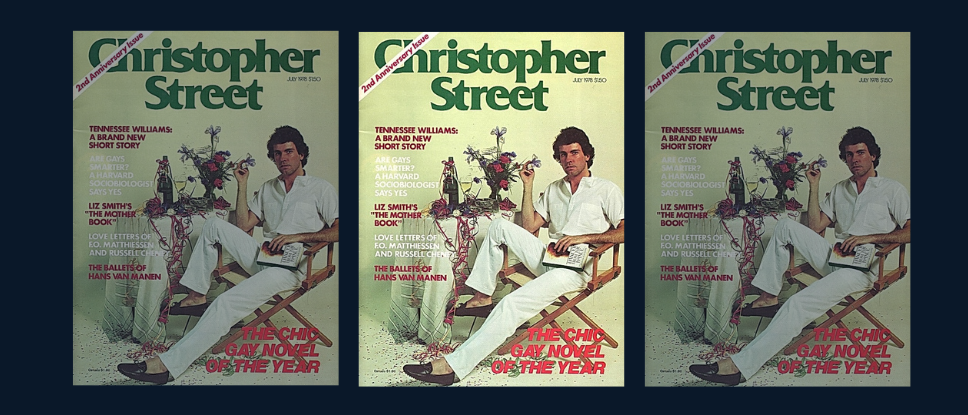
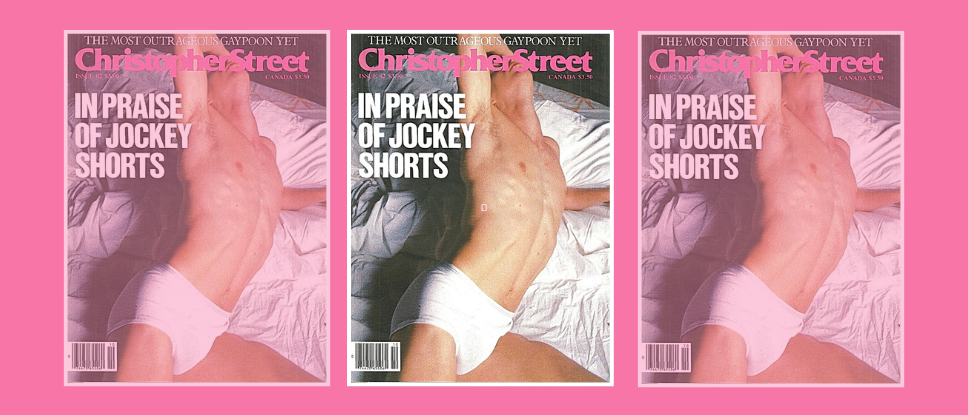
This article appeared in the November 1983 issue of Christopher Street.
“I didn’t get much sleep last night / thinking about underwear / Have you ever stopped to consider / underwear in the abstract?”
—Lawrence Ferlinghetti, “Underwear,” from Starting from San Francisco
In the spring of 1958 I had a vision: I saw my high school classmate Eddie Pike in his jockey shorts.
He was taking his sweet time neatly folding his street clothes before getting into his baseball uniform. From his crew cut all the way down to his crew socks, his look stunned. This was my own especial miracle at Fatima, my Song of Bernadette; this was my metaphorical first fuck, the instant that I first laid eyes on Eddie Pike in his jockey shorts. It was The Day the Earth Stood Still. A quarter of a century after, the vision of Eddie Pike in his blinding white jockeys is still with me; it was like staring into the sun. Let me explain why this image so transfixed me and why it undoubtedly also made an impact on my evidently straight pals, one of whom just afterward raised the corroborating cry of astonishment, “Did you see Pike!”
I grew up in the Fifties. To anyone with a memory of the Fifties, this is a shorthand that explains a lot. The butch of today, who shows off with impunity a toney, flat, muscled midriff under a half-shirt might not understand. In the Fifties a bright color on a man was enough to make him suspect, and the heart of the voluptuary lay like the heart of the nerd beat beneath a white button-down.
Men’s underwear likewise was consistent with this conservatism of dress. A voyeur recently registered this sighting through a hotel-room window: a cluster of teenage boys, stripped by the heat to their flashy, colorful bikini briefs, stood before a mirror primping “like chorines.” In the Fifties such a scene would have been inconceivable. Man and boy wore boxer shorts or white briefs. These were the options. Quite a dichotomy, but vive la différence! It enhanced the totemic value of jockey shorts that this choice implied somewhere along the way a rejection of boxer shorts.
By 1974 menswear designer John Weitz could write that “the so-called boxer short . . . seems to be through” (his italics). From its own 1983 poll, Glamour magazine found out what kind of men’s underwear turns women on. Thirty-five percent responded that the bikini most turns them on; 32 percent went for jockey shorts. A randy splinter group (21 percent) would lobby for none at all. Among the also-rans were boxer shorts, which appealed to a piddling 10 percent. That same spring Gentlemen’s Quarterly flatly noted that “the knit support brief remains America’s uncontested favorite.” What persuaded virtually an entire generation to slip into something more comfortable?
To fathom their profound erotic hold, to understand their sovereignty, it may be useful here to identify the properties of jockey shorts and reflect upon their connotations.
The happy phrase jockey shorts is well known and understood; it is the nation’s term of endearment for a native fruit of the loom. With the onset of fashion underwear for men, however, the phrase gave up its precision. It had been understood to be synonymous with the term briefs, “close-fitting legless underpants,” when the only kind of briefs around were what comedy writer Selma Diamond on Jack Paar’s Tonight Show succinctly characterized as “the white ones.” Today the phrase has wider applicability. It is usually invoked to identify any type of underpants that reproduces the form of traditional briefs and even—less often and with less justification—to identify any type of men’s undershorts, about what the trade name BVD signified for an earlier generation.
John Weitz in Man in Charge: The Executive’s Guide to Grooming, Manners, and Travel expresses best the general understanding of the term today:
It’s Jockey-type shorts, friends; those tight, knitted little devils which can go all the way down to almost-bikinis, which give you moral and physical support, and which leave no telltale folds under your tight-assed pants.
Ideally the phrase jockey shorts would be restricted (and for the sake of this scrutiny it will be) to mean standard white cotton briefs, what “everybody” wore before the men’s underwear revolution. The phrase refers to the exemplar of American men’s abbreviated underpants, the white briefs put out by Jockey International, the company to which we’re beholden for both design and nomenclature. But we must enter one more qualification before pitching headfirst into our subject. The jockey shorts that we invoke always have a visible elastic waistband; this is a sine qua non. When a designer conceals the elastic waistband, he makes a gesture toward style—even if he doesn’t attain it—and the briefs pass into another realm, the realm of fashion underwear. A disqualifying degree of self-consciousness has set in. When fashion overrides utility in his choice of underpants, the butch is on his way to becoming a dandy; he strays outside the range of this study.
This visible elastic waistband, when it is visible above the pants of the butch, is an identifying mark. The waistband, visible in its glorious entirety or only detectable by a thin strip, is the badge of his unreflectiveness. Leaning over to bury his head under the hood of his jalopy or just glowering on a street corner, the butch is unconscious or unconcerned that his slip is showing. With its suggestion of a jockstrap, the visible waistband implies that something below the waist requires this extraordinary support. Subtler than a codpiece, it’s a periphrasis for men, when this concept is illustrated by open palms held facing each other—and far apart. It’s almost a boast. Jockey shorts have a taking naive manliness.
❡
A woman had agreed to let a gentleman friend about whom she felt there was “something sleazy” occupy her apartment during a long absence, and she felt “funny” about it. She wasn’t quite able to put her finger on the source of her uneasiness, but suddenly she was able to imagine the worst: her friend nosing through her underwear drawer; she revoked the offer. As she explained, “There’s nothing more personal than your underwear.”
In their scholarly, understated The History of Underclothes (London, 1951), Drs. C. Willett and Phillis Cunnington write: “We must infer that the fascination of any undergarment depends mainly on its concealment.”
These testimonies suggest why a piece of cloth could develop a cachet. Since a dick is the salient feature of the piece of cloth under discussion, it is not surprising that those afflicted with what the Cunningtons refer to as “erotic prudery” might regard jockey shorts as positively licentious. Such shameless avowal bothers them and can’t be fended. There is something stark and undeniable in the spectacle of unrelieved white jockey shorts.
What creates the hothouse atmosphere most conducive to unbridled growth is repression, and nothing flames demand like scarcity. In the Forties and Fifties, outside of usually sterile underwear ads, an occasional Life candid, and the Sears catalogue, photographic peeks at men in their jockey shorts were as scarce as hen’s teeth. A child especially would be puzzled by the anomalous situation in American movies: all of the men wore boxer shorts while jockeys were nowhere represented. What was the meaning of this curious omission? What could be behind Hollywood’s unequivocal denial of jockey shorts? Why was this veiled reference to dick itself veiled?
This prohibition, set up and enforced by the studio system, prevailed for over the first thirty years of the existence of jockey shorts. When they finally reached the screen, in an independently made film released through conventional channels, their debut was auspicious but went unremarked. Our researches are subject to amendment, but evidence indicates that in 1965 Sal Mineo became the first actor to violate this taboo. In a heavy-breather called Who Killed Teddy Bear? this second tier icon of the Fifties plays his opening scene in nothing but a pair of standard tight white cotton Jockey briefs. We don’t see his face, but we do see his defined hard body stretched out on a bed as he whispers into the mouthpiece of a phone, which he holds close to his own mouthpiece. This dramatically lit sequence was undoubtedly the early work of Michael Chapman, the film’s second unit cinematographer, who was later praised for his cinematography for Martin Scorsese (Taxi Driver, Raging Bull), Phil Kaufman, and others. Only lamplight provides the illumination that enables us to pick out the details of the scene, and the chiaroscuro in this black-and-white film intensifies the effect.
Despite Mineo’s breach of standard practice, men in jockey shorts didn’t become a commonplace in American movies until four years later. Suddenly in 1969 they were up there. By then other things beside the studio system had broken down. We caught Robert Forster in his jockeys in Medium Cool. In Alice’s Restaurant an army of draft-age men presented a spectacle of “all-pervading white” as they took their pre-induction physical. Their lowest common denominator seemed to be jockey shorts.
We’ve gotten used to the view, so how could anyone but an eyelash when some lunker in a picture show strips down? Still, even at any vaguely effective sex scene in a movie or during an interval where actors are en dishabille, a hush falls. There seems to be a communal intake of breath—“Don’t nobody move!”—that isn’t expelled until the actors get back into their clothes or the scene changes. You’d think the Holy Ghost had descended upon the apostles.
With actors today blithe in jockey shorts even in network TV’s most innocuous prime-time unit, the situation comedy (with Christopher Knight in an episode of Joe’s World the supreme example), it is hard to believe that such disclosure ever cost anyone his or her career. Yet in 1968, before the age had been retailored, Molly Haskell, reviewing an evening of one-act plays in the Village Voice, wrote that she had to waive her “vestigial Victorianism” to “itemize the [plays’] breakthroughs in stage exhibitionism.” She elaborates upon one of them:
The rapist, Alberto, is played by Argentinian actor Hector Elias. He undresses down to his jockey shorts and before our averted eyes proceeds to massage—wait, let me start over—commences onanism with a stuffed kitty cat.
A year later Andrew Sarris, writing in the same publication, made these comments on Rip Torn’s performance in the independent film Coming Apart:
Torn is the first actor who can cross the frontier of exhibitionistic sexuality and still retain an ironic distance from it, not to mention his being the first actor not to seem embarrassed to be caught only in his jockey shorts, the prescribed mystically Maileresque costume for parlor paladins. Indeed, Torn can even shift moods while in his shorts, a feat of self-aplomb I doubt that even Gielgud could duplicate.
Americans are resilient and quickly adjusted. But meanwhile the policy of non-disclosure had fostered a fruitful area of erotic speculation: what kind does he wear? “One of the most interesting moments in any incipient love affair or in any public dressing room—comes when someone whom we find attractive takes off his or her clothes and reveals a new message written in underwear,” writes Alison Lurie in The Language of Clothes (New York, 1981). This spirit of inquiry probably originates during the looking-up-dirty-words-in-the-dictionary phase of sex and the sharp ache of longing to know is probably most acute in the boy-crazy adolescent girl who is twice cursed—without male siblings and not privy to the boys’ locker room. Especially to her a pair of jockey shorts becomes an exotic foreign object. Terra incognita becomes the focus of all her thoughts.
Statistical analysis can help her toward her goal of forbidden knowledge, even though nothing is so heartening as empirical knowledge. “Rich men wear boxer shorts, never Jockey or bikini-type briefs.” That’s it according to Playboy Fashion. Rock stars are unthinkable in anything as “floursack dull”—as a Oui writer implied he’d term them—as jockey shorts. We associate rockers with flash or nothing. (Cf. Rock Stars in Their Underpants, London, 1981.) But she can be sure that day-in, day-out, the proletarian packs his tool in a pair of white jockey shorts, the foundation of the working class. Preferably a crisp new pair. In their pristine state they instill the greatest confidence. In ’em blue-collar feels cocky and up-and-at-’em; he knows he can conquer the world. With smirking self-confidence, he appraises himself in the full-length mirror. He knows he’s hot shit. He playfully pulls on the elastic waistband of his shorts, and lets it go. Fuck Kellogg’s Rice Krispies! Jockey shorts have Snap! Crackle! and Pop!
❡
“I see White City!”
Over a quarter of a century ago this was the chant, containing an allusion to the local amusement park, of one of a group of little boys. They were confronted with the spectacle of an equally little girl who sat on a stoop in such an unladylike way that they were entitled to see up her dress. The “white” located at that mysterious juncture knew a secret that it kept. “White” was indivisible from this proscribed region.
“Nor, in some things, does the common hereditary experience of all mankind fail to bear witness to the supernaturalism of this hue.” So writes Herman Melville of whiteness. The association of white with “divine spotlessness” makes white the logical choice for underwear, especially when one considers that in medieval times “the idea of underclothes was associated with the idea that the body was sinful, a source of evil, which needed constant discipline.” Even this far into the twentieth century it has been difficult to persuade men to contradict this logic. Even despite the inroads made by fashion color, white yet prevails. Those who do get divorced from white do so gingerly. An executive at Jockey has commented, “American men move most easily to blue when they buy their first colored underwear.” Another Jockey executive identifies a substantial market share as “forever white.”
When it was still known as Cooper’s, Jockey introduced what it now designates the “Classic Brief” in January 1935. As a 1974 company profile in Men’s Wear put it:
From the snowy winter morning 40 years ago when the Davis Store in Chicago displayed Jockey briefs in its window and sold the unique style in landslide proportions, it was obvious that the traditional ways of selling underwear had to change.
The original Jockey shorts were a shrewd Americanization of a Continental design. According to the company president, Jockey shorts were the brainstorm of A. R. Kneibler, who headed the design staff in the early Thirties. He “was absolutely intrigued by a picture of a man sunning himself in a bikini on the French Riviera.”
Nothing so attests to the continued performance of Kneibler’s design as Calvin Klein’s venture into this field with a variation on it forty-eight years after it was introduced. Perhaps Klein was tacitly endorsing what a University of Glasgow instructor maintains in a review of Roland Barthes’ The Fashion System: “. . . when a fashion becomes overelaborate, nostalgia for simplicity can easily set in.”
To make this staple irresistible to the Bloomingdale’s set—at $14.50 the three-pack—Calvin Klein didn’t merely rely on his name to sell it, even though it is neat the way in emulation of Jockey it’s stitched in silver thread and reiterated all around that visible elastic waistband. For Bloom’s you need tone, so Klein in his campaign blended “the classic” with “the all-American.” He chose a good-looking but not pretty all-American Olympic pole vaulter for his model, and shipped him to the Greek island of Santorini for the posing session with Bruce Weber. Wearing just his Calvins, Tom Hintnaus leans against a white monolith like the new Prometheus. For nearly a year, on a billboard 45 feet by 48 feet, this colossus in white briefs bestrode New York’s Times Square. In the midst of the boom in men’s fashion underwear, this represented not a revival but a reassertion of basic briefs. It reassured the man more comfortable with good ole “dumb” white jockey shorts.
Along with their whiteness, the most immediately discernible feature of jockey shorts—and one that provokes the most remark—is their uncompromising tightness. In a sketch on SCTV, John Candy kidded the American male who insists on correct size in everything he wears except his underpants. Laughing nervously and looking like a big overgrown kid, Candy aped the anguish of a futile effort to hide his squirmy discomfort. This proclivity to go for the smaller size may account for the sense of jockey shorts as a compact for the cock ’n’ balls: too much meat forced to occupy space somewhat smaller than it comfortably requires. “The white ones” are also “the tight ones.”
Tightness is what chiefly differentiates jockeys from boxers and what recommends them to a new generation. At the same time, the binding tightness of jockeys comes in for its licks. When Cooper’s began acclimating American men to the form-fitting underwear, their advertising campaign played up its comfort and urged men to “Stop Squirming!” by making the switch from trunk-style underwear to Jockey. But there is evidence that what brings relief to millions is just what makes millions of others ill-at-ease—the thought of jockey shorts makes them squirm.
Clerk is David Reuben, M.D., on tight underpants. The quotes are from his useful sexual catechism of 1969, Everything You Always Wanted to Know about Sex (But Were Afraid to Ask). The passage is from the section on male homosexuality, and we join him at the point that he is considering “sartorial requirements of butches”:
Unfortunately for butches, clothes do not make the man. This is especially true of underclothes. Peel off the top layer of a butch and there is a queen underneath. Their underwear is truly amazing. Some take pleasure in men’s shorts so tight they can barely meet the needs of nature. Others choose briefs so brief they barely exist. Most butch underthings are little better than skimpy athletic supporters—two straps and a sack attached to the tails of a super-tight shirt. It works fine—the shirt is always tucked in, the genitalia held tightly. The only problem is that the poor fellow can’t bend over.
Why do homosexuals do that?
One of the main reasons for such concern with underwear is the homosexual’s desire to display his genitals. They are his stock in trade and he wishes to show them to best advantage. What a good uplift bra is to a prostitute, a good pair of undershorts is to a homosexual. Held high, thrust forward, clearly outlined by almost unbearably tight clothes, his sexual organs are there for all the (gay) world to see. This is part of the homosexual courtship and in the areas where homosexuals gather, it is really something to see.
In Gerald Walker’s 1970 novel, Cruising, a 21-year-old copper is told to impersonate a gay. John Lynch’s assignment is to infiltrate Manhattan’s gay subculture in order to track down the killer in a series of violent gay homicides. In front of a mirror the decoy sizes himself up in his new persona:
. . . He put on a pair of jockey shorts.
One of my adjustments, he thought, looking at himself again. He hadn’t known what to think when [Captain] Edleson asked him what kind of underwear he wore. He said he was a boxer-short man. But the captain said from now on he would wear snug jockey shorts. That, he explained, was how they achieved the bulging-basket effect.
So now, Lynch thought, I’m walking around, bulging away, just like all the other queers. How many of them try to figure out what this old shillelagh looks like or how much it would hurt if I ever drove it home on them? What a life.
More recently, Abigail Van Buren, in her syndicated Dear Abby column (70 million readers), presided over a national debate about the inadvisability of wearing jockey shorts on the grounds that they sharply reduce a man’s sperm count and imperil reproduction. Several couples testified that conception promptly followed the husband’s return to “old-fashioned, loose-fitting underwear.” This was a good excuse for jeremiads on the disturbing tight underpants, even though a later article in Mother Jones (April 1982), “Why Johnny Can’t Have Kids,” made a more scientific case that the likely culprit is the “explosion of spermatotoxic substances into the environment.” The article doesn’t acquit “tight-fitting jockey shorts,” but treats them less like the perpetrator and more like an accessory after the fact.
❡
These presumably straight writers impute to jockey shorts fagginess or at least a lack of masculinity, but the most deafening broadside against the pernicious briefs appeared in a 1970 issue of Gay, the short-lived sister publication to still-going-strong Screw.
In “Let It All Hang Out!” Hector Simms lets “the jockey short conspiracy” have it. He nails jockeys for causing sterility, impotence, and “atrophy of the male crown jewels.” He adds that they are “hideously uncomfortable” and when you need to take a leak “inconvenient.” He goes on. Jockeys are “a cotton vise,” “a disgusting, cunningly disguised castrator,” “a genital corset, a miniature iron maiden to constrict and deform our balls, a cotton guillotine to chop off our virility,” and “a menace to human reproduction.” He claims that men are “being conned into strapping themselves up so tightly that it would take a fluoroscope to detect a sign of genitals.” It’s this that really bestirs Hector Simms, and makes him turn on jockey shorts the whole arsenal of his vocabulary. Jockeys give a fist-like emphasis, but Simms rejects this eye-catching confirmation. He likes to feast his eyes on a pendulous schlong clearly outlined against a guy’s pants leg. Given the equipment, a guy achieves this effect more easily in boxers or no underwear at all.
Even someone rhapsodizing about Tom Hintnaus as “My Underpants-Man” takes exception to tight briefs. John Wallace, writing in the New York Native, qualifies his passion by noting that the Calvin Klein ads did not “change the way I look at briefs (nasty, constricting necessities for the man on the go).”
Another gay publication, Alternate, poked fun at this jockey shorts hysteria in a mock issue of the National Enquirer, synthesizing these points of view:
The A[merican] M[edical] A[ssociation], in a co-sponsored report with the Church of Divine Population, has announced that jockey-type shorts cause homosexuality, rape, and low sperm counts. Christian men, who were also married, were encouraged by the Church of Divine Population to rid themselves of jockey-type briefs for the less restrictive boxer-type brief to insure both heterosexuality and high family counts. The AMA would not release the details of the study, noting: just trust us, we’re here for your benefit and we know what’s good for you.
The Visual Dictionary of Sex (London, 1978), while allowing that “the erotic function of underclothes might seem too flimsy a subject to merit discussion,” suggests that “men who wear ‘athletic’ briefs usually enjoy a minor but constant stimulation as a result of the cupping support which these give to the male genitals.”
Thus “athletic” briefs appeal to man’s dual nature. They confer forbidden pleasure at the same time that they exact the penance for it by mortifying the flesh. It’s an unending fair exchange; the transaction is renewed each time a puritan pulls on the briefs. How else explain why John Wallace can complain of their constricting tightness yet regard them as “necessities” or why the husband of one of Dear Abby’s correspondents, after implanting the seeds of “three beautiful children,” goes “back to wearing jockey shorts.”
We’ll let John Berendt, writing in New York magazine, have the last word. Awakened in the middle of the night by an intruder in the next room of his apartment, he explains what action he took: “First I reached for a pair of undershorts on a chair by the bed and slipped them on. Then I picked up the phone. (I assume the order of priorities speaks for itself. If not, let me say that Jockey shorts never felt more like armor.)”
❡
On an adult male jockey shorts are reductive in other ways than their tightness.
Infantile, childish, adolescent, faggy, and fem might read the litany of further strictures upon briefs. Jockeys are possessed by puckish esprit that delights in playing with our perception of them. It flits in and out, focusing first this then that aspect. Sometimes it brings out multiple associations at once, depending on the variables of model, observer, and context. It is their protean character that Duane Michals turned to such good account. In one of his photographic sequences Jockey shorts become Mount Fuji; they effect this transubstantiation by the agency of a stiff trick.
To a mother jockey shorts might recall the diaper, for what is the diaper—in whiteness, in texture, in amorphousness struggling for form—if not jockey shorts inchoate? More universal is the association of jockeys with boyhood. Boyish briefs. Can anyone, seeing Pete Rose out of his Cincinnati Reds uniform as he hoists his bat to model Jockey hip briefs (People, December 15, 1978), deny that it’s possible for a full-grown man in just his briefs to take on a disarming little-boy quality. When a woman tells Rabbit Angstrom in John Updike’s novel Rabbit, Run as he approaches her in his underwear: “I thought only kids wore those elastic kind of pants.”
One nostalgic adult male who still finds enchantment in the cartoon world created by Walt Disney and Charles Shultz also finds enchantment in jockey shorts. Mickey Mouse, Charlie Brown, jockey shorts, all emblems of childhood.
A boy whose father and older brother wore boxer shorts extrapolated from these data that boxers were what adults wore. Jockeys were kid stuff. In another family, in the early Sixties, a father who independently arrived at this same conclusion, waged a fierce generational battle with his strapping 14-year-old son for persisting in jockey shorts. The father even dramatized his point by an unavailing purchase of boxers, which, in a spirit of compromise, the son wore to bed. Not unlike that father, Hanes introduced their new line of fashion underwear by gently bullying potential consumers: “Some guys are still walking around in the same kind of underwear they wore when they were kids.”
We’ve already noted the aspersions on jockeys as faggy. It was the fag image of jockey shorts—but especially of the newer Continental-style briefs and bikinis (two strikes against these: faggy and foreign)—that made Baltimore Oriole pitcher Jim Palmer crucial to the Jockey company of Kenosha, Wisconsin. Only a card-carrying heterosexual, a married father-of-two, three-time Cy Young Award winner like him could have been man enough to slay the fag image. Underwear of Champions. Posing in an endless array of Jockey shorts, being interviewed on TV at 10 o’clock in the morning in nothing but a pair of baby blue hip briefs and T-shirt, or signing underpants at department stores all around the country, Palmer has negotiated a subtle neutrality without losing his balance once. He demonstrates the same poise he’s said to have on the mound. A Jockey advertising VP summed up Palmer’s appeal, the key to his triumph: “If my daughter was going to come home and marry someone, the best way she could describe him is to say, ‘Dad, I’m going to marry a guy like Jim Palmer.’” As actress Angie Dickinson said to him, “You’re handling this shorts thing very well.”
Yet briefs, a usage first applied to women’s frilly underthings, can qualify even the masculinity of a pass-muster guy like Palmer. In Marge Piercy’s Braided Lives, a teenage girl describes her first sexual experience with a boy:
To free each of us is different. He pushes my dress up, we pull his trousers down, unpeeling like the skin from an orange. His underwear is surprisingly familiar, for it’s like what Mother buys on sale for me, cotton, white, childish.
In James Dickey’s novel, Deliverance, a hillbilly orders his male rape victim to strip. “Them panties too,” he adds. In his biography of Elvis Presley, Albert Goldman reveals Elvis’s obsession with the image of virginal teenage girls in white panties: “His basic erotic image [was] a crotch covered with white panties and showing a bit of pubic hair—an image no different essentially from male to female.”
Munsingwear, in a trade ad in Men’s Wear, once had the effrontery to hit a competitor below the belt by exploiting this perception. On one side of a double truck, there’s full-page shot of a burly Joe Sixpack in a plaid flannel; on the other Munsingwear wants to know: “Would you sell him underwear that looks and fits like women’s panties?” Below this copy there’s a picture of Jockey Classic Briefs overlapping lacy panties. Munsingwear concludes: “The other manufacturer’s brief and woman’s panties look almost identical.”
In Rabbit, Run, the woman character quoted above further observes of Rabbit in his Jockey shorts that “in those damned underclothes you do look kind of like a rabbit.” Now that Playboy Enterprises, Inc., has announced its plans to introduce a male equivalent of the Bunny to the “serving staff” of the New York Playboy Club, they might reconsider his “provocative garb.” The observation in Rabbit, Run suggests that Jockey Classic Briefs would be the perfect outfit. What better in an age that construes a man to have attained the nationalistic hedonistic ideal when he has mastered the ability to “play boy”? Jockey shorts facilitate this imposture. A guinea shirt—the colloquialism that best expresses the athletic undershirt with straps—and knee-high tube socks would complete the ensemble. A tiny cross on a delicate chain—for frisson—is optional. If worn, however, cross and chain should be silver, coordinated with the silver thread that spells out Jockey at the waistband.
This all-white outfit would bring out the cute boy in the man. “In secular life white has always stood for purity and innocence,” writes Alison Lurie. “Logically, all-white outfits are most frequently worn by babies and very young children.” So dressed, the male Bunny—known as a Cottontail—will have to run a gauntlet of foxy ladies with hand trouble. As he’s trying to get back to his station with a tray full of drinks elevated above his head, they’re pawing him and grabbin’ ass and feeding his snatch five-dollar bills. This last gets quite popular with patrons, and comes to be called “passing the basket.”
❡
Infantile, childish, faggy, and fem, but mainly adolescent.
It is during adolescence that the marriage of form and function is most blissful. In adolescence jockey shorts reach their zenith. This is their most powerful association—Essence of 17. The physically strong, mentally awake teenage boy feels like Columbus when he discovers an inexhaustible natural resource right between his legs, a driving road to pleasure that’s on uncomplaining 24-hour call. He anoints it with Vaseline Pure Petroleum Jelly. He cuddles it and pays it little attentions. He becomes adept at pocket pool. He holds it upside down for short arm inspections. Someone squeezes on it, his pecker goes stone; it’s this sensitive. No wonder he keeps it in cotton.
In Rabbit, Run Rabbit spends a night at the home of his old high school baseball coach. He’s uncomfortable because Coach Tothero sticks around when it’s plain he wants to be getting undressed for bed. But he relaxes when he understands why:
Tothero waits and Rabbit waits and then realizes Tothero wants to see him undress and undresses, sliding into the unpressed khakis in bed in his T-shirt and Jockey shorts. . . . It takes Tothero back in time. Because of all the times he stood in locker rooms watching his boys change clothes.
It is during adolescence that these boys-becoming-men are nearly unanimous in their underpants. In the 1977 film Fraternity Row, set in 1954, the pledges submit to paddling and other humiliations dressed in uniform white jockeys. Likewise in the paddling scene in National Lampoon’s Animal House. Even in an account of a recent frat riot at Cornell, the novelist Richard Price matter-of-factly reports that each pledge was told to strip to “his jockeys.”
This was an inevitability that the Jockey company helped along. An ad in a 1940 Esquire—which features an artist’s rendering of a pledge getting the paddle over his Jockey briefs—advised:
If you’d rather not look too conspicuous in the locker room or dormitory, you’d better wear Jockey. Because at most good colleges and preps, Jockey is like a pair of slacks or an odd jacket—something that practically everybody wears.
You can be sure that if a registering freshman, away from home for the first time, ventured down the dorm corridor in just his shorts—and the shorts weren’t jockeys—soon enough the example of his peers would have brought this maverick in line, and he’d be hitting the nearest mall to load up for the duration. He’d be wishing he’d had the foresight of David Tipmore, who wrote in the Village Voice that the Saturday prior to his departure from Indiana for his first day at University of Michigan was “the Saturday of innumerable errands,” including “a purchase of 25 pairs of briefs.”
As a correspondent to the armchair voluptuary’s bible, Straight to Hell, said in a fond recollection of life in his college dorm: “We spent a lot of time just wearing Jockey shorts.”
Infantile, childish, adolescent, faggy, and fem. These available qualifications modify the dread butch without annulling his manhood. They scale him down without the sacrifice of his surly self-confidence, the élan vital of the butch. Meanwhile, his jockeys continue to hold him up. He sleeps in ’em; at home he hangs out in ’em. Jockeys served him under pegged pants when he was a greaser in the Fifties; now when he’s become a grease monkey they serve him still. No wonder a guy gets attached to them and, at least in the imagination of fiction writer Margaret Atwood, they get attached to him. In her review of Frederick Barthelme stories, Moon Deluxe, she says the author tells what “it’s like to wake up and find out that you’ve been cast in the unenviable and secondary role of Ken in the Barbie Doll game, condemned to passive observation, your Jockey shorts coextensive with your skin.” This might explain why John Travolta still wears Fruit of the Loom briefs, what he probably grew up in. “They’re the only kind he’ll wear,” his confidant told People. But Travolta, as sensitive as the princess in The Princess and the Pea, “turns them inside out so the tag won’t scratch.” They must provide a link to his New Jersey roots. Why else would one of the highest paid movie stars in the world wear underwear that has the pathos of Woolworth’s? Even so, just the thought of Travolta in his Fruits is enough to make a body—well—commence onanism.
It is no wonder so many—even movie stars—apply for the benediction jockey shorts confer. They’re so snug a guy feels as if the hand of God were cupped over his privates. So white they’re incandescent. Just released from their sheath and not short a lease, they retain a nimbus that bathes cock, balls, and sweet ass in holy light. Edmund White has noticed this. In his novel A Boy’s Own Story, a 15-year-old watches from his bed the approach through the dark of the 12-year-old who’s about to be joined to him: “He, too, had jockey shorts on, which appeared to glow.”
Eddie Pike, too, had jockey shorts on, which appeared to glow. ❡