This article appeared in the December 1982 issue of Christopher Street.
ZIPPING AROUND San Francisco on his moped, vacationing on the Russian River, eating at Claire’s in New York, fighting off the mobs in Brazil—all attest to the ubiquitous nature of Sylvester, the premier disco performer. Whatever stereotypes you hold about disco performers probably apply to Sylvester. In most senses of the word, he is disco. As cliché-ridden as the term is, it still has force and impact in the gay community—only we’ve changed the term to “dance music.”
Sylvester still performs, still rants, still raves, still reigns. His current hit, “Don’t Stop You’re Moving Me” from his All I Need album on the Megatone label is number three on the Billboard disco/dance music ratings for March 8. He has recently returned from a highly successful European and South American tour, where he was greeted by wild crowds, standing ovations, and nervous state security personnel. But Sylvester is more than synthesized sounds, glittering costumes, and amorphous sexuality. Behind the style is indeed substance.
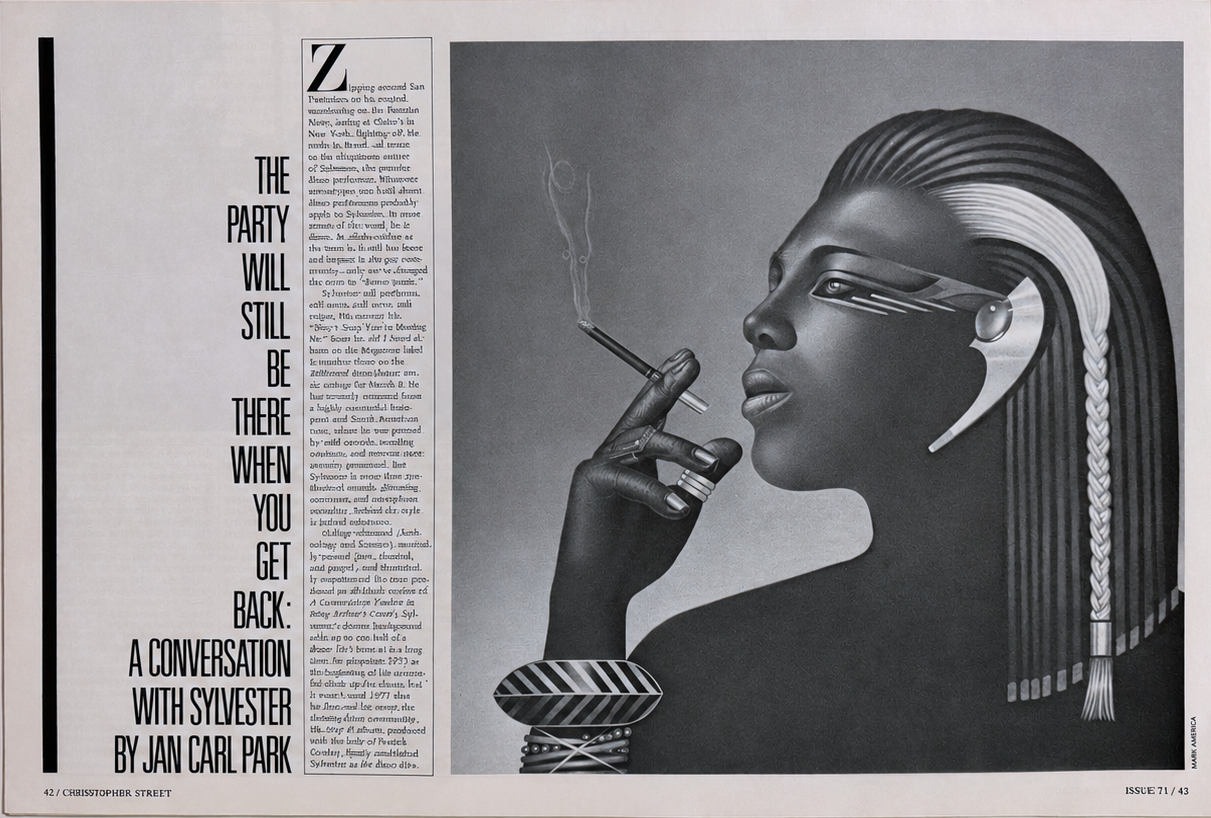
College educated (Archeology and Science), musically trained (jazz, classical, and gospel), and theatrically experienced (he once produced an all-black version of A Connecticut Yankee in King Arthur’s Court), Sylvester’s diverse background adds up to one hell of a show. He’s been at it a long time; he pinpoints 1973 as the beginning of his successful climb up the charts, but it wasn’t until 1977 that his first real hit swept the thriving disco community. His Step II album, produced with the help of Patrick Cowley, firmly established Sylvester as the disco diva.
The introduction of the now common (in some cases all-too-common) synthesized sound provided Sylvester with a touring act that sounded, to everyone’s surprise, just like the record. Following the Step II album, which featured the hit singles “I Need Somebody To Love Tonight” and “Stars,” came a live album, Living Proof, with its top-ten tune “Can’t Stop Dancing” (guaranteed to put 1.5 miles on your pedometer).
I managed to catch up with Sylvester while he was in New York on a promotional tour of the All I Need album. Sylvester, open and frank, discussed at length the death of Patrick Cowley, a close friend, the producer of his music, composer of his hits, backup man in his touring band, and member of AIDS, the splintered gay community, cloneism, and conformity were all topics of an hour long discursive on the state of gay life.
Jan Carl Park: We’ve just been discussing your jazz background, and the fact that you are related to Billie Holiday and that your grandmother was a jazz singer. How do you think your audience would react to you if you stepped out of the dance music format?
Sylvester: I’ve tried to do that, but people won’t let me. When I’m touring with a band I do a lot of jazz singing and people are amazed that I can sit and sing softly with just a piano or acoustic guitar. People think my whole life revolves around disco music, but it doesn’t. I have a strong background in jazz, classical, and gospel music. I write my own music, play the piano, and practice the violin. I use my taped shows and club act to show people that I can perform other than disco music. In the middle of a disco set, I’ll have all the sound dropped out, sit down, and sing “A Song For You” and demand that the audience listen. It might seem strange for a person to be performing in a disco with just a piano, but people don’t freak out.
I’ve come to realize that I get more shit from queens than I get from anybody else on this issue. I do. I get this conformist shit from queens all the time. They always want to read me. They always want me to do it their way. I am not going to conform to gay lifestyle as they see it and that’s for sure—that’s the very last thing I want to do.
What do you mean by conforming to gay lifestyle?
Clones. This heavy homosexual thing. That’s why I’m not a big advocate of gay rights. Simply because you don’t go out in the world demanding your rights when within the community you don’t give them. So I say fuck them. I don’t care. You don’t go out and ask the world to give you everything that you think you deserve when within the community you have the leather queens who don’t like the jean queens and the black queens who don’t like the white queens, and the queens who don’t like beards, and lesbian women who don’t want to be gay-identified, and this bullshit and that bullshit. The community itself is so fucked up that I refuse to be bothered. Maybe it is a real bad attitude to take—I don’t know—I just don’t see gay people coming together.
Let me give you an example of how our community fucks itself over: when I go places and I see they are carding people at the door, or they are turning women away because they are wearing open-toed shoes, but they don’t card me or turn away Diana Ross with open-toed shoes, I stop right there and say, “If you are carding people at the door, you card me too.” I refuse to go into clubs that play that selectivity game at the door. If this game is going on I say bullshit, I’m not coming in your fucking bar. I don’t see where people get off on this “power trip” that they think they hold over people because ultimately it is the very people that come to the door that pay the doorman’s salary. It’s discrimination within discrimination that I hate the most.
That’s why I said what I said about gay rights—we’ve got to clean up our own house first. It seems ridiculous that nine times out of ten you can be accepted on the job even when people know you are gay when you can’t be accepted in a gay bar because you have a Lacoste shirt on. Let me tell you, my shows are all E.O.Q.—Equal Opportunity Queen—shows, because they are for everyone. I’ve stopped shows upon hearing that people were being hassled at the door—I will not perform at a place that discriminates or segregates against anyone.
In your opinion, what can give gay people a better, more united political position?
Fear. The only thing that will unite people is a threat. Anita Bryant and the Briggs Initiative motivated people to get over their bullshit and unite. But as soon as the threats were dealt with, the same separatist bullshit started all over.
Perhaps the issue of AIDS—the fear, the threat—will unite the gay community once more. Having lived with Patrick Cowley’s AIDS-related illness (pneumocystis carinii pneumonia), how do you view AIDS as a political issue?
Why must death be the ultimate thing to bring people around? When people first became ill due to AIDS, none of us took it seriously—not as seriously as the straight community is now taking it and using it against us. The gay community needs to be completely aware and to stop bullshitting. Everyone needs to be informed. They need to know what is going on. The community has to become aware of the seriousness of AIDS. They should be smart enough to see their friends and brothers dropping by the wayside. It’s one thing to read in the paper that someone else has it, but it’s a totally different picture when someone close to you, like Patrick was to me, dies from it. Or worse yet, when you have it, not knowing why, where, how you got it. It does not have to be that way.
I saw what it did to Patrick. I saw what it did to a healthy person. If people could just see what I saw. Patrick and I were very, very close. We grew up in the music profession together. We had the same circle of friends. We lived on the same street and always knew where each other was. When Patrick became sick we at first thought it was parasites, but he didn’t have parasites. He was ill but didn’t know what he had. He collapsed and was admitted to the U.C. Medical Center. His first stay in the hospital lasted four months. During this period he learned he had AIDS, but not KS or PC-pneumonia. After being bedridden for so long Patrick lost the use of his legs and couldn’t walk without the use of crutches. He lost so much weight that he looked like a little old man.
But he recovered. He left the hospital, he returned to work. He did the synthesizers and hand-clap backgrounds for my last album. He produced an album for Paul Parker. He then produced his own album, Mind Warp. He wanted to do more. He was in the studio constantly. We literally had to prop him up to work.
Patrick’s last album, Mind Warp, is filled with allusions to his death. Was it written with the intention of being a lyrical last testament?
I believe that the music reflected the place, or space, that he was in at the time. Of course, when you write music you are affected by what goes on in your life. With Patrick, knowing death was near, I feel it was his way of dealing with death. I believe it was his way of putting into words and music the termination of this part of his existence.
Did you and Patrick discuss his illness? Did he feel that his gay “lifestyle” resulted in AIDS?
Patrick and I went through all the feelings associated with death: hope, bitterness, sadness, and acceptance. Patrick’s lifestyle was not excessive. That was what was so amazing about the whole thing. Look, we’ve all been wild. We’ve all done whatever we do. I wouldn’t say Patrick fit into that category. Patrick once wrote a song called “Make It Come Hard,” it was about sucking cock in the bathroom, the baths, the holes, it’s really sleazy, but it was a fantasy song for him. He would play the song, sing along with it, and laugh.
Having lost a close friend like Patrick to AIDS, what would you say to the gay community about this illness?
Get out of the fast lane for a few minutes. Be just a little more aware of your body. Move over to the slow lane for a couple of days. Make sure you are healthy. Make sure your sex is right. You can learn to do things in moderation. That’s what keeps you surviving. In order to do what I do, I have to have time off. I have to have time to center myself, to get myself together. Don’t worry, honey, the party will still be there when you get back. ❡