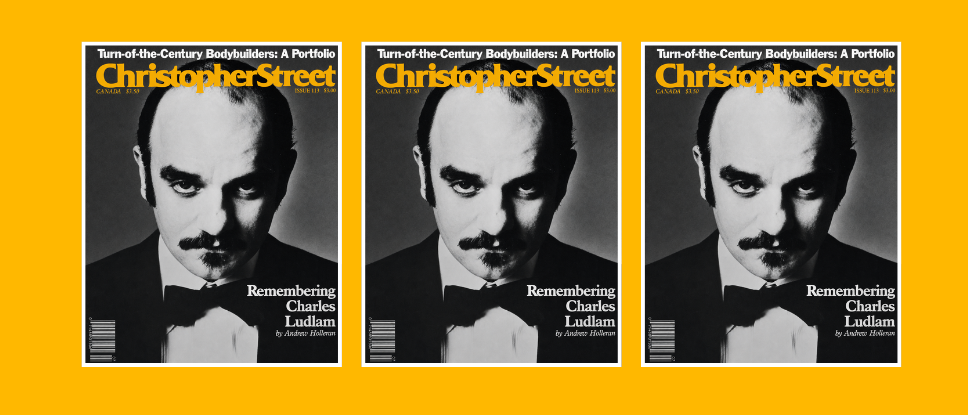
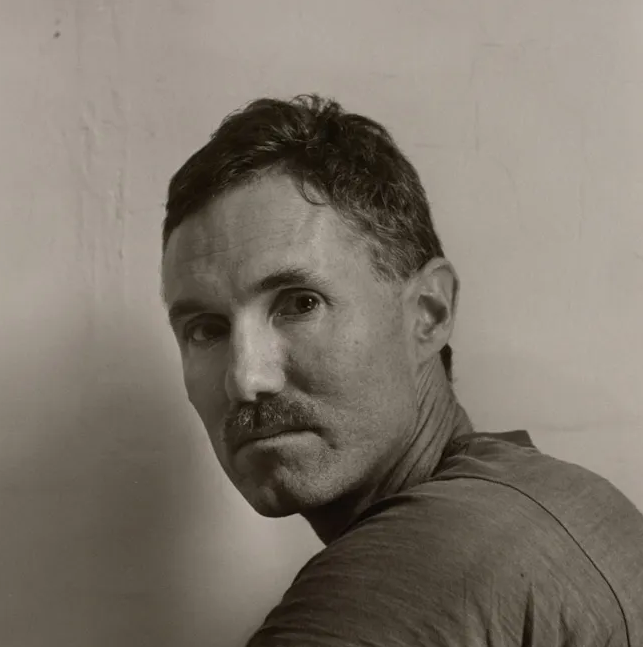
This article appeared in the July 1987 issue of Christopher Street.
ONE NIGHT IN 1970, I think, friends took me to a very small theater on Tenth or Eleventh Street to see a play called Hot Ice. It was a play about cryogenics, and it cost five dollars, I believe; no one explained what we were about to see, yet everyone I went with—people who had seen Turds in Hell or Bluebeard—had about them a certain air that implied there was no need to explain. I would soon see why one went to any play Charles Ludlam and the Ridiculous Theatrical Company put on.
At the time, I’d stopped going to the theater—mainly because the baths were far more thrilling, more dramatic, and cheaper than anything on Broadway—and because I basically agree with a friend of mine who said theaters should be shut down for ten years and be allowed to open after a decade’s darkness if, and only if, there was some justification for it. (And who got up during the second act of a play once and said—when I hissed, “Where are you going?”—“Home, to watch Masterpiece Theater.”) That was the problem. Sitting in a theater uptown, one was always wondering: Why did they have everyone drive in from the suburbs, get a baby-sitter, come uptown on the subway, for this? Why couldn’t we be at home in our underwear, watching this on TV? With Charles Ludlam one never asked these questions. Uptown, one found oneself observing people in their living rooms—or, as the “legitimate” theater continued to shrink from a news-clogged world it could not compete with, their dining rooms (Table Manners, The Dining Room), as if the family melodrama now sounded so distilled down to the single pieces of furniture (The Bidet). On the local five o’clock news you watched, as you dressed for the theater, a man walking a wire strung between the twin towers of the World Trade Center; when you got to the theater, you saw a woman cleaning her house before she committed suicide. That strange custom of applauding the set when the curtain went up (so often on a plush Manhattan apartment, reproduced to the last book on the library shelf) seemed as artificial as the plays on Broadway at the time; we might as well have been clapping for the designer rooms at Kips Bay, or the windows at Altman’s. At Hot Ice there was no curtain, if I recall; the stage, very small, depicted the laboratory of a mad scientist (the character that lay beneath, behind, within, it seemed, almost all the roles Charles Ludlam took on), and from the moment he came onstage, I knew something was going to happen.
Nothing is so ephemeral as a theatrical performance—it even differs from night to night—and, in an age when songs, concerts, films, books, the explosion of The Challenger, the inauguration of a president, can be reproduced over and over again, hoarded and stored, what Ludlam did on his little stage is remembered solely by people who happened to see him. Writing about him now seems dumb, like analyzing laughter, which no doubt Ludlam did, but never in front of us, onstage; in front of us, onstage, he simply induced it. He induced more than that, however; in any performance of Camille, half the people in the audience were sobbing and half were shrieking with laughter—at the same line. That was Charles Ludlam. In a country whose critics, and actors, are always bemoaning the absence of a repertory company, Charles Ludlam, and the Ridiculous Theatrical Company he founded, were just that: a place we could go year after year, to new play after new play, to be entertained. How he did it I don’t know. Proust had trouble analyzing Paris—Sarah Bernhardt vs. Berma in Remembrance of Things Past—and Ludlam was, like Bernhardt, just an actor. And playwright. And director. And designer. And—it would sound ridiculous, I suppose, if I said genius, but that was how I felt that night in 1970, sitting on the edge of my seat at Hot Ice, open-mouthed as any child at a Punch-and-Judy show.
Charles Ludlam did a Punch-and-Judy show, in which he took all twenty-two parts, and that was only one aspect of his theater mania: Nothing in the performing arts was foreign to him, or unused. Puppets, wigs, balloons, snoods, musclemen, fake fog, mechanical fish, daggers, goblets, vacuum chambers, flowers, and real flush toilets found places in his theater. His theater was very—theatrical. If someone had never seen a play in his life, he could have gone to Charles Ludlam and seen virtually all of theater encapsulated in one performance. Ludlam was comprehensive—pure theater. Which we were starved for—driven to his little group by the staleness of Broadway, the fatuities of a mass-produced, television-dominated, film-and-book-soaked century that gave equal time to the fall of Beirut and the fire in Michael Jackson’s hair started by a commercial for Pepsi-Cola. Drowning in what Godard said the West had simply too much of—Culture; on the lam from history, novels, films, the New York Review of Books—and none of them any FUN! Grenades ready to explode in our seats when Ludlam came onstage—pins pulled by this short, bald man with a big nose, large dark eyes, and a little girl mouth. There was something about Ludlam—no matter what the costume, wig, or role, he held you in thrall. There was an insane, cracked quality in this smoldering anarchist of kitsch that made him, no matter what the scene or part, the center of attention. Onstage he had the air of a madman, really, listening to some lurid music of the spheres the rest of the cast could not hear. This performer, who looked, on the street, like the superintendent of an apartment building on Jane Street, or a janitor sweeping up at a high school on the Lower East Side, or a salesman who sold trusses out of an office in midtown Manhattan, was, when he came onstage, an actor so charismatic, so in possession of his method, that no matter how bad the play—and there were a few one did not rush to recommend to friends—or how mundane the particular passage, one never took one’s eyes off him. Ludlam—and his gothic eyes—always seemed at the least perturbed; at most, as loony as Rasputin.
The greatest comedy has this element of madness, perhaps—the sense that we’ve shoved off, there are no limits, the actor is wacko. (Mel Brooks, not Woody Allen; Richard Pryor, not Bill Cosby. Never Bill Cosby.) Lunacy and cunning pulled Ludlam’s chariot with competing force. The saying “Life is a tragedy to those who feel, a comedy to those who think,” is too schematic, after all. Because most of us think and feel, if not always simultaneously, the pressure of the two creates an urge in some of us to just—lose it now and then. That’s what the cult of Dionysus was all about, and the city of Dionysus is where Theater started. You could lose it with Charles Ludlam. It would be pointless to subject Ludlam to a dissertation—he was too funny—and yet no one was more grounded in theater’s ancient roots than he; like a child running through the contents of his bedroom closet, putting on fake noses, mustaches, pulling out toy airplanes, little plastic gladiators, goldfish bowls, ray-guns, Cleopatra wigs, he always gave the impression of having assembled the particular play from a magic storeroom in which he kept, like some obsessed bag lady, every prop and character that two thousand years of Western history had washed up on the shore of a childhood on Long Island. If uptown you watched depressed people in their living rooms, when you went to the little theater that became Ludlam’s permanent home, you sat down before a palace in Carthage, a temple, a crypt, a tomb, a railroad station, a yacht cruising the Aegean with billionaire and diva taking the sun—everything but the living room: Instead of a hausfrau committing suicide, Camille in Paris, gayety times, other centuries, cultures, codes of conduct: the gamut of Western culture’s books, plots, and characters. Ludlam added subjects, when the theater was subtracting them, introduced new plays, when the houses uptown were dark for lack of original work, became more theatrical when most of the lore and craft of theater seemed to have slipped away to Hollywood.
Ludlam did make movies—even appeared in a television sitcom I tuned to once by accident—but his genius belonged to the theater. Theater was his subject. He mined past plays, for his exaggerations, intonations, looks, monologues, asides, settings, props. He made fun of all its pretense. Once Ludlam sat down on a toilet onstage in Stage Blood, delivered Hamlet’s soliloquy, stood up, pulled the chain, and in that single flush sent up every apartment erected on a Broadway stage. In Ludlam, realism was make-believe; make-believe was the joke (and the delight)—so that we gasped when, as a Carthaginian princess about to be put to death before her marriage in Salammbo, he raised his skirt to reveal what looked like a vagina for ritual shaving. And we thrilled when the cardboard train, he sliding onstage to deliver Galas (the diva whose first line, at the station café, was, “I’ll have the veal cutlet”). The make-believe train was the sort of thing children would be delighted by, but then that is what we all were, at a Ludlam play: children. Smart, jaded, ironic, sophisticated children, watching a magician dress up, caress, and bring to life again a theater whose corpse the “legitimate” theater was too sophisticated, too tasteful, too realistic, too something to rouse.
It seems that simple: Ludlam used theater—its most ancient, vulgar tricks—when no one else was able to. He did so, chiefly, by making fun of it. That was all he needed to give us entrance to realms one could no longer visit any other way. The god of originality in the arts, after all, is mean: One can no longer offer up on his altar a sonata like Schubert’s, a play in iambic pentameter, a poem like Keats’s. One can only write The Importance of Being Earnest once. (So today we get electronic music, and Julian Schnabel.) Ludlam found a way around the altar—had a key that unlocked the door of that chamber behind the deity in which all those heroes and heroines, villains and virgins (Camille, Bluebeard, Hamlet, Wagner, Callas—and Houdini) were waiting to amuse us again. The key, the rejuvenating alchemy, was Satire. Farce. A unique aesthetic in which the classic became avant-garde. Who else but Ludlam would have staged an obscure novel by Flaubert as a send-up of Hollywood epics about gladiators with the sort of chests that made Groucho Marx say he never went to films in which the men’s tits were bigger than the women’s? (Ludlam merely hired a group of muscle builders from a local gym.) Who else but Ludlam would have given us Camille? With such conviction—such art—that half the audience was laughing while the other half groaned, and what the audience was doing changed from moment to moment, line to line, syllable to syllable, as we followed the rises and dips of that incredible voice—that resonant, dark, wounded, demonic, sinuous, whimsical, whining, wheedling, imperious instrument.
Ludlam was above all a master of the punch line—the mainstay of Woody Allen—which punctured the balloon of High Art but fast. (When Camille is dying, her lover Armand ends a fond declaration of his love with the words, “Toodle-oo, Marguerite!” When Galas lists the reasons she wants to die, the last one is, “And there’s nothing on television tonight!” But the punch lines came only after we’d drunk rapturously of the Real Thing. One may ask, “What did we know of the Real Thing?” “Tragedy is dead,” said the critic. We could no longer stage this seriously. Our mother, too rational, too prosperous, too aware of genocide to care about individual fate. Why, then, did we sit rapt before dying Camille? Ludlam, all those years when the theater uptown was either Las Vegas vulgar or dead, was our only showcase of the bravura roles, the classic acting of a sort one could no longer find, in the Age of Realism—in a culture whose solution for grief is grief counseling, whose reaction to catastrophe is stress management and acupuncture. Ludlam played Tragedy. He played both Tragedy and Farce and refused to tell us which was which. He died onstage of tuberculosis, or heartache, and left us not knowing whether to laugh or cry, suspended somewhere (with parted lips) between the two, so that when he raised his gloved hand to his lips, as Camille, and coughed those three little coughs—just three—the audience both howled and stopped laughing altogether.
He also performed at a time when what was underground and what was homosexual were one—there was a whole decade, after all, between Candy Darling and Harvey Fierstein—and his two greatest roles were basically Tragic Drag: women whom fortune dumps in a rather rude way—Camille (whom Ludlam played more than once, a favorite he could always resurrect) and Galas. It seems now in retrospect that all art presupposes a certain health, leisure, freedom in which to laugh at things that in Life are actually horrid and brutal. We all could scream at the three little coughs which caused earlier generations to sob—or Galas’s lament, “Everyone I know is either dead or in Monte Carlo!”—because at the time we were worried primarily about our latissimus dorsi. Ludlam was described to me, in fact, that night I saw Hot Ice, as an ornament of gay New York—like the Loft, the Everard—pleasures of a segment of society that in 1970 was fun. In the theater that night were people who had come to the city, to work and play, for whom Ludlam was the adored genius whose next play (no tortured intellectual he, observing long periods of silence before he had something new to say; Ludlam put on plays the way bakers bake bread) was a piece of news joyously transmitted in the hallways of the baths. When Ludlam turned, in Camille, to his maid in a boudoir in Paris and said (in that ruminating, pathetic tone), “Throw another faggot on the fire!” whole ages of repression went up in shrieks. (“There are no faggots in the house, Madame,” the maid replied respectfully. And Ludlam, rising on one arm on the chaise longue to look directly out at his audience with that morose expression would say, “What? No faggots in the house?”)
There were lots of faggots in the house, of course—in bronzed, muscular habitués of gyms and Fire Island, in plaid shirts, muscles, and mustaches—and if everything Ludlam did was ironic, a double entendre of sorts, so were their lives, and Camille and Galas spoke to that. Ludlam was superb in a lot of other roles (Le Bourgeois Avant-Garde, Salammbo, The Mystery of Irma Vep), but there were plays I let run without making the effort to see, because they were merely satire, or, as a friend fumed one time when I asked how the new one was, “hardly high school.” (Some high school! What Bluebeard said might apply as a small understatement to Ludlam’s work: “When I’m good I’m very good, and when I’m bad, I’m ... not bad.”) Camille and Galas, however, were of another order. Drag is a profound joke—the fundamental homosexual joke, no doubt: the Woman at Bay, Wounded but Triumphant, lascivious or frigid, repressed or mad, rings all the notes, high and low. That which appalls the race in real life (change of sex roles) onstage enchains. Charles Ludlam was the greatest drag I’ve ever seen. It ceased to be drag, in fact, or acting: it was art. That mouth, those eyes—that voice, that fan! That insidious send-up of absolutely everything! That superb evocation of the classic, the romantic, the aristocratic. (Yes, aristocratic. The secret wish of every homosexual—the drag queen as Queen. Of the Universe.) We sat in our jeans and T-shirts in a city, culture, and century flooded with fake emotion and took Camille utterly seriously—the only way we could take it: as a joke.
Alas, the veneer of culture is quite thin, and make-believe no match for reality. The misery of nineteenth-century tuberculars is no longer a subject for exquisite farce; and this generation—for whom tragedy could be performed only as farce—is now having to separate them again, and put farce in the attic. Not only is Charles Ludlam gone, it seems, so is humor. One no longer can make jokes about death. One can no longer make jokes at all—the curtain’s down. Talleyrand is supposed to have said that those who never lived before the Revolution never knew douceur de vie—well, those who never saw Charles Ludlam before the plague missed some brilliant moments in the theater. Oh, were they brilliant. Oh, was he funny. Oh, is he dead. Oh, is this plague—ridiculous. ❡
Andrew Holleran is the author of the celebrated novel Dancer from the Dance (1978) and, most recently, The Kingdom of Sand (2022). He wrote a regular column for Christopher Street from the late 1970s through the early 1990s. [Andrew Holleran on Wikipedia]