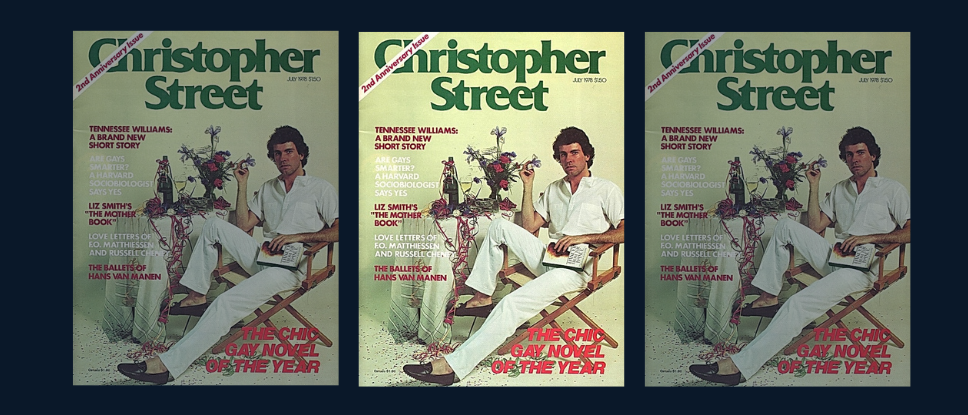
This article appeared in the December 1980 issue of Christopher Street.
IN LATE SEPTEMBER a new discotheque opened in New York in a theater that was once the Fillmore East. The irony of this is only slightly less keen than that of the plaque on the St. Marks Baths, which says, “This is the site of the last Manhattan residence of James Fenimore Cooper”—or that even as the Saint took over the Fillmore East, another trend which considers disco to be passé as rock now permeates the East Village. For on the sidewalk where more than two thousand gay men waited patiently in the warm night for a look at their latest discotheque is stenciled, amidst the myriad names of punk groups, the words “Clones Go Home.”
Almost a decade has passed since that first, small, and nearly mythic discotheque, the Tenth Floor, opened in the West Twenties. No one knew what disco was then. During the next ten years disco became, to put it mildly, a big deal. It became a profitable industry, it won an Academy Award, it spawned record companies and more discotheques than anyone might have predicted: from Paradise Garage to Flamingo, from Bond’s to the Underground, there are now at least twelve big places in Manhattan where a gay man can dance on a given Saturday night. The biggest of them all is Bond’s, and at Bond’s the dance floor is so large that one feels one is on the deck of an aircraft carrier. (To prove the theme of plus ça change, Bond’s began as a nightclub built in the Thirties, then became a clothing store, now once again a nightclub, disguised as a discotheque.) At Bond’s, dancing is not the thing: Bond’s is the thing. The night I stopped dancing at Bond’s to watch the gorgeous fountain, I knew something had happened: the special effects had finally upstaged the dancers. If we were all looking at the Dancing Waters, we were not looking at each other; we were not even listening to Grace Jones.
And not only Grace Jones. Bond’s is a fascinating study in the musical generation gap. Most evenings begin with New Wave music, which certifies the discotheque’s trendiness, but also clears the floor of one generation of dancers and leaves only young men in their twenties jerking like patients in the throes of electric shock treatment. Then the discare returns to disco music and the crowd comes back. Disco has been going through an identity crisis: it has to stay new, but if new means New Wave, it is no longer disco. New Wave is white, technological, sarcastic, and nasty. Disco is black, melodic, emotional, and erotic. (Listen to Donna Summer’s “Wanderer” to hear the problem.) While the punk crowd began gathering in the crummy and obscure rooms that gays used to come to, gay disco was being accorded palaces more and more deluxe.
Yet these past few years each lavish new discotheque has only embarrassed some of us, like the steak dinners your father bought you when you really weren’t hungry. Another laser beam? The music, in the end, was all that mattered, and the elaborate special effects were like the drugs people add to a sexual act they have performed so often they need something else to make it thrilling again. Another effect, another laser beam became the disco equivalent of the toasters and microwave ovens that new bank branches give away to people who open an account. They had nothing to do with dancing, which is, after all, a very unpretentious moment, of people forgetting themselves in the music. It can happen anywhere. Even the Sandpiper on Fire Island (a comfortable, beachy sort of place into which you wandered in and out with the breezes) turned into the new Pines Pavilion, which, when it opened, was commonly agreed to be “a big room in Soho.” The pavilion, like the Saint, is admirable on its own terms—the terms of the high-tech discotheque of the Eighties—and yet when we saw the video projected on its great white wall above the dancers, we could only think of the pornographic slides shown at the Eagle’s Nest, which provide yet another excuse not to look at the person next to you. One wanted to cry, “Turn off the bubble machine!”
We began to get critical, too, and found the music often inexplicably bad. There were nights at Flamingo when we stopped and said: “Wait! This is no accident! No man could play music this bad accidentally! He had to search out these rotten records.” For several years one heard better music in greeting card stores, baths, bars. Everyone was under pressure during the heyday of disco, including the discare. Getting on and off the dance floor several times a night was frustrating; it was hard to find thirty minutes of continuous dancing anywhere. Places got more crowded to boot, and friends complained after a night at Flamingo that they knew no one there. When you went alone to Flamingo, it was a lot like walking through the General Motors showroom on Fifty-ninth Street to see the latest Cadillacs: it was where people went to display the bodies they had worked on all week at the gym, to see people and be seen. Going dancing had also become expensive. Very expensive. (A guest at the Saint’s opening night confessed he had brought along a Quaalude, not for dancing but for the moment when he handed over a $20 bill to get in.) And, finally, it had become very late—you couldn’t go to the Ice Palace this summer until two in the morning at the earliest. So if dancing was expensive, crowded (gay life is more populous now: the gay Four Hundred at the Tenth Floor is two thousand at the Saint), unrewarding musically, and too damned late, what was the point? People began staying home on Saturday night so they could get up to enjoy the next day.
So when a friend called this fall to ask, “Which should I join, Flamingo or the Saint?” it seemed like the deadest of dead issues. The most demented dancer we knew had moved to San Francisco, a city that is sprouting big discotheques now also, but he moved there because, as he put it, “I don’t dance any more. You know what I mean? It’s all finished.” On the Island when someone said of the soon-to-open Saint, “They have a coat check like the ones you see at the dry cleaners,” his host only threw up his hands in disgust at the triviality of the observation. In one sense it wasn’t: standing in line for an hour to check your coat is at best depressing. In another sense, it was actually a measure of what discos had become. (As someone said the night the Saint opened, “I want them to show all four special effects in the first hour so I can go home. I have a date tomorrow.”) Somehow the technology of discotheques had come to a climax just as the immaterial—could one say spiritual?—essence of disco was fading. When we walked past the renovations at the Fillmore East this summer, lingering to watch the shirtless carpenters amidst the sawdust and the sound of drills, we wondered if it could work: another discotheque, ten years later.
Or the Saint, we knew, was the work of the people who had given us the New St. Mark’s Baths—the most popular in the city right now, the one you tell out-of-town visitors to go to. It is large, stylish, and efficient (all the things we imagined the Saint would be). Yet people had reservations about the Baths: like the new discos, the place is too big, too stylish, too efficient. Somehow the intelligence and talent had produced something like one of those brand new symphony halls with bad acoustics; it didn’t resonate. It was filled with gorgeous bodies, yet in the end it was impersonal and unerotic. At such places one felt like a consumer—a consumer of erotic love, of music, of sperm—but a consumer. We had all been swallowed up—we, the untouchable caste, lurking in slums, secret clubs, casual places—by the Gross National Product, the gay Chamber of Commerce. Bars had slide shows; baths showed porn films, offered Jacuzzis, fantasy rooms, and Rush; we had newspapers, magazines, huge discos, efficient baths. But where was I? Feeling more alienated each time I was lashed by another laser beam . . . which happened so often at Bond’s and the Underground that someone said, “These may be the first discos that can give you cancer.”
In fact it seemed too poetically just when we learned what happened one night this summer during a fire at Bond’s: the crowd kept dancing until the firemen pulled the plug because they thought the smoke coming out of the vents was an effect.
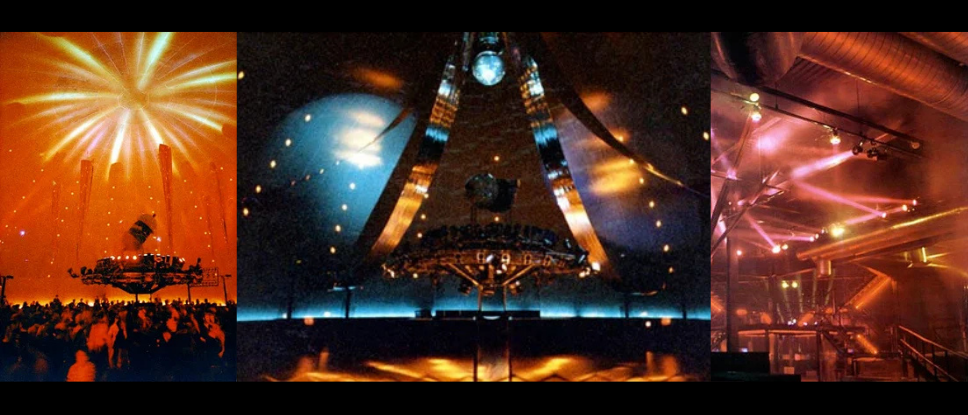
On the night of September 20, nevertheless, we were in line on Second Avenue waiting to get into the Saint. People were excited. A woman in a sequined jacket and pillbox hat arrived breathlessly along with a man in dinner clothes and said, “We’re friends of the Baron von Corvo and we’re supposed to meet Disco Sally here.” It was so bad it was touching. One had the feeling they had awakened in the night, dressed, and rushed to the Saint on nothing more than the news that another discotheque was opening. After being told that they could not enter, one suspected they would take a taxi to another opening and try the same routine again. The Saint, at any rate, was not for the crowd that climbs out of the occasional limousines in search of the successor to Studio 54. It was for the long line of handsome clones, veteran dancers, that stretched around the block at one point nearly to Third Avenue. We arrived at midnight, and when we left at four they were still out there, waiting patiently. At noon the next day some were still dancing. It would be easy for the purposes of this article, this reflection on disco, to say the Saint was not worth the wait—but it was. When the stars projected onto the perforated aluminum dome that covers the dance floor began to rotate, galaxy after galaxy, above our heads as Donna Summer sang, “Baby I want you,” there was nothing to do but throw up our hands and scream. It was glorious.
And yet, when I turned to a silent friend and asked what he had been thinking of during all these galactic splendors, he said, “The security guard.” ❡
Andrew Holleran is the author of the celebrated novel Dancer from the Dance (1978) and, most recently, The Kingdom of Sand (2022). He wrote a regular column for Christopher Street from the late 1970s through the early 1990s. [Andrew Holleran on Wikipedia]