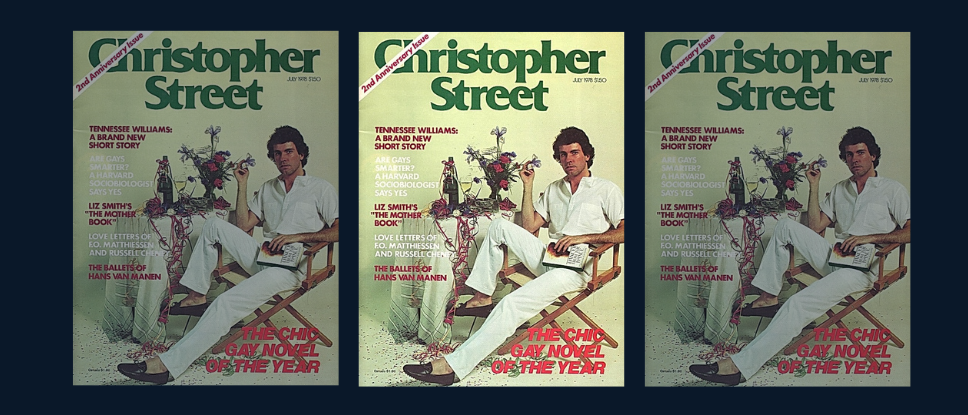

This article appeared in the April 1984 issue of Christopher Street.
HE WORE A BLACK T-SHIRT and faded jeans and he was not so good-looking he was threatening, but good-looking enough to resemble dessert. He had large blue-gray eyes and a shock of dirty-blond hair falling down his forehead and a mustache (conveniently) of the same color, and he was talking. He was the person who comes into the bar who wants to leave it in five minutes, if he can, with a trick. He was shorter than I—always a plus—and this added to the impression that he was swimming through the shallows, somewhere at crotch level, like a shark with one thought and one thought only: food. Everyone at the bar was engrossed in a television movie, but the young man—who could have been anywhere from twenty-five to twenty-nine (the golden age of Trick)—kept moving in and out of the bar’s two rooms, and the garden outside, not looking at the television, searching for companionship. His eyes, when they came into the light of the doorway and caught mine, were those pale, clear, luminous slates which anything might be written; the eyes of the Trick that say, “I am nobody. Who are you?” The tables were piled with ash children—on which we could draw something and, by picking up the cellophane sheet, erase it instantly and return the table to a pale gray blank—are what he was, are what the Trick is. Write on me, he says, and then lift the cellophane and I’ll be ready for another to draw his picture on me. This expression gives nothing away because (a) there is nothing to give away; and (b) he doesn’t want to limit himself to a particular role, because if he does that, he reduces the number of potential tricks, and tonight he can’t take chances, tonight he must get laid.
When a man comes into a bar in that mood—so horny, as a friend of mine once said, your ass squeaks when you walk and you think as you’re trolling Fifth Avenue or the subways are making it their extreme honking—he often scares the horses. It is possible to be too horny. I watched him follow a short, plump, smoldering marshmallow in the garden—another man clearly on the prowl—but he got nowhere and returned to the bar. Then a battered, older man with liquid blue eyes entered, and the black T-shirt nodded at him, and I felt the curious deflation of knowing that he would sleep with any one of us, that whoever said yes first could have him. I totaled things up. On the plus side: If he were that horny, only one of us wanted really to leave with three physically dissimilar men, he would surely be gone, body-devouring sex. On the minus: he was a cheap slut. Seated on a barrel in the corner while he passed back and forth like Lady Macbeth (the sleepwalking), the ball of string we dangled in front of the cat to get her to grab at it and paw, I didn’t move. I couldn’t. I had a cold coming on, I was low, I had come to the point where I no longer spoke Trick. I’d had—a month before—my last dark stranger.
I hesitate to call him My Last Trick because I learned early in life never to say, stamping my foot in anger, “I will never come to this bar again!” Or, “That is the last time I set foot on Fire Island.” Or, “This is quite simply the last time I ever go to the baths.” I knew even then the words never and last had a magic power. To say you’d never return to the Eagle meant you were there the following Saturday. To say this visit to Fire Island was your last was to wonder, as the boat returned to Sayville, whom you could visit next time. To promise you would never pass beneath the arch of the Everard again meant you were there the next night. Never, last time, that’s it were shibboleths as potent as open, sesame. The only time you give something up is the time you are so indifferent to it you don’t even make the vow or use the word never. You simply forget to do it. The last time we do things in life, we are not aware till years later that it was: the last time we saw Bob, the last time we visited London, the last time we water-skied; years pass and then one day we realize I’ve never been back, and probably won’t, so that was, though I didn’t know it, my last time.
There were nights, of course, I wondered—would there come a time when I’d see someone out the door, turn to the cat, and say, “All right. THAT was my last trick. I’m stopping—with number one thousand four hundred forty-four!” Or wake him up the next day, or say to him just before he left, “By the way, you are my last trick,” and present him with an old toaster or an alarm clock? And my friend, when I opened the door, would ask, “Who was that on the stairs?” And I’d say, “That was my last trick.”
“You mean your most recent,” he’d say.
“No, the last one I’m ever going to have.”
He’d look at me, sit down, and light a cigarette.
“I’ve just decided there’s no point,” I’d say. “I’m not meeting anyone interesting anymore—I’m not falling in love. I’m just tricking, with people I’ll never see again. That was my last.”
He’d guffaw.
“I’m serious!” I’d say. “Tricking used to be rare and wonderful, but now the market is flooded and it isn’t much fun. Remember when only a few people tricked? Well now everyone does it. Tricking caught on. Most tricks—most people, let’s face it—are dull. Or worse, so used to tricking by now, they’re all professional tramps. It used to be something you did to find love, but now it’s something you do because you go to a gym and must be getting in shape for something. That was my last trick.”
But just then there was a knock on the door. I reached over and opened it: It was my last trick holding the toaster. “I’m sorry,” he said, “but I just couldn’t leave the building without knowing. What did I do that made you decide to never trick again?”
“Nothing,” I said. “You were fine. Really. You were a good trick. I can’t think of a thing wrong.” I took a deep breath and said: “It’s just that we didn’t—connect.”
“You mean—?”
“Nothing passed between us, there was no—emotion.”
“There was excitement!” he said. “You moaned.”
“There was excitement, but no emotion,” I said. “There was no—feeling. There was not even any—limerence. We did not even have a crush on each other.”
As my friend, seated as near the kitchen door as I, suddenly kicked his foot out and slammed the door in his face. I was horrified. “You don’t treat people that way!” I screamed.
“He wasn’t people,” he said, “he was a trick.” I opened the door to apologize, but there was no one there. I went out into the hall and called—on his name, because I wasn’t sure what it was, but “Come back!” The clatter of his feet going downstairs, and the slam of the door to the street, preceded me by two landings all the way down. I considered running out after him, but had to consider the fact that in a crowd—especially in the ghetto—he would look like a lot of other people. By the time I reached the fifth floor again, I was panting and even more angry with my friend. “You are precisely the problem!” I yelled when I sat down across the kitchen table from him. My friend said impatiently, “He was just going to stand there and dither.”
You answered his question, what more could you say? He was obviously bad sex.
“Why do you say that?” I said.
“Well, why else wouldn’t you see him again?”
“I just explained why,” I said.
“Then we’re back where we started,” he said.
“That was my last trick,” I said.
“But what will you do?” he said. “How will you live?”
“If I stop tricking?” I said. I paused. “Actually, I don’t really know. I don’t know what I’ll do with my time now. I’ll have to rethink life—get a new program for living—find some other interest.”
“But what, you bozo?” he hissed.
“Well, I don’t know,” I mumbled. “Travel. Cooking. Theater. Fitness.”
“You sound like the feature pages of a newspaper. You sound like the department headings in a news magazine.”
“Religion. Books. I’ll read again—I haven’t had time in years. Tricking takes so much time. You think about it when you’re not doing it, and when you’re doing it, you’re wondering if he really likes you. I know it won’t be easy. I’ve tried to stop tricking before—it was like trying to leave a discotheque. You say you’ll wait for a good song to leave on and end up sitting through some lousy ones. And then, when the good song does come, it makes you want to stay for some more. It’s hard, saying that was my last trick.”
My friend sighed, expelling a stream of smoke, and looked irritated at me, then the wall, then me again. “You can’t stop tricking. Tricking is life. Tricking is the only adventure we can take that does not require a yacht, a Lear jet, and a Mediterranean island. It is life itself. And it is what we were made to do.”
“I used to agree with you,” I said. “When you first come out, it’s how you learn everything about yourself and the world. It’s the way you find your first lover, or at least how much rent someone is paying for a comparable apartment. But then you grow older, and as you become more of a person, with tastes, wisdom, appreciation, beliefs, you become less of a Trick. You go out and you think, There’s more to me than my sexual quotient. I’m a man. With a rich accumulation of detail. I can’t reduce myself to a trick. And you think it’s a terrible prison, a language with only one word, that we are forced to speak because we have no other. And it seems the most stupid, reductive, and sterile exchange between people there could possibly be. You lose heart. You finally say, This is getting you nowhere, give the man your toaster, and say, ‘You’re my last trick.’”
But my friend had not really been listening—he had used the time to mull over in his mind the problem presented. “Perhaps the truth is you’ve been tricking badly. You’ve been simply inept. Choosing the wrong tricks.”
“Evidently!”
“You’ve tricked the way women go through bathing suits in a bin in a bargain basement. As if all you can do is try the one within reach at the moment. Tricking cannot be done that way. You have to be smart. You must pick and choose.”
“Why why? Since anyone can turn into a lover,” I said.
“Nonsense!” he said. “That only shows you’ve had no idea what you were doing. You should know three things in tricking,” he said, holding up three fingers. “What you want, what you offer, how far you can trade up. Everyone wants to trade up in tricking.”
“I don’t want to trade up,” I said. “I just want him.”
“Describe,” he said.
“A lean, quiet man with glasses who’s bright. And calm. And has a good sense of humor. And loves me.”
“Oh forget it,” he said in a dark voice.
“Why?”
“It’s too specific,” he said. “It doesn’t exist. Or if it does, it’s married. The good ones are all married. They snap them right up.”
“But why don’t I snap them up? That’s the problem—why don’t my dreams want to marry me?”
He stared at me. “Would you marry your—” he said. There was a reverberating silence. The cat yawned—once, twice. A horn honked in the street below. “That is the question. The question everyone has to ask himself, and no one dares.”
“Well,” I said. “I think so. I hope so. Would you marry me?”
“Don’t be silly,” he said. “I’m your friend.”
“And there is the problem,” I said. “Friends get affection, tricks get good-bye.”
“No one said it wasn’t screwed up,” he said. Then he sat gloomily smoking for a while, and finally extinguished his cigarette, held his hands palm-up to the sky, and said with a shrug, “Maybe that was your last trick. Let’s go to lunch, then Canal Jeans.”
But of course it wasn’t—though I left the black T-shirt glowering like a B-movie actress in the corner of the bar, my period came later that summer, and I went out desperate for human contact. To stop tricking is to stop life, in some terrible way. You feel guilty when you let a trick go. What’s wrong with me? you ask yourself. Getting old? That was perhaps part of it. Sometimes tricking seems juvenile. Glowering in the corner of the bar that night, the black T-shirt looked like a junior high school I once went to, and which I walked past years later and paused beside to watch, through the wire fence, the kids playing games with each other on the field. It is easy to be funny about tricking and dangerous to be serious about it. But sometimes you’re peeved. I told myself I had a bad cold coming on the evening I left the black T-shirt unpicked up in the bar, but it was almost a month or more before the menstrual cycle hit me again, and I went out looking for—what other option do we have?—a new and inspiring person I’d never met before.
This time I was black T-shirt, but not so desperate and gloomy—I was calm, nevertheless, afloat on the incoming tide of desire, watching the Olympics in a bar. Love crystallized on a man nearly as indifferent to me as I’d been to black T-shirt. I followed him out into the parking lot, and he kindly asked me home. He was tall, rangy, lean, wearing glasses, intelligent, calm, and getting over the lover of two years he’d divorced six months before. The sex left me with the conviction he’d do nicely for the rest of my life. When it was over he said, “I have to get up at five tomorrow.” I took my cue. Last names were not exchanged. He put on a brown robe and gave me directions out of the city. Saying good-bye we hugged. When we went out onto the porch, he noticed two thick envelopes at our feet and bent down to pick them up. “They’re from my ex,” he said. “He must have dropped them here while we were inside, because they weren’t here when we came in.”
These envelopes were so plump I could not think them love letters—they had to be contracts, or applications to a university. My heart went out to the man who had dropped them off (was he watching us now from behind a hedge up the street?), because we were both now in love with the same man: the still center of the storm turning the envelopes over in his beautiful hands. What discipline I showed descending the stairs and entering my car! Whatever a Trick is, he knows what is expected of him. No toaster from this man—there would be others besides me. The night was cool and fragrant. The directions he gave led me faultlessly out of the city’s knot of expressways into the dark countryside—an extension, somehow, of his masculinity. As I drove home I wondered what the future held. Sometimes a trick puts you out of commission for a while—the memory so good, you wish to honor it, the encounter so fine there is little chance the next one will be anything but depressing in comparison. Or he may send you out again for the same reason a man with a hangover reaches for a drink the next day. You don’t know you’re a trickster till long after you’ve become one—like the man who realizes he is an alcoholic only when he finds himself facedown in the bathroom at eight in the morning when he is supposed to be dressing for work. “Do you consider yourself promiscuous?” someone asks one day, and you don’t know quite what to say.
When I got home the next day, I called my friend up and said, “Listen. I want you to help me fill out a form. I want to apply for a Guggenheim—I want a grant.”
“For what?”
“I want about two thousand dollars,” I said, “to answer an entire page of model and masseur ads in the Native.”
“Now you’re talking,” he said. “Come on over, and I’ll help you with the essay.” ❡
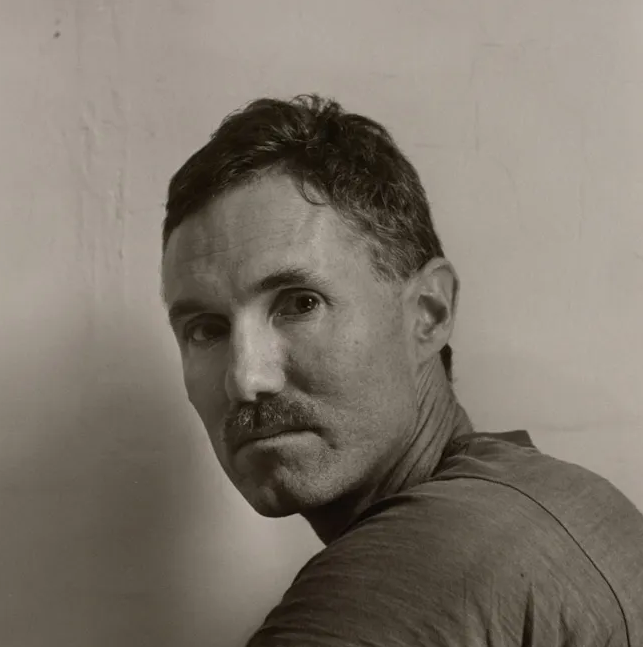
Andrew Holleran is the author of the celebrated novel Dancer from the Dance (1978) and, most recently, The Kingdom of Sand (2022). He wrote a regular column for Christopher Street from the late 1970s through the early 1990s. [Andrew Holleran on Wikipedia]