
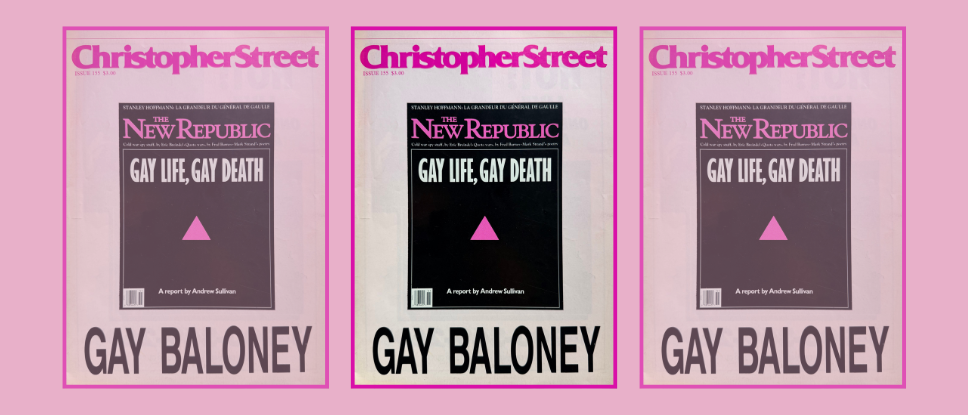
This article appeared in the January 1991 issue of Christopher Street.
THE EVENING OF January 22, Dan Rather looked tired—sleep-deprived, subdued; as if the magnitude and abundance of the news had overwhelmed even him. Even his fatigue was interesting, however. Though CBS has been in third place for some time now, I watch it partly because Rather is so bizarre a presence on the screen: those strange bug eyes, that odd, crazy ghost of a smile that usually appears at inappropriate times, the sometimes clumsy, tongue-tied, mouth-full-of-golf-balls speech that leaves one yelling, “This man can’t even talk!” On the evening of January 22, as the Aaron Copland-esque theme music faded (piercing high notes, connotations of a vast continent), Rather began to speak, when up popped a head between him and the camera—like one of those scenes in Zelig when Woody Allen inserts himself into some famous, serious, historical moment (Hitler, the Wright Brothers). The face said, “Fight AIDS, not Arabs!” and then was gone—as in some vaudeville act, when the hook reaches out and pulls the performer off stage. I was astonished. Rather cut to a commercial, then apologized later in the newscast for what he called the acts of “rude” people. Not as rude, I thought, as “AIDS.” ACT UP had zapped the evening news. The face on the screen that split second was that of a writer, John Weir, whose novel about a young man who comes to New York, loses at love, and dies of “AIDS” (The Irreversible Decline of Eddie Socket) I’d just read. His appearance on CBS (and that of other zappers on The MacNeil/Lehrer News Hour) were part of a “Day of Desperation” staged by ACT UP in New York, that also included disturbances in Grand Central Station.
The zapping of CBS was thrilling, comic, hilarious in its way, but when I saw Weir pop up between me and Rather, before the hook yanked him off camera, I had a sinking feeling the stunt would prove nothing at all except that someone could invade the CBS Newsroom at broadcast time. Which was sad—because it raised an important moral issue: i.e., if we can mobilize all those men and machines and nations to kill Saddam Hussein, why can’t we cure “AIDS?”
More than half a century ago, William James wrote an essay called “The Moral Equivalent of War” in which, decades before “AIDS,” he wondered approximately the same thing. How can we translate men’s martial energy to civilian problem-solving? James was struck by the contrast between the pride men feel in belonging to an army and the vague shame they feel as citizens of a mere “cosmopolitan industrialism.” It was “but a question of time,” he wrote, “of skillful propagandism, and of opinion-making men seizing historic opportunities” before we brought the romance and glamor of war to the moral shoddiness that pervades civilian life. All he could come up with, however, was a sort of Civilian Conservation Corps, to which “our gilded youth” would be “drafted off, according to their choice, to get the childishness knocked out of them, and to come back into society with healthier sympathies and soberer ideas.”
The epidemic has drafted off “our gilded youth” and knocked more than the childishness out of them; they’re gone. James wanted a moral equivalent of war because he hoped to preserve the martial virtues in society—discipline, selflessness, excellence—without having to kill other people. (Something William F. Buckley, Jr., also suggested last year when he proposed a universal draft; an idea I doubt Americans will ever accept for the purposes of character-building.) The war being waged by the people suffering and caring for the sick is not for character-building, however; it’s to save people’s lives. The war they are engaged in is one that has gone, like most wars, way beyond character-building; it’s ended up in despair and desperation. A Day of Desperation in New York seems to have captured the national imagination as much as James’s famous essay in 1910, or Buckley’s book last year—that is, not much.
There are those who would argue we do have a war on “AIDS” underway—so expensive that other sectors of the research community have recently been complaining that “AIDS” is taking more than its share of funds. There are those who say the war on “AIDS” is precisely the sort that is not susceptible to impatient demands of quick victories; the long, drawn-out, tedious sort we brought to a close in Viet Nam. A war that can be fought while the rest of life goes on, a war that—like all American campaigns since World War II—is not supported by the whole society, only a part of it. Or that it is naïve to expect a war on “AIDS” because (the ACT UP view in its extreme form) Americans do not care if gay men, blacks, Hispanics, drug-users, die. Or that the only reason “AIDS” activists say the country isn’t doing enough is that a cure has not been found. (Quite logical.) That people since the time of William James have been trying without success to translate martial energy into civilian reforms without success. Who knows? The point is—whatever the reason—till now the war on “AIDS” has been like most wars on disease: the sick crying out for help to a society that is itself healthy.
❡
That is the image on television, at least, where we experience wars now. The TV picture of “AIDS” is an aging clone with KS being examined by a doctor in a hospital room. The TV picture of the war in Iraq is a fighter pilot standing beside his jet describing how he hit his targets on his last run. Some competition. Like the War on Poverty LBJ declared, the war on “AIDS” is one of those campaigns the public is not roused by; like Viet Nam, one of those guerilla conflicts society wishes would go away. Like Korea, one of those battles being fought on the side, by a portion of the populace, while the rest of the country goes on with life as usual. (Indeed, in books like The Myth of Heterosexual AIDS, one sees the argument that if the epidemic affects only gay men, the country need not worry.) In an article by Andrew Sullivan in the December 17, 1990, issue of the New Republic, it’s argued that the war on “AIDS” has failed to unite even the communities most threatened by it—that, given the differences in political styles among any group of people, “ACT UP has inevitably alienated a whole group of gay men” so that rifts now exist. Rifts not only between people opposed to/in favor of radical tactics like the Day of Desperation, but between those who have tested positive for antibodies to HIV and those who have not. (The latter schism, Sullivan says, has not been mentioned in the gay press, but can be seen by anyone reading the personal ads.) Gay men have learned that “AIDS” is hard, not easy, to get, which understanding has produced, Sullivan writes, “a subtle, pervasive segregation among gay men.” The taboo against homosexuality in the black communities is so strong that black politicians and church leaders have failed even to mention the subject. In short, the war on “AIDS” has fragmented even the fragment of society fighting it.
 Andrew Sullivan
❡
Meanwhile, the country continues to sit in front of its television sets and watch the war in Iraq. The bombs reach their targets and explode, silently, on screen. The planes return, the technology works (unlike the “AIDS technology”: invisible, often disappointing, drawn out over years. The same week that Dan Rather is zapped, a man from Miami calls to tell me about a book he’s writing on the drug trials he’s been involved with in the past six years.) Furthermore, the “AIDS technology” does not blow things up (on TV). It’s not for killing people. It’s supposed to be for saving them, from the consequences of what the public still considers a venereal disease. No wonder it hasn’t tapped the gushers of patriotism that Desert Storm has, with all its surprisingly classic World War II overtones (letters to soldiers, blond pilots out of Top Gun being interviewed beside their jets, while maintenance men paint yet another symbol of a successful target run on the fuselage). Wars on poverty, wars on disease, wars on homophobia will probably never galvanize the audience the way the war on Saddam Hussein has. To date, it seems as if the only people calling for a war on “AIDS” are those who’ve lost friends to it, or who, as Sullivan describes ACT UP, are personally threatened. Even gay men, Sullivan implies, do not have to enlist in the battle if they think they’ve been spared. “The hopeful idea,” he writes, “that a community is being forged in the face of death is untrue, not because it is beyond the capacity of gay people, but because there is nothing as isolating as one’s own extinction. There is, ultimately, no community of the dying. There are only the dying.”
And even the dying have not been enough to produce a national consensus—an obliteration of every other topic, the way the war in Iraq has shelved every other subject (“AIDS,” the S&Ls, Lithuania). It’s been said for years that young men are dying before their time, that the epidemic has claimed more people than those who died in Viet Nam, but the fact seems to elicit little sentiment. (One wonders if the obituary page of newspapers like Update, in San Diego, or B.A.R., in San Francisco, should not be published, periodically, as a full-page “ad” in national magazines; perhaps then the magnitude of the waste would move people.) In this country, it takes a Ryan White to tap the tear ducts. For that matter, no one seems to care much about “AIDS” in Africa, either (though famine periodically gets a rock ’n roll concert); the news that a third of Zambia has been devastated by the disease does not get the same reaction the drought in Ethiopia does. Which makes all the more humorous and apt the name of a new publication some men in San Francisco have begun for people with “AIDS” tired of all the fatuities: the Diseased Pariah News. Those who don’t have to deal with “AIDS” don’t want to.
At the end of his essay in the New Republic—after describing not only the isolation of gay activists, but the estrangement of gay men from each other—Sullivan tries to find a silver lining in this gray cloud of fragmentation. For one thing, he writes, this very isolation has led to a “strengthening of gay identity,” and the knowledge that a new, less ravaged generation of gay men will replace the one that is soon going to be missing, and that it will surely gain something from the knowledge of the current horror.” (I wouldn’t bet on this.) For another, “We have gained subtle, private strength from meeting death in this manner. And there is the consolation that at least one myth about gay life, held by gays and straights alike, has finally been put to rest.” What myth? That gays are lonely. “It is an irony of the isolating nature of death,” he writes, “that it is also curiously universalizing. Gay men die like straight men die. Loneliness, it turns out, is not the condition of being homosexual. It is the condition of being human.” Small comfort, one is tempted to say. Hard cheese for Tony. Not really quite the isolation one would like: Since everyone dies alone, we’re all together.
A few years ago, Emmanuel Dreuilhe wrote a short memoir of his own battle against “AIDS” (Mortal Embrace) that paints the solitary nature of this struggle in a manner whose ending does not try to find anything uplifting in all this. Dreuilhe used a war metaphor throughout. He distinguished—as Sullivan does—among the degrees of personal exposure to “AIDS” that characterized the people he saw by comparing them to soldiers just arrived at the front, vs. those who have been there a long time, vs. those still behind the lines, living civilian lives. Reading Mortal Embrace, one gets a powerful sense of the fact that, at some level, each soldier in the foxhole faces Fate by himself.
Nor is there anything consoling about this; Dreuilhe’s keen ability to describe it, the book itself, is perhaps the only consolation. The war in Iraq only reminds one again how many people can remain at peace while a fragment battle for their lives. Even if “AIDS” proves, in the end, to be less like World War I than the Spanish Influenza epidemic that carried off millions after the Armistice, it still raises a moral question that the zapping of Dan Rather, the essay of William James, echo. Obviously, wars are fought out of self-interest. Apparently, the American public does not feel its interests are threatened by “AIDS.” And since this seems to them a crisis affecting a few constituencies only, the war in the Persian Gulf and the war on “AIDS” will remain two very different efforts no amount of metaphors will bridge; the only sort of war that gets people stirred up is the real thing. ❡
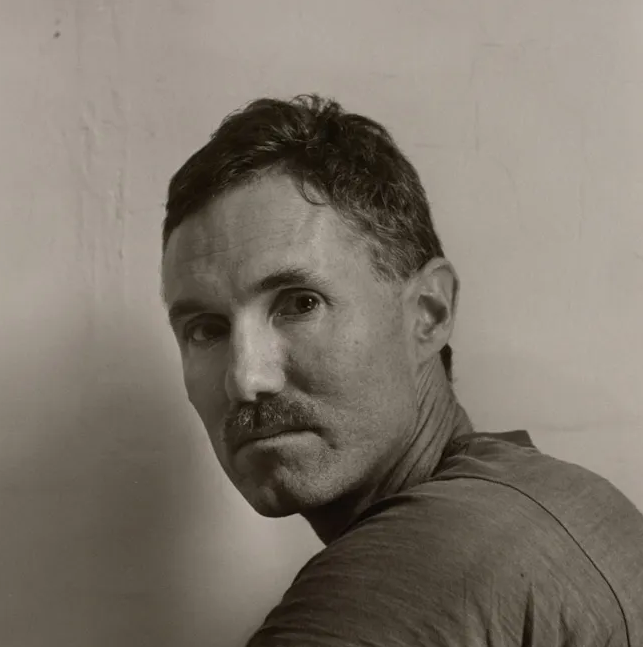
Andrew Holleran is the author of the celebrated novel Dancer from the Dance (1978) and, most recently, The Kingdom of Sand (2022). He wrote a regular column for Christopher Street from the late 1970s through the early 1990s. [Andrew Holleran on Wikipedia]