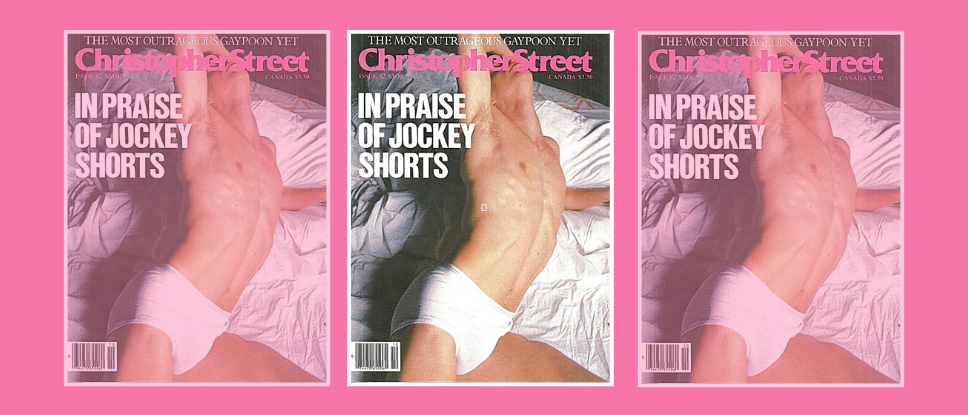



THE FLOWERING of urban gay male culture in the 1970s brought with it a heady new culture of casual sex and an agitated debate about what it meant. Charley Shively, of Boston’s radical Fag Rag, famously wrote of “Indiscriminate Promiscuity As an Act of Revolution.” Christopher Street, for which Fag Rag served as a kind of political foil, approached the new gay promiscuity with more ambivalence, playfulness, and irony. The magazine published the bemused, sex-addled Edmund White as well as the dour Seymour Kleinberg, whose thoughts on this subject we discussed in a previous episode. And then there was Andrew Holleran.
Holleran’s Dancer from the Dance is one of our canonical texts, but in this episode we consider one of his playful, gossipy columns from Christopher Street, whose format suggests a kind of Carrie Bradshaw avant la lettre. They open with a question, an observation, or a cliché—Is everyone in New York looking for a new apartment? Is everybody having threesomes now?—and proceed to report possibly-invented gay perspectives on this thing everyone is now supposedly doing.
In “Fast-Food Sex,” published in the April 1979 issue, Holleran reported hearing of a man in New York who was swimming against the tide of gay promiscuity:
Weary of sex even—yes, I’m not afraid to admit it: I was congratulating that man for having sex only three times in the past year. The last time I had been intrigued by a sexual confession (such a staple in gay life, one would almost prefer a companion to discuss nuclear fission) was when a friend told me of a fellow he had had to date nineteen times before he could kiss him. How marvelous that in 1979 someone would still refuse his person to another! For people aren’t refusing their persons much any more. In fact, grabbing a body is about as easy as going downstairs and buying a hamburger—which is why in San Francisco they call it “fast-food sex.”
The “man who dated 19 times,” as Holleran goes on to call him, becomes an avatar for his ambivalence about gay promiscuity and the yearning for domesticity that is a powerful theme of his entire oeuvre. Cheap and abundantly available, sex has supposedly lost its power to thrill or even to signify. Already at the peak of post-Stonewall gay life, we see the outlines of discourses that persist today in the perpetual rants against Grindr, “hookup culture,” and open relationships, as well in revived reactionary critiques of the sexual revolution and a yearning for a type of eroticism imagined to be lost. Promiscuity is held to blame for an alleged shallowness of gay relationality, for preventing the establishment of deeper intimacy and coupling, and on and on.
We love Holleran and his witty, queeny columns, but we’re not having it. In this episode, we talk about how promiscuity is made into yet another questionable binary: casual sex vs. intimacy and coupling, for example, instead of seeing sex as something that signifies differently in different contexts, part of different modes we move between in different spaces and seasons of life. “Part of being a healthy postmodern subject is being able to move among these different ways that sex can be,” Blake says in our conversation. “It can be romantic in a dangerous way, it can be romantic in a cozy way, or not very meaningful at all, which is fine, too. But the unhappy contemporary subject seems to feel stuck in one of these modes and is resentful about it.”
Casual sex may not be an “act of revolution,” but it’s not an act of alienation, either; it’s a distinctive inheritance of modern gay life that is ours to debate and to elaborate.
Listen to more episodes of Off Christopher Street
 David Sessions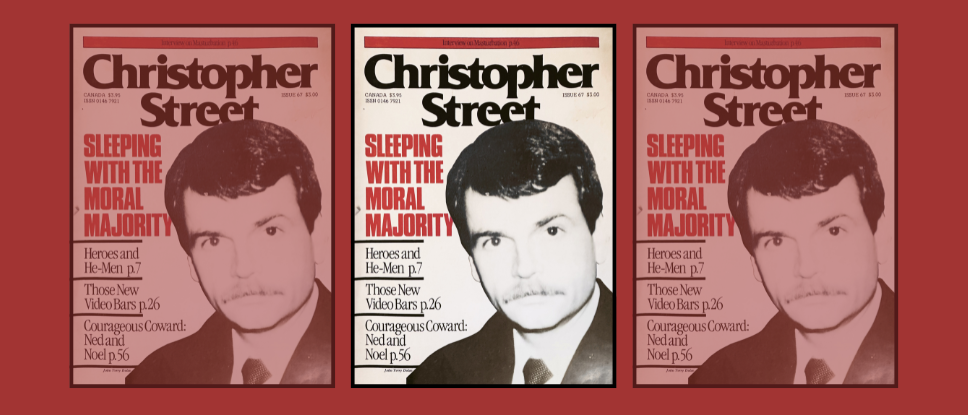
 David Sessions
 David Sessions