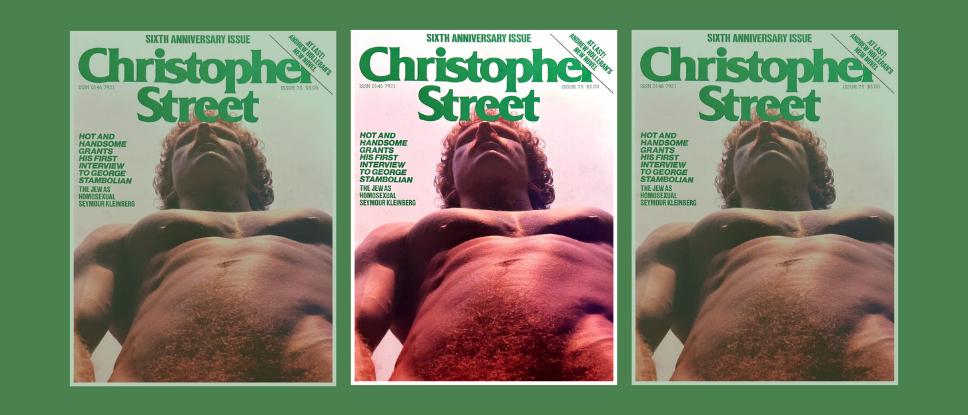
This article appeared in the March 1980 issue of Christopher Street, on pages 48-54.
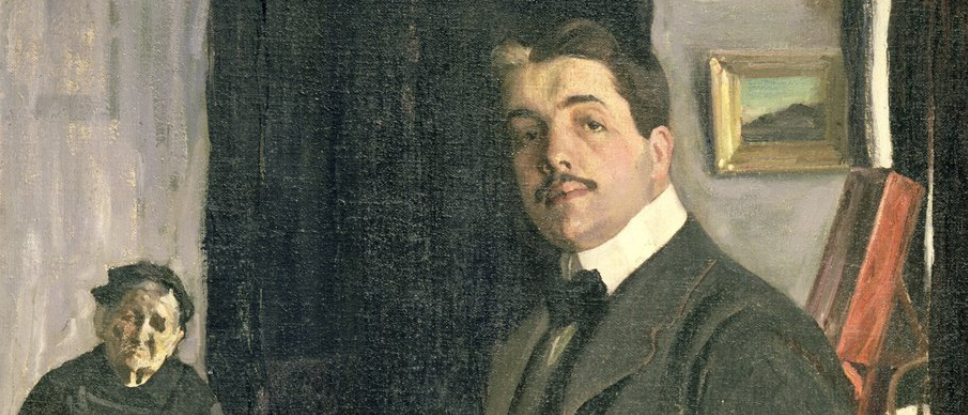
THE NAME OF Sergei Diaghilev is invariably linked with ballet in most people’s minds. In just what capacity is not always clear. When Diaghilev died in Venice in August 1929, people at newsstands in London and New York were heard to remark, “What a pity, I never saw him dance.” Of course, those better informed have long known that the bulky, heavyset Diaghilev was neither a dancer nor a choreographer. In 1951, a young art student named Jacqueline Bouvier (better known today as Jackie O.) won a contest sponsored by Vogue magazine with an essay in which she described Diaghilev as “an alchemist unique in art history,” whose specialty was achieving an interaction of the arts and an interaction of the cultures of East and West. The same essay cited Diaghilev’s ability to get the best out of his composers, designers, and dancers, and to incorporate it into “a unified yet transient ballet masterpiece.”
This view is not wrong. But it is incomplete, because it only takes into account Diaghilev’s activities from the time he became involved with ballet fulltime, that is, after 1909, when he was thirty-seven years old. This usual Western view omits his major impact on the arts in Russia between 1899 and 1909, a time when Diaghilev and a group of his friends altered the course of their native culture with their educational activities. In the Russian context, Diaghilev is a major figure in the history of literature, of painting, of philosophy, of music, and of all the other arts; it is not giving him full credit to restrict his significance to ballet (where he is admittedly very important) as the two recent books published in this country have done. (Richard Buckle, Diaghilev, Atheneum, New York, 1979; John Percival, The World of Diaghilev, Harmony Books, New York, 1979.)
Diaghilev’s story begins in 1890, when, at eighteen, he came from his home in the provinces to St. Petersburg hoping to become either a singer or a composer. He settled at the home of his aunt, a remarkable woman named Anna Filosofova, widely known at the time as a civic leader and prominent feminist. Friend to a number of important writers, including Tolstoy, Anna Filosofova was the sister of Diaghilev’s father. Liberal, and in some ways even radical, in her politics, she was married to a public prosecutor noted for his zealous persecution of political dissidents and revolutionaries. Somehow their ideological differences did not prevent this oddly matched couple from bringing four children into the world and giving them a warm domestic environment that was the envy of their classmates. Their youngest son, the tall, blond, and spectacularly handsome Dmitry, usually called Dima, was the same age as Diaghilev. He had just graduated from high school, where he was the center of an intellectual coterie of young boys that later became the nucleus of the World of Art movement and of the journal of the same name that Diaghilev edited.
Late in 1890, Diaghilev and Dima Filosofov traveled to Italy together. During that trip, they became lovers, a relationship that was to endure for the next ten years. It was his cousin and lover Dima and Dima’s circle of school friends who stimulated Diaghilev’s intellectual development and helped form his views on art and his artistic tastes. Dima’s classmates included two of Diaghilev’s future stage designers, Alexander Benois and Leon Bakst; the dilettante-musician Walter Nouvel, who was later to be closely associated with Diaghilev in his ballet enterprises; and Konstantin Somov, who became a famous painter in Russia in the early twentieth century (he emigrated to America after the Revolutions and was active in this country as a portrait painter in the 1920s and 1930s).
Like Dima Filosofov, Somov and Nouvel had been gay since their teens. According to the memoirs of Alexander Benois, Dima and Konstantin Somov had had a passionate love affair in high school, which was well-known to their classmates. Walter Nouvel carried a torch for the handsome Dima Filosofov for the rest of his life. While he never got to be his lover, Nouvel did remain a lifelong friend of both Filosofov and Diaghilev. Other members of this group, such as Benois and Bakst, were straight. What bonded together these young men of diverse sexual orientation from the age of about seventeen or eighteen was their shared interest in the arts and their dissatisfaction with the way the arts were perceived and written about at that time.
At the end of the 1880s and in the early 1890s, cultural life in Russia was politically polarized and artistically provincialized. On the one hand, there was academic stagnation: a taste for patriotic, storytelling painting; conventional, well-made plays with a bourgeois moral; Victorian novels. On the other hand, criticism was dominated by a school of critics who are now called revolutionary democrats in the Soviet Union but whom it is more meaningful to call radical utilitarians. Forerunners of present-day socialist realism, the influential Russian critics of the end of the nineteenth century demanded that art be socially relevant, address itself to current problems, be patriotic and strictly realistic in form. Their criteria entirely overlooked such values as originality or profundity. They preferred that the didactic message, which they saw as the aim of all art, be couched in familiar and accessible terms. Their insistence on topical relevance precluded any serious interest in the arts of earlier periods or of other cultures.
The young men around Diaghilev and Filosofov in the World of Art group saw both of those approaches to art—official academic and countercultural revolutionary—as equally limiting, provincial, and philistine. The aim of their association was mutual education and expansion of their cultural horizons. They quickly discovered whole areas of important art the critics of their time were ignoring: the Russian icons, church frescoes, and church architecture of the earlier centuries, which the art critics of that time thought backward and superstitious, not beautiful; in painting, the eighteenth-century and early nineteenth-century Romanticism, which were both held in contempt for supposedly lacking realism and social significance; and some recent Western phenomena, such as the Pre-Raphaelites in England, the music of Wagner and his followers, and, after some hesitation—it took them a while to recognize them—the French impressionist painters such as Degas and Monet. In the field of literature, the World of Art group was among the first to realize that the great Russian writers of the nineteenth century—Gogol, Turgenev, Tolstoy, Dostoevsky—were important not only as topical social commentators or indictors of the inequities of czarist Russia but also as magnificent and original literary artists each of whom had his own idiosyncratic vision of life that could not be fully explained by the catchall term realism.
By twenty-five, Sergei Diaghilev had come to realize he had no future as a musician. He had a pleasant singing voice but not of a caliber for a concert or operatic career. He tried studying musical composition with Rimsky-Korsakov and Liadov, but both told him he had no talent as a composer. Something of an apprentice to his lover, Dima, and Dima’s friends when he first joined the World of Art group, within a few years Diaghilev discovered his organizational talent, which made him the group’s undisputed leader. In the second half of the 1890s, members of the group made a few disjointed attempts to bring the universalist aesthetic of the World of Art group to public attention. Dima Filosofov published some literary criticism, Alexander Benois designed the sets and costumes for Wagner’s Die Götterdämmerung for the Mariinsky Theater, and Diaghilev edited the yearbook of the Russian imperial theaters, which turned out to be a triumph of typographical art. One of Diaghilev’s often overlooked contributions was to the visual side of books and journals, a fact that is very much recognized in the history of typography in Russia.
In 1898, Diaghilev put his considerable fund-raising abilities (which were to serve him so well during his later years as ballet impresario) to good use and persuaded two wealthy individuals to finance his pathbreaking journal, The World of Art, which he edited jointly with Dima Filosofov and which included contributions of other members of the World of Art group as art critics, music critics, designers of typographical layout, and illustrators. The journal was published for only five years, but historians of Russian literature, art, and culture—at least those in the West—see its appearance as triggering a major turning point in Russian cultural attitudes. D. S. Mirsky, the most authoritative historian of Russian literature, points out that between the 1860s and 1890s, literature and the arts were valued in Russia only if they expressed ideas that were considered currently relevant. This explains, for example, why such a major literary figure as Anton Chekhov had difficulty getting recognition. The reigning radical ideologues thought Chekhov lacked topical relevance and therefore judged him politically harmful. However, by the end of the first decade of the twentieth century, Mirsky argues, Russian society was aesthetically one of the most sophisticated in Europe. He gives the main credit for this to Sergei Diaghilev.
This two-pronged offensive against academicism and conformity, on the one side, and the supposedly revolutionary insistence on the propagandistic and didactic aspects of art to the exclusion of everything else, on the other, caused an enormous stir when The World of Art began publication. Attacks came from diverse quarters, right and left alike. The most usual accusation was that the journal was decadent, but it was also called sick, immoral, and antipatriotic. In the West, one often hears that Diaghilev was an art-for-art’s-sake aesthete, a view repeated in the two recent books on Diaghilev by the English dance critics Richard Buckle and John Percival. This is totally erroneous. The debate between art for art’s sake and socially engaged art had been argued in Russia and settled back in the 1860s. By Diaghilev’s time, it was a question of freedom to enjoy the great art of the past and to create a new art of the future without the restraining of simplistic party lines promulgated by narrow-minded and ignorant critics.
The World of Art and several other remarkable journals patterned on it between the end of the nineteenth century and the 1917 Revolution served as rallying points for the finest Russian modernist painters, poets, critics, and musicians of the early twentieth century. The literary section was edited by Dima Filosofov, and it was through his literary contacts that his relationship with Diaghilev came to an end. Among the prominent literary contributors to The World of Art was the important and innovative woman poet Zinaida Gippius (or Hippius), a key figure in twentieth-century Russian poetry, and a poet whose work influenced just about every other twentieth-century Russian poet. The first few issues of The World of Art serialized her travel account called “On the Shores of the Ionian Sea.” One of the chapters described her visit during the previous summer to the all-male gay colony in the town of Taormina in Sicily, centered around the pioneering photographer of male nudes Baron Wilhelm von Gloeden (his work has been rediscovered recently, and there has been much writing about him and reproduction in the gay press of his photographs of young Sicilian boys).
Zinaida Gippius and her husband came to be good friends with von Gloeden—she even describes an all-male dance she attended in his studio. As we know from her published diaries, that summer in Taormina was a pivotal juncture in her life. Since she was twenty, she had been married to the prominent novelist and critic Merezhkovsky, but it was a platonic, never-consummated marriage. She had romantic involvements with some other men and women, all of which broke off inconclusively because she could assume neither a male nor female sexual role. In most of her poetry, she writes of herself in the masculine gender, and according to some memoirists, she may have been physically hermaphrodite, with sexual characteristics of both sexes. Yet in outward appearance she was a very pretty and elegant young woman. Her summer with the all-gay male crowd around von Gloeden convinced Gippius that she was an androgynous man—that is, a man intellectually and emotionally but with a woman’s body. When she returned to St. Petersburg, she began searching for a male androgyne with the exact reversal of her traits as her ideal lover. Her choice fell on Dima Filosofov. With the willing assistance of her husband, she set out to break up the relationship between Diaghilev and Filosofov.
By the turn of the century, that love relationship must have been under some strain. Filosofov was getting more and more involved in religion and mysticism and also in the revolutionary ferment that was to culminate in the 1905 Revolution, which gave Russia a parliament and some shaky constitutional guarantees. Gippius and Merezhkovsky were also interested in mysticism and politics and used these shared interests to alienate Filosofov from Diaghilev. To keep Filosofov more securely within their orbit they joined some other literary figures in organizing the Religious-Philosophical Society, a series of meetings that ended the decades-old estrangement between the Russian liberal intellectuals and the Orthodox clergy. Several books have recently been written about this phenomenon, because the outcome was a new religious strain in Russian symbolist poetry and philosophy, a religious sensibility that affected Russian literature for the rest of the twentieth century, all the way to Pasternak’s Dr. Zhivago and Solzhenitsyn’s August 1914. In this area as well, Diaghilev had his impact, albeit a negative one, since the entire phenomenon of the Religious-Philosophical Society was organized in order to break up his affair with Filosofov.
Zinaida Gippius was mistaken in thinking that Dima was her ideal male androgyne. He was and remained a homosexual man. It is not likely that any woman, no matter how attractive, could have seduced him away from Diaghilev. But Gippius offered a package deal: not only herself, but her husband Merezhkovsky, to whom Filosofov was very much attracted, as well as a new kind of mystical and revolutionary church that the three of them were to organize to replace the existing Orthodox church. After a tug of war over Filosofov that lasted for several years and culminated in a physical fight (when Diaghilev caught Dima having dinner with Gippius at the most elegant French restaurant in St. Petersburg, the Donon, and tried to beat him up until the waiters pulled him away), Zinaida Gippius got her way. Filosofov moved in with her and Merezhkovsky. He stayed with them from 1904 to 1919, when he deserted them in order to fight the Bolshevik government with a group of Russian anarchists based in Poland.
As we now know from correspondence that has been made public, all ended up losers. Instead of her ideal androgynous soul-mate, Gippius found herself loving a gay man who, after a brief erotic fling with her, confessed that it nauseated him to be physically near her. Filosofov, who was hoping for a ménage à trois in order to win Merezhkovsky, learned that Merezhkovsky was unable to respond sexually to men (or, apparently, to anyone). Diaghilev lost what was probably the greatest, most formative, and longest-lasting love of his life.
The breakup of this ten-year relationship led to a drastic change in Diaghilev’s career and sphere of interests. There now seemed no purpose in publishing the journal he and his lover had jointly founded. In any case, it was then that The World of Art lost its financial backing. And there seemed no point in continuing to live in St. Petersburg, where Diaghilev ran the constant risk of encountering the man he had loved and lost in the company of the two people—Gippius and Merezhkovsky—who won him away. It was partly to be away from St. Petersburg that Diaghilev turned his attention to acquainting Western Europe with Russian art and music. In the years between 1906 and 1909, he organized a succession of exhibits in Paris of Russian art of all periods, as well as concerts of Russian music and performances of Russian opera. By 1908, Diaghilev and his other associates from The World of Art were planning a Russian ballet season in Paris, intended to highlight the choreography of Michel Fokine, the reformer of Russian ballet, whose work blended traditional ballet with modern dance as practiced by Isadora Duncan. At this point, Diaghilev met the man who was to become his next great love, and it was this encounter that sealed his commitment to ballet for the rest of his days.
That man was, of course, Vaslav Nijinsky. At the time of his first meeting with Diaghilev, Nijinsky was a promising young dancer at the Imperial Ballet, noted primarily for his elevation—the ability to perform high leaps. In his private life, Nijinsky was kept by a wealthy aristocrat, Prince Pavel Lvov, who paid his bills, bought his clothes, and was known to lend him overnight to influential elderly friends. This was something Nijinsky hated but went along with because Prince Lvov and was willing to do anything for him. For Lvov, Nijinsky was only one of a series of kept lovers, and he was looking for a pretext to get rid of him when Diaghilev conveniently appeared on the scene.
If Nijinsky was no more than an expensive toy for Prince Lvov, his love relationship with Diaghilev amply exemplified the finest features of the ancient Greek love between a teacher and his disciple. In their five years together Diaghilev developed a promising, little-known young dancer into the greatest male dancer the world has ever seen, a dancing actor of amazing depth and power, and an innovative choreographer who collaborated as an equal with the most important artists and composers of the age, among them Claude Debussy, Richard Strauss, and Igor Stravinsky. Diaghilev placed Nijinsky in the very center of the fabulous artistic projects he devised, had him participate in the creation of such durable masterpieces as Stravinsky’s Petrushka and Rite of Spring, Debussy’s Afternoon of a Faun, and Ravel’s Daphnis and Chloë, and had him dance as the partner of the greatest ballerinas of that time: Kschessinska, Pavlova, Karsavina.
They shared their life for five years, which were also the years of their shared artistic triumphs. Then, finding himself away from Diaghilev during an ocean crossing to South America, Nijinsky suddenly proposed marriage to a young Hungarian woman he hardly knew and with whom he had exchanged no more than a few sentences. There was a bisexual side to Nijinsky, which was bottled up during his years with Diaghilev but which now came to the surface. Diaghilev felt betrayed when he got the news of Nijinsky’s marriage. It was the Filosofov experience all over, with a woman stepping in once more and taking his lover away from him. But he still loved Nijinsky and still valued him as dancer and choreographer. Two years later they had a reunion in New York. Nijinsky arrived with his wife and daughter. Diaghilev was there to meet them with flowers.
Diaghilev had by then found a new lover in the person of Leonide Massine; he was willing to let bygones be bygones and wanted Nijinsky to dance for his company. But he had not reckoned with Romola Nijinsky. Always inept in practical matters, Nijinsky let his wife manage his career. Her idea of managing was to sue Diaghilev for back pay for the five years when Nijinsky and Diaghilev were lovers and shared their finances, or to threaten to call off a ballet performance unless Nijinsky’s fee for that evening was raised. The situation soon became intolerable, and it was made worse by the presence in the company of two Tolstoyan religious fanatics who kept assuring Nijinsky that his earlier relationship with Diaghilev was a sin and a crime against God. It was too much for a man of Nijinsky’s sensitivity, and he lost his mind soon after.
In looking over Nijinsky’s oft-described career, one realizes that there would not have been a Nijinsky without his relationship with Diaghilev. The popular legend of a Nijinsky exploited by Diaghilev, of a Svengali-like Diaghilev holding sway over the great dancer owes its origin to the writings in Nijinsky’s diary, made when he was going insane, and to the vindictive writings of Romola Nijinsky, who bore Diaghilev bitter hatred. The legend owes its acceptance to a combination of homophobia and a popular taste for melodrama. Instead of the reality of the brilliant man shaping and developing his lover’s genius for the sake of the art they both loved, people find more satisfactory to believe the version reflected, for example, in the famous 1940s film The Red Shoes, where the Nijinsky figure was changed into a woman (played by Moira Shearer) and the character based on Diaghilev was played as an irrationally possessive tyrant.
Leonide Massine was a sixteen-year-old dance student when Diaghilev discovered him. Unlike Filosofov, who was gay, or Nijinsky, who was bisexual, Massine was totally heterosexual. But he was willing to become Diaghilev’s lover for the sake of his career and for the artistic education he knew he would derive from the relationship. He had no cause to regret his decision. An unknown teenager when he met Diaghilev, Massine was one of the best-known choreographers in Europe when he ran away from Diaghilev with a pretty English dancer seven years later. It is remarkable how little the three women who took Diaghilev’s most important lovers away from him got for their pains. Zinaida Gippius got Filosofov, only to end up with a man who saw himself her prisoner and could not bear to touch her. Romola Pulszky got Nijinsky, only to end up with a human vegetable on her hands, for whom she had to care for the rest of her days. Vera Clarke, the English dancer who seduced Massine away from Diaghilev, found herself abandoned two years later and faded into obscurity.
During the last decade of his life, when he was in his fifties, Diaghilev had nonexclusive, nonpossessive love relationships with three remarkably handsome young men, affairs that overlapped in time and did not end in loss, as did the three great loves of his younger days. All three of these men were unknown and unformed artistically when they came to him and all of them had long and productive careers in the arts, lasting, as it happens, to this very day. The English dancer Patrick Healey Kay, better known by the stage name Diaghilev devised for him, Anton Dolin, appeared in some of Diaghilev’s last ballets and was a soloist with various ballet companies after Diaghilev’s death (including the American Ballet Theater in the 1940s). Dolin is still active in London theater life. Serge Lifar, a Russian who became a naturalized Frenchman, went on to a career as the premier danseur and choreographer of the Paris Opera, and he also wrote one of the first and still one of the best biographies of Diaghilev. Igor Markevitch, Diaghilev’s last love, is today one of the best-known orchestra conductors in the world.
Of course, Sergei Diaghilev served as mentor or patron or formative influence to many artists who were not his lovers or were not gay—straight men like Stravinsky or Balanchine, gifted women dancers, women choreographers, and even women stage designers. But as Igor Stravinsky was to complain somewhat puritanically in his old age to Robert Craft, the backstage atmosphere at all Diaghilev enterprises was unabashedly homosexual. Everyone who worked with him had to accept this openly gay presence. A symbiosis between homosexuality and art was something Diaghilev took for granted. As a very young man, he sought out Tchaikovsky a few weeks before the great composer’s death and established a friendship with him on the basis of their shared sexual orientation. Somewhat similarly, he met Oscar Wilde in Paris in 1898, just before launching The World of Art, in part to obtain some Aubrey Beardsley drawings from him.
But it is his personal involvement with the men he loved that can be said to be memorialized in much of his achievement. When histories of Russian literature and culture tell us that The World of Art changed the whole Russian cultural outlook in the first decade of this century, that fact stands as a monument to the love affair between two gay cousins, Dima Filosofov and Sergei Diaghilev, who created that journal and jointly formulated its aesthetic principles. If we look at the brilliant age of Diaghilev ballets just before World War I—the dazzling scenery and costumes that set the Western art world on its ear, the great ballerinas, the memorable music—we can see how it was all centered by Diaghilev around his lover Nijinsky. In the post-Nijinsky period, the remarkable collaborations—the Satie-Picasso-Massine ballet Parade, recently revived by the Joffrey ballet, the de Falla-Picasso-Massine Three-Cornered Hat, the Rossini-Respighi-Derain-Massine Boutique Fantasque—were created to highlight the talents of Massine both as dancer and choreographer. And the Balanchine ballets of Diaghilev’s final years, some of which are still greatly in evidence, such as the Stravinsky-Balanchine Apollo or the Prokofiev-Rouault-Balanchine The Prodigal Son, which Baryshnikov danced recently on public television, were originally vehicles for Diaghilev’s young lovers Serge Lifar or Anton Dolin.
Diaghilev is very much around these days. There are new biographies, there are exhibits of Diaghilev-inspired designs every few years, ballet companies from the Joffrey to the Oakland Ballet are arranging programs of homage to Diaghilev. It is impossible to turn on the radio without hearing Stravinsky’s Firebird or de Falla’s Three-Cornered Hat or Ravel’s Daphnis and Chloë or Poulenc’s Les Biches or some other ballet Diaghilev commissioned or inspired to help create. What is not always remembered is that while he was helping to give the world all this great music and dance and art, Sergei Diaghilev was also expressing his gay love for the men in his life. ❡
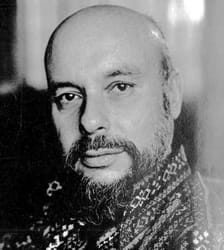
Simon Karlinsky (1924-2009) was a professor of Slavic languages and literature at the University of California, Berkeley. He wrote widely on homosexuality in Russian literature in Christopher Street and other gay publications.