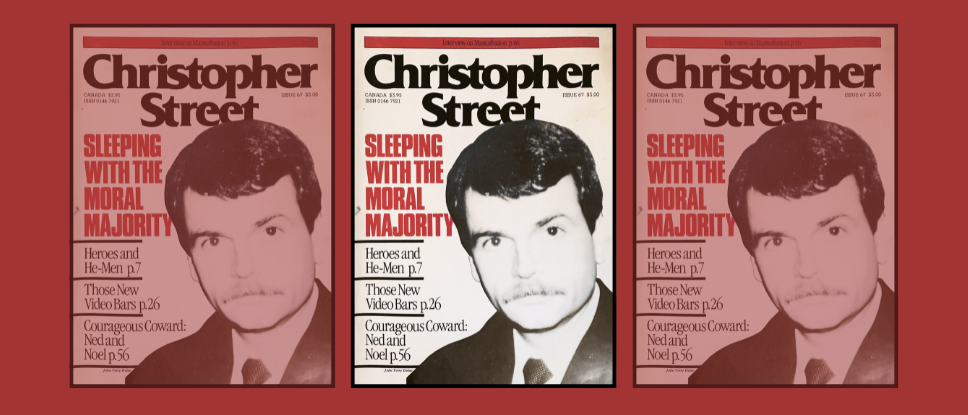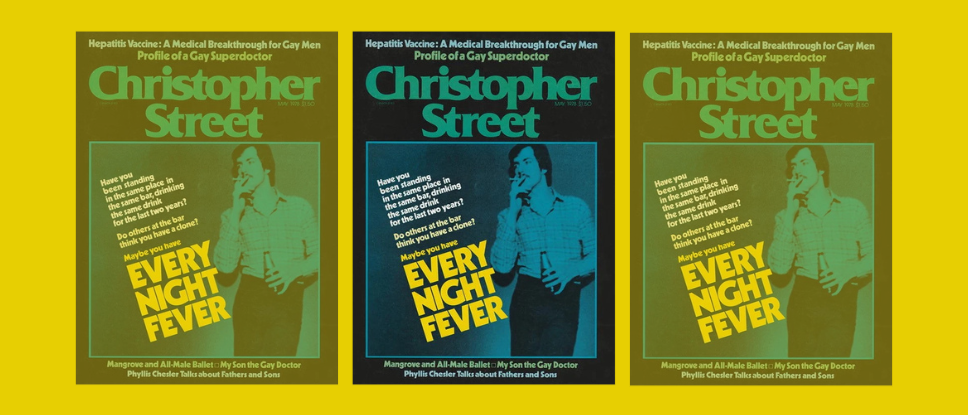
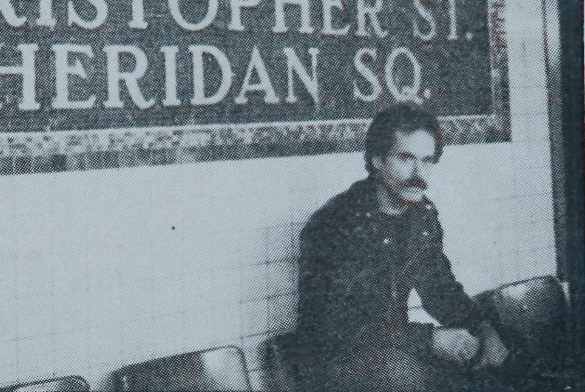
This article appeared in the October 1982 issue of Christopher Street.
I'M NOT SURE WHEN the sight of a clone began to baffle me—perhaps around the time the word “clone” came east from Castro Valley, where I presume it originated. (San Francisco slang has given us so many acidly accurate terms: Clones, Daddies, Muscle Pussy, Fast Food Sex.) A clone came to stand for a homosexual male with no individuality, no imagination, and no heart. But originally it was a visual tag. A clone was defined as a male homosexual in his twenties or thirties (if there was any age limit at all) who—I’ll give you my version—traveled in packs with other clones, had short dark hair, a short dark mustache, and wore Levi’s, work shoes, plaid shirt, and bomber jacket over a hooded sweatshirt. The jeans were faded and sometimes frayed in strategic places. Dark glasses were aviator-style and occasionally mirrored. Lately the work shoes have been replaced by black Patrick sneakers.
The look was never as hard as (and always distinct from) the look of leather. (In the early Seventies leather implied motorcyclers and S/M. Today it is worn by New Wave boys with bad skin and art directors in Ron Chereskin shirts and thin ties.) Clonestyle was not a soft look, certainly—especially when the dark glasses were mirrored—but it was more a middle-of-the-road version of the masculine homosexual style; it took its elements from sports, professions such as garbage collection, the military, rather than motorcycle riders. One found most of the clothes in fact at Army-Navy surplus stores and places like Modell’s, Herman’s, and Hudson’s. The bomber jacket varied, the jeans refined themselves into button-fly 501s, the work shoes became Patricks, handkerchiefs were added to the back pocket to indicate sexual proclivities, and in winter a woolen cap, but this uniform pretty much remained the same over the decade of the Seventies. I used to find these clothes myself—before they became a cliche, before I was aware I was assembling a uniform—at Hudson’s on Thirteenth Street and Third Avenue.

Today Hudson’s has bleached floors, and redesigned rooms, and merchandise for the affluent people who have colonized Fourth Avenue and wear goose-down parkas, and ski during the winter. But in 1971 Hudson’s was a decrepit, gray, and dingy place presided over by a gruff old man who refused to allow anyone but himself to operate the cash register. He seemed to me a carbon copy of the nasty old man who worked the desk at the Everard Baths in those days; which is where you would see the people you met at Hudson’s on a Saturday afternoon, later in the evening. It was all a closed circle in those days: Hudson’s for shopping, the Eagle for a bar, the Everard for a baths, Fire Island for a beach.
The men who began clonestyle were not themselves clones. They moved on to other styles by the time their plaid shirts and bomber jackets were the uniform of the large population of homosexual men who lived in Manhattan by the end of the decade. The men who began clonestyle were people who, ironically, prided themselves (consciously or unconsciously) on separating themselves from the crowd. Hooded sweatshirts had been purely utilitarian till they began wearing them; in the same way hospital furniture and office equipment were, until men used them to create the interior design known as High Tech. They not only introduced clonestyle, but short haircuts, moustaches, High Tech, and Disco: it seems remarkable, looking back, that these occurred simultaneously. But now and then you went home with a man with short black hair and a black moustache who lived in a loft furnished with industrial carpeting who hung up his Air Force flight jacket before turning on a light which illuminated a vase of gladioluses, a drawer in which he searched for his grass, his Crisco, his bottle of poppers: and you saw that it was all of a piece.
There was something anti-fashionable in clonestyle, nevertheless: they were interested, rather, in sex. The men who came into the Sandpiper on a fall evening in their hooded sweatshirts, bomber jackets, and jeans wore the sensible clothes any man would wear in cold weather. No one wanted to look “dressed”—that was the reason they stopped wearing Lacostes—and not a single thing they wore was either impractical or uncomfortable. They looked like suburban men who repaired telephones for a living, hunters, Dartmouth boys coming into a bar—which they certainly were not: some of them were art directors who lived in Chelsea.
❡
WHAT SORT OF PEOPLE were these fellows who began the style that became the cliche of the Seventies, these proto-clones? What was a proto-clone beneath his plaid shirt and hooded sweatshirt? Certain things went along with the look at that time—a good body, for instance. He went to a gymnasium and if he took drugs recreationally, he also took vitamins, ate high-protein diets, and began each day with a breakfast shake containing several raw eggs and a banana. The echt-clone neighborhood was Chelsea (with the echt-clone bar: the Eagle’s Nest). He belonged to a generation which was breaking away from effeminate homosexual cliches of the Fifties, and was as handy with a blueprint as with a score of Turandot. He traveled, redesigned his apartment, worked as a psychiatrist, doctor, art director, teacher. He used poppers and perhaps cockrings and went to San Francisco for New Year’s Eve. He was young on Fire Island before the Ice Palace was the place to dance on Saturday night, and the Sandpiper became the Pavilion. He had friends like himself.
These men happened to congregate in cities even if their clothes were, curiously enough, suited to the woods. The clones in the advertisements for Winston cigarettes were always rappelling down cliffs or cutting redwoods in the Pacific Northwest. (Whether the proto-clones dressed like the Winston man, or the Winston man was the inspiration of a proto-clone in an advertising agency, I never knew; but the Winston man is still, down to the last detail, a perfect clone—a definition of the term, in fact.) Yet few of those men left Manhattan except to visit Fire Island, Folsom Street, or Los Angeles. Yet the jackets and hiking shoes made for the forests of Washington State were perfect for New York, whose hard sidewalks, asphalt wastes, bitter January wind, and general grime distress what the trade calls “personal furnishings.” And because most of them roamed at odd hours of the night to odd parts of town, it was just as smart to dress down. One was perfectly attired for a wilderness not of trees and crags, but of parking lots and piers. The clothes made sense to an urban homosexual: they were impervious to the depredations of concrete and long hours of walking; they kept you warm; they worked.
Nothing in the realm of style lasts very long, however, and within two years this outfit was so formulaic that one evening while walking down Eighth Street I passed a man wearing it and thought: How odd. He put those clothes on to attract other men, presumably, and yet they have the opposite effect. They’ve made him entirely invisible: a non-person.
Yet in San Francisco clonestyle was so tyrannical at the time—as now, for all I know—that if you went to Castro Valley in khakis you weren’t unfashionable; you were invisible. You weren’t homosexual. Nobody even looked. At the height of the clone age, the Advocate put ads in our subways showing a bare-chested young man astride a ten-speed bike with a sweatband around his forehead. You prayed someone was just off-camera about to throw a cream-pie in his face. By then poppers were manufactured on assembly lines in bottles, Disco was an industry, discotheques enormous, Castro Street and the West Village lined with boutiques. It was eerie to find oneself in a room filled with handsome men in moustaches who all went to a gymnasium and wore plaid shirts. One asked: Is this the point? Did we all come to New York just to look, act, and talk like each other? (Which was when the anonymous wit in San Francisco christened them clones.)
These clones were certainly attractive—encountered individually on a streetcorner in Akron—but lumped together in herds they were as sexy as antelopes. Some of the men who began the look, the proto-clones, saw what was happening and discarded their plaid shirts just as they had once eliminated the Lacoste. They shaved off their beards and moustaches—often with unflattering results—simply because everyone now wore facial hair. Christopher Street became seedy and the proto-clones stopped going out to dance. Sex got reduced to something as formulaic as button-fly jeans. Finally boys from Long Island came into town with their girlfriends on Saturday nights in bomber jackets and plaid shirts, their keys hung on the right side of their belts, like homosexuals looking for a top man. And on the sidewalk of my block the words “Clones Go Home” were stencilled by a group called “Fags Against Facial Hair.”
❡
I WAS A CLONE MYSELF: I had straight, short hair and moustache, wore my Herman Chemi-Gums because they were good shoes, knew a hooded sweatshirt kept me warm beneath my jacket. But I would no more put all the elements of clonestyle on than I would have gone out in a dress. I didn’t want to be a cliché. I suspected that the clones I saw in the bars and discotheques were individual men with their own tastes, thoughts, feelings—but one would never know it, and after a while I began to think they weren’t. By the end of the Seventies nearly everything having to do with clonestyle was shabby. The clone himself became—as a new generation of clean-shaven, Fifties-inspired homosexuals moved into town—something of a relic. It surprised me one afternoon to see three clones on the boat to Fire Island so complete they looked like dolls—until I learned a few days later they were Spaniards vacationing in America. Unaware that the outfits were passé in this country, men from Madrid still wore red plaid shirts with leather thongs around their necks. A clone was as quaint as a hippie by 1982. His clothes hung on racks in Saks in expensive versions by Ralph Lauren and Calvin Klein: the real death knell of street fashion.
The Eagle’s Nest was still filled with what you might call clones, and it was still the handsomest crowd in Manhattan but that was because some elements of clonestyle coincided with a classic masculine look. But entering a bar like the Seventeenth Street Saloon in 1982 was like walking into a time-warp. The men were very attractive—clones usually are; that’s the joke—but there was a look of the past about them. By the end of the Seventies there was even something sinister about clones: an association with amoebas and opportunistic infections. I met the best-looking clones seated across from me in public clinics, doctors’ offices, waiting for our laxative to work. One came to associate a handsome man with stools in a paper cup. A clone was a person whose past made him a candidate for diseases no clone wants to get; the Seventies ended unpredictably in a doctor’s office.
Or is this too apocalyptic a version of the demise of clonestyle? The handsome man with the dark eyes and trimmed moustache is, after all, a universal image of the male lover. And just because a style becomes defunct through popularity, this does not mean—as with Disco—that it will not survive as it was before it was fashionable. Clones were always with us—my favorite is a photograph taken of Fiorello La Guardia in 1931: an unidentified man standing behind the mayor at a radio broadcast. The handsomest living clone left New York two years ago and now resides in Miami. But there are plenty left in town. Linger outside The Saint some night and watch the men assemble—more clones in one place than you’ve ever seen: a clone palace! They arrive in groups of six, and in groups of six one has to look at noses to distinguish them. Inside, standing by the dance floor alone, some of them are just what you’d like to go home with. But outside milling about on the sidewalk, they discourage the onlooker as much as they attract. How cold, competitive, it all seems! Within his clump of clones talking in bored voices, he waits in black leather on the sidewalk hoping he will not be approached by a panhandler, or drunk, or fellow homosexual asking him if he has a membership to The Saint. The clone queen puts on clonegear as if it equipped him with some atomic ray-gun—as if clothes were a substitute for personality—which he shoots Attitude as he goes through the streets annihilating pedestrians: Wonder-Clone.
But remember: clones are human beings, too—and a few days later, after witnessing their arrival at The Saint, you find yourself walking across town on a mild winter afternoon and see one coming toward you in a daytime dress. His face is open and inquiring. He is a sympathetic sight—one veteran of a decade silently recognizing another. I wonder as I look at his faded jeans, plaid shirt, hooded sweatshirt, mustache, and short, graying hair, why we do not change—when it would be so easy. Because this is how that generation views itself? Because the clothes are simply comfortable, familiar? Because he wants to identify himself to other clones? As he comes toward me on the sunny sidewalk I see a man immured in another decade. And I think: Perhaps every man, consciously or unconsciously, dresses as he did in his sexual prime to attract lovers. Time moves on, and the world sees us differently, but in our own minds we are an age we want to be eternally—even if it is contradicted by the date we scribble on our checks. After a while part of us grows old no longer. ❡