This article appeared in the September 1979 issue of Christopher Street.
“… the camera’s rendering of reality must always hide more than it discloses.” —Susan Sontag, On Photography
NEW YORK HAS BECOME a city where directions can be given based on remembered violence against gays. “Meet me at the restaurant where the cops threatened to beat us up and then gave us a summons for ‘jaywalking.’” “I’ll see you later, on the corner where Tim was attacked with rocks by kids shouting ‘Fag!’” “Let’s go for a walk in the park, where those guys with baseball bats attacked gays.” “Let’s have a drink at the bar where the bouncer beat Doug up for handing out leaflets about Cruising.”
Everyone thinks his or her incident is isolated. But at an ad-hoc town meeting to protest the filming of Cruising in the gay community this summer, the crowd of several hundred gay people was asked who among them had been assaulted or personally knew someone who had been assaulted recently because he or she was gay. Over half the people present raised their hands.
That is the New York in which William Friedkin set about filming a gay murder mystery.
It’s 1941. Let’s make a murder mystery in Germany with Jewish bankers for local color. Don’t tell me about the camps, about the isolated incidences of violence against Jews. My film is about something else.
“The camera is a kind of passport that annihilates moral boundaries and social inhibitions, freeing the photographer from any responsibility toward the people photographed.” —Susan Sontag, On Photography
Gays as Local Color
They come from New Jersey and Long Island. Actually, they come from all over. They walk down Christopher Street hand in hand, a little nervously but still in a bemused mood. Sometimes they stop to kiss each other, flinging their heterosexuality like acid into the faces of gay men passing on the streets. They shake their heads disapprovingly when they see two male or female hands touch. They don’t stop to buy drugs because they’re too busy shooting up superiority.
They have come into the city from the doubt of the suburbs to smirk and to slum. They need to see our neighborhoods as zoos in order to maintain certain notions about the “civilization” of their own.
“There is an aggression implicit in every use of the camera.” —Susan Sontag, On Photography
Setting Yourself Up as an Exception
When Cruising comes out in theaters you may find yourself having to explain (like pre-Holocaust Jews) that you are “respectable,” that you aren’t an uncouth ghetto homosexual, that you are an exception. In her essay “We Refugees” Hannah Arendt describes certain tendencies among Jews in the death camps “to interpret the whole accident as personal and individual bad luck.” You may find yourself having to make mystical statements about anti-gay violence when it happens to you. You may be forced to view history as a matter of fate. You may or may not be one of the lucky homosexuals who escapes. Statistically, you are safe. Everyone cannot be attacked on the same night.
The demonstrations this summer were politically important: The protest created a counter-image of connectedness in the gay community.
“Through photographs, each family constructs a portrait chronicle of itself—a portable kit of images that bears witness to its connectedness.” —Susan Sontag, On Photography
The New Political Stereotype: The Affable Homosexual
Harmlessness has become a part of gay urban charm. At a time when neoconservatives want to make harmfulness the gay urban image, we are seeing the emergence of a new political stereotype: the Affable Homosexual.
During a confused political period, like our mini-outbreak of history this summer in Greenwich Village, the affable are the most confused and try to turn their confusion into a kind of charm. The affable choose to make clever personal comments during times of trenchant political protest. The affable worry constantly about the motivations of the non-affable. During the protests against Cruising some of the affable wanted to know if the demonstrators had jobs (or were these more uncouth ghetto homosexuals?). The protesters disturbed the comity of the Affable Homosexuals’ image.
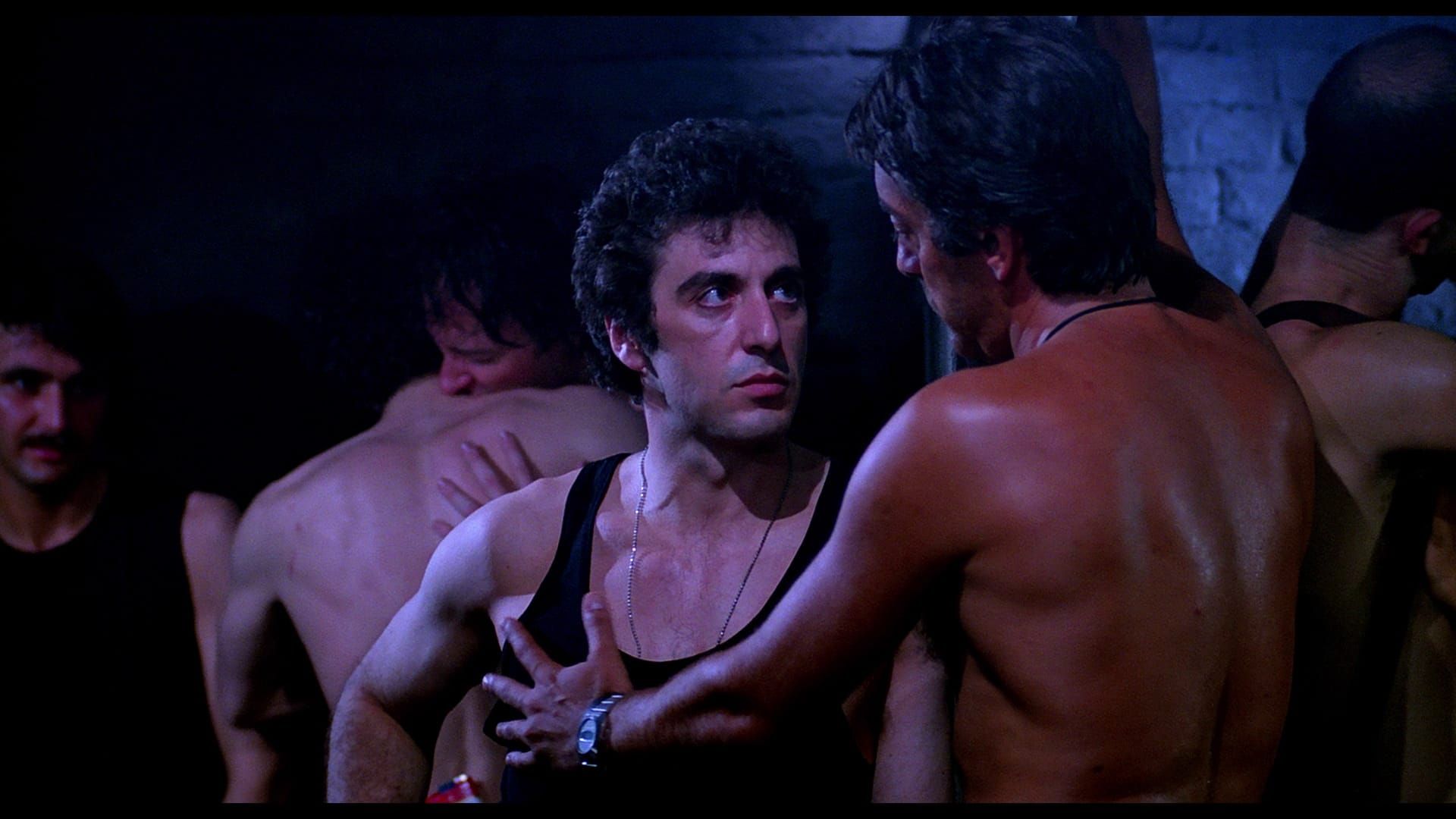
One Affable Homosexual talent agent said to me in an elevator: “Do you realize that they’ll make this movie a hit?” The affable seemed to see the whole Cruising affair in terms of budgets, overages, and Al Pacino’s career prospects. Many of the affable are never attacked on the streets. They take cabs.
Harmlessness draws the fury of the oppressor. Gay disinterest in gay power is a communal suicide note. (Hannah Arendt about the Jews in a similar political situation: “The Jews without knowledge of or interest in power, never thought of exercising more than mild pressure for minor purposes of self-defense.”)
The Emergence of the Performing Homosexual
“Whenever the enemy seeks control he makes a point of using some oppressed element of the population as his lackeys and henchmen, rewarding them with special privileges, as a kind of sop.” —Hannah Arendt, “The Jew As Pariah”
William Friedkin’s Performing Homosexuals acted like small grateful puppies at the master’s table. The master didn’t say “Bark,” he said “Cruise.” The master didn’t say “Roll over,” he said “Fistfuck.” The master didn’t say “Fetch,” he said “Fellatio.” Sometimes the master didn’t say anything at all. The puppies knew what to do.
Kevin McCarthy, one of the Cruising extras, in an article in the SoHo Weekly News, called what the master told them to do “acts of fellowship and union and love.” Another individual suggested that homosexuals will do anything to be in a movie. We now know their price. They will perform homosexual local color for $60 a day. During the shooting on the Lower East Side, some of these Performing Homosexuals called the protesters “radical fairies.” McCarthy gave us a good example of the kind of person Arendt describes as one who “begs from those he ought to fight.”
The Cruising extras were either too drugged or too ignorant to see that Weintraub and Friedkin were on the set with a sexual ideology that held them in implicit contempt.
“To take a picture is to have an interest in things as they are, in status quo, remaining unchanged (at least for as long as it takes to get a good picture), worth photographing—including, when that is the interest, another person's pain or misfortune.”
“... using a camera is not a very good way of getting at someone sexually." —Susan Sontag, On Photography
The Gay Love Affair with the First Amendment
Many of us who were born into the gay movement at colleges had our first political experiences defending our First Amendment right to form campus gay organizations. This continues to be a problem on many campuses across the country. We were using the First Amendment to stop gay oppression long before Friedkin and Weintraub utilized it to initiate gay suffering.
Homophobic liberal columnists who tried to dissociate us from our support of the First Amendment were engaging in a familiar pre-holocaust tactic: denying a people their history. Indeed, mocking our history.
The Superstructure Strategy
“To photograph is to appropriate the thing photographed. It means putting oneself into a certain relation with the world that feels like knowledge—and, therefore, like power.” —Susan Sontag, On Photography
One year it was Born Christians. Now it's a sleazy Hollywood project. Next year it will be the Born Nazis. The Superstructure Strategy is to exhaust the gay community. Synagogue filmmaking, like damage-control politics, intends to sap the community's strength.
In an essay in a new collection called Hannah Arendt: The Recovery of the Public World (St. Martin's Press), Bernard Crick discusses Arendt's understanding that before you exterminate a people you must "degrade" them—break their wills and erase hopes. The first goal is to trick the community out of thinking of itself as a community.
How clever to send the cameras into the ghetto. Make them pose on-sided images of uncouthness, then notice that partial picture to make them feel that they have somehow asked for anything that happens to them as a result of it.
“Just as the camera is a sublimation of the gun, to photograph someone is a sublimated murder—a soft murder, appropriate to a sad, frightened time.” —Susan Sontag, On Photography
In his essay on Arendt, Crick writes that "Minorities, like the Jews, thought it enough to be emancipated from formal restraints; it took them long to realize that, as it were, the price of freedom-from-restraint is not just vigilance but constant activity."
I think the coming together of the Village gay community on this issue was in part a way of telling the Jewish survivors of the Holocaust "We too have learned from your history. Your lessons have transcended your people." As Arendt said at the end of "The Jew as Pariah": "Only within the framework of a people can a man live as a man among men, without exhausting himself."
While William Friedkin and Jerry Weintraub ran around the city this summer trying to humiliate the gay community, I could have sworn I saw the framework of a people more clearly than ever before. ❡