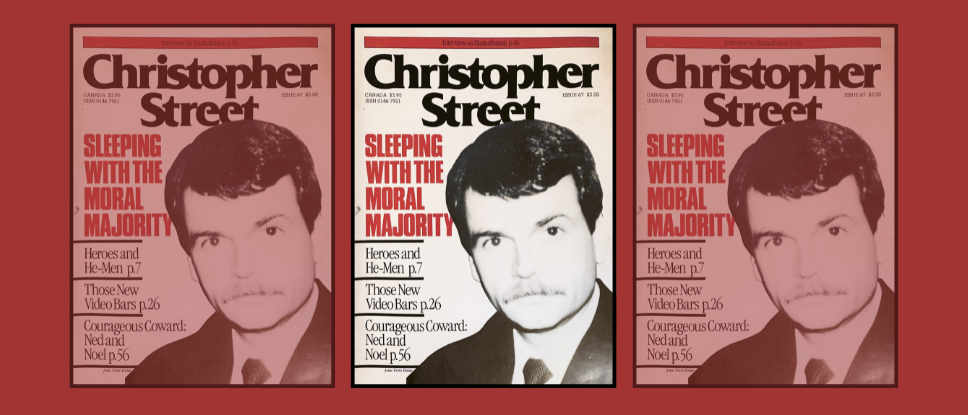
This article appeared in the August 1982 issue of Christopher Street.
WITH THE ARREST OF the John Birch Society’s most prominent spokesman of the late 1950s and early 1960s, former U.S. Army General Edwin Walker, in a homosexual encounter in a Dallas park, and of Richard Nixon’s unsuccessful appointee to the Supreme Court, G. Harrold Carswell, in a similar situation in a men’s room in Florida, it should be obvious that liberals hold no franchise on homosexuality. There is an interesting and important difference, however, in the kind of person who moves in a society that does not condemn homosexual feelings and another kind who is clearly defined by himself and his society as a deviant, but who places himself among the most rigid defenders of that same society—among those he should naturally regard as enemies.
Lucian Truscott IV examines such a character in Dress Gray, his novel about a homosexual cadet who is murdered at West Point. The deviant was the perfect cadet; the Spartan life of “don’ts” suited him much better than it did those whose lives weren’t so sharply defined. In telling him so specifically what he could not do, the society was also telling him what he could get away with. At the time, there were dozens of restrictions at the all-male academy against showing affection or having sex with a woman, but there were no such rules about doing the same things with other men. Roommates were “wives.”
I am told by several friends who worked and went to parties with them that many of the key people sent in by Ronald Reagan to plan his inauguration and the transition from the Carter administration were secretly but actively homosexual. During the Christmas–New Year’s holiday season just prior to the inauguration, they held several private parties. One that was described to me took place in the Foggy Bottom townhouse of a man who has been one of Reagan’s closest advisers from the beginning of his political career. Although he is married and has children, he lives in Washington with a male lover. The guests at his party and the others I heard about were all white, all male, and—except for a few young Democrats looking for work—all Republicans. Two handsome young California lovers arrived at the Foggy Bottom party driving matching sports cars and wearing identical shoes, slacks, shirts, ties, and V-necked sweaters.
The kind of stories that were told at these parties were the kind that little boys tell about getting away with breaking the rules. The thrill was that they were passing for straight. One man—known as “Reagan’s Capote”—came up with a flamboyant idea of having the military units in the inaugural parade march with American flags instead of rifles. The Pentagon was dumbfounded. “Why,” some military spokesman was quoted as saying, “we’d just as soon march down the street with our pants unzipped.” But, the gay revelers whooped, didn’t the Pentagon understand that this was exactly what Reagan’s friend would love to see?
All of these people are part of an underground society of very wealthy and powerful homosexuals, some of whom were at the heart of the earlier anti-Communist and anti-homosexual crusades of Joseph McCarthy, and all of whom are active in the new-right groups. Their true sexual identities keep them from any kind of public roles, but this vulnerability has also put them in touch with some of the country’s biggest sources of money, however corrupt. Like the women, Jews, or blacks who succeeded in spite of societal attitudes about their kind, these men have a stake in preserving their own oppression. They don’t see it as oppression at all. They see it as privilege conferred on them because they are special; if other homosexuals suffer from oppression, then they deserve it because they are so weak or just not clever enough.
It is the best of both worlds that these men enjoy. They are lawyers, real-estate men, construction contractors who—in terms of financial success—are at the very top of their professions. They have everything that money can buy, including a gay lifestyle in the midst of a disapproving (in earlier times, at least) world.
In Washington, a group of such men meets on a regular basis and stages lavish parties fairly often. They actually make up names for their little club, “the RPQs—rich and powerful queens” or “the Thirteen Richest Fairies.” The lover of one of them was handed two hundred dollars and told to prepare a party for the new Republican arrivals in town around the time of the inauguration. He laughed contemptuously at such pocket change, carried the money down to a male go-go place on Ninth Street, and gave it to one of the young dancers to come do a striptease for the Republicans. The liquor and food for the party cost several times that amount, and everybody got a laugh out of the lover’s introduction of the dancer: “This is just to show you that two hundred dollars can still buy something worthwhile.” The young man began to bump and grind and remove his clothes on top of the dining room table. One of the distinguished guests promptly turned away from the dancer and faced a wall until he had finished. “Why do you think he did that?” I asked a friend who was there. “Oh, it wasn’t the impropriety of it, I can assure you. I know him. He just felt that anything erotic should be kept in the dark.”
❡
A CHEAPER CUSTOMER—at fifty dollars a turn—of the young dancers on Ninth Street for many years was a young congressman named Robert E. Bauman. Born April 4, 1937, in the rural town of Easton (population 8,500) on the Eastern Shore of Maryland, Bauman had spent half his life on Capitol Hill. He started out as a page, worked as a congressional aide, and then was elected in a special election on August 21, 1973, to succeed a congressman who died in mid-term. A Roman Catholic, Bauman was a member of SS. Peter and Paul Church in Easton. In 1960, he married Carol Gene Dawson and they subsequently had four children.
Bauman was no mere conservative Republican; he was a militant fighter against any and all things liberal. He and his wife were both among the ninety-three founders of Young Americans for Freedom, and he served for a time as national chairman of that group. He was co-founder and national chairman of the American Conservative Union. As the energetic and aggressive head of these groups in the 1960s and 1970s, Bauman was one of a very small number of activists who decided on the issues and tactics and laid the groundwork for the new-right victories at the polls in 1980. The religious right, said a victim of one of their campaigns, “just took the same issues laid down by the ACLU and baptized them and called them ‘moral.’”
A short, scrappy fellow, Bauman saw himself as the feisty “watchdog” of the U.S. House of Representatives. Like Jesse Helms in the Senate, his tactics often served to embarrass his colleagues and slow down the legislative process, but they also served his purpose by constantly putting liberals on the spot with controversial issues through published roll-call votes. For no other reason than to get liberals to commit themselves in public, he would raise these issues, which would normally have been calmly worked out through compromises. He was so despised that once, when he stayed home because of the snow, his colleagues mustered up a quorum and forced through as many votes as they could. The conservative Americans for Constitutional Action gave him a perfect 100-percent score for his voting record, and so did the oil lobby. The National Council of Senior Citizens rated him zero.
In an exclusive interview with John Rees in the John Birch Society’s Review of the News, Bauman was described as the “bulldog of the House.” He said, “Anytime the House is in session, America is in danger.” Liberal Republicans, he added, were nothing more than “Democrats in drag.”
But in the 1980 elections, the year of the conservative and of Republican victories nationwide, Robert E. Bauman himself went down to defeat against an inexperienced young Democrat. The reasons why go back to the bars on Ninth Street where the male hustlers hang out in Washington.
The Maryland congressman was charged with soliciting sex from a teenage boy, after an extensive FBI investigation showed that Bauman was a prime target for blackmail. Although Bauman later denied it, the FBI report noted several instances where he had already paid blackmail. The mother of one of his sex partners had also asked Bauman to have another of her sons discharged from the navy after the boy got in trouble for going AWOL. At the same time, proceedings were begun in Baltimore against a twenty-six-year-old man who had worked as a street hustler in Washington since he was thirteen, the year he claimed he first met Bauman. They met at a sleazy bar in Washington, but the two were born just seventeen miles apart on the Eastern Shore of Maryland. This man had tried to extort two thousand dollars from Bauman by threatening to tell his family about his extramarital affairs. He was apprehended when an FBI agent posed as an aide to Bauman and heard his offer.
The newspaper accounts all mentioned Bauman’s anti-homosexual votes in the House. He was a co-sponsor of a bill that would amend the 1964 Civil Rights Act to allow employers to discriminate against homosexuals without federal interference; it would also have prevented federal interference in discrimination suits where homosexuals were involved. In July 1980 Bauman voted for an amendment that prevented the Legal Services Corporation from representing homosexuals; he had voted for the same measure in 1977, when it was defeated. Bauman was also among the original signers of the Family Protection Act, which contained a number of anti-homosexual provisions.
Bauman responded to the solicitation charge with an extraordinary statement that said, in effect, he must have been drunk and didn’t know what he was doing. “In recent years, I have had an increasingly serious personal problem with the consumption of alcohol. Last winter my drinking problem reached what I now realize to be the stage of acute alcoholism, although I did not know it at the time. . . . I have confessed my sins, as my religion requires, and I am in the state of grace and will remain so with the help of God.” The eleven-paragraph statement carried only this reference to the charge: “The charge involved is solicitation.” He did not mention homosexuality.
❡
MEANWHILE, BAUMAN’S longtime friend and physician, Albert Dawkins, back home in Easton, told The Washington Post: “I would not consider Bob an alcoholic. I define an alcoholic this way: when the use of alcohol interferes with the person’s productive life or his health, his ability to function. There is no evidence I know of in the lifetime I’ve known Bob Bauman that alcohol interferes with his productivity, his ability to function.”
Although his conservative friends urged him to resign, Bauman refused and continued to run for reelection. He did finally resign as chairman of the ACU—at the urging of William F. Buckley, Jr., among others. But he remained on the ACU’s national board of directors. Paul Weyrich of the Committee for the Survival of a Free Congress said, “It’s not that I don’t forgive him. It’s that he has brought dishonor to the movement in which he has been involved.”
After a few weeks of silence, Bauman called a press conference to announce that he’d been cured. “I do not consider myself to be a homosexual,” he said in answer to a reporter’s question. “I will not discuss the clinical details,” he snapped in answer to another question. “I don’t owe it to anyone but my God, and I have confessed to him and am going forward. I have changed. I am not going back to this grave problem in my life. I have not had a drink since May 1.” Bauman refused to understand that nobody really cared about his drinking, or more to the point—he was frustrated that the reporters wouldn’t follow along when he tried to shift their attention from his homosexuality to his drinking.
After a few weeks of silence, Bauman called a press conference to announce that he’d been cured. “I do not consider myself to be a homosexual,” he said in answer to a reporter’s question. “I will not discuss the clinical details,” he snapped in answer to another question. “I don’t owe it to anyone but my God, and I have confessed to him and am going forward. I have changed. I am not going back to this grave problem in my life. I have not had a drink since May 1.” Bauman refused to understand that nobody really cared about his drinking, or more to the point—he was frustrated that the reporters wouldn’t follow along when he tried to shift their attention from his homosexuality to his drinking.
Most of us who live in Washington were still telling jokes about a similar attempt by the congressmen involved in Abscam who, one by one, claimed they had a problem with alcohol and that must have been what made them take money from FBI men posing as Arabs.
At least one of Bauman’s supporters didn’t care what he did, as long as he voted right. This was Joseph Kesner, who had sponsored a bull roast for Bauman’s reelection campaign. He said, “If he was working with children where he was forming little minds, I might take a different view. But Bob Bauman, whether he’s a homosexual or whether he’s got four legs, expresses my views in Washington.” Kesner’s words, in my opinion, suggest that the attitudes in the hinterlands about homosexuals are not nearly so rigid and inflexible as many of the new-right leaders seem to think.
The solicitation charge against Bauman was eventually dropped after he agreed to go through a six-month rehabilitation program. Although he was defeated in his bid for reelection, Bauman’s conservative pals apparently accepted him as cured. He was hired by Trent Lott of Mississippi, the House minority whip, at one thousand dollars a week to instruct the freshmen Republicans on House procedures—using a manual Bauman had written on the subject.
❡
SUCH A PERSONAL CRISIS played out in public brings out the best and worst in small-town Washington. I mean, we all laughed at Bauman. The curious thing is that at the same time, another conservative Republican congressman found himself in a similar predicament over his homosexuality—and we did not laugh at him. This was Jon Hinson of Mississippi, a member of the national advisory board of the Conservative Caucus, who, it turned out, had been one of the survivors of a fire at a gay movie theater in Washington in 1978 in which five men were killed. Hinson’s involvement became public when he filed a deposition in support of the families suing the owners of the theater. It was a noble gesture that took real courage, I thought, and I wrote to Hinson and his wife and told them so.
Back home in Mississippi, there were dark rumblings that this would be the end of Hinson’s political career. But one of his supporters, W. D. (Billy) Mounger, an independent oil man, said: “You’d think a man who had acknowledged frequenting a homosexual theater would have been run out of Mississippi. But some folks would rather have a queer conservative than a macho liberal, and they may be right.” Hinson was reelected, but during his next term he was arrested during a homosexual encounter in a public men’s room in a House office building, after which he resigned. It was then revealed that he had previously been arrested on similar charges in a park in Arlington and at a bookstore in Alexandria.
A Democrat who went to the same Baptist church Hinson attended had also noted the difference in the way people responded to his troubles and to Bauman’s. He told me: “Hinson was a man with real problems and he hadn’t been up there demagoguing it on the subject; and he didn’t lay it all to alcohol once he got caught, either.”
Meanwhile, the Bauman jokes continued: he’s head of the “oral majority”; he was born on the Eastern Shore but reared in Washington; give him back his seat, boys.
There was one line in a Washington Post story that must have reflected a general attitude at the time. An Easton neighbor of Bauman’s said: “It kind of makes you wonder: Who else?”
Who else? I know of at least ten other prominent leaders of the Republican right who have either had sex with friends of mine or gone to gay parties with them. According to people I trust, there are at least twenty members of Congress right now who are homosexual; not all of them are conservative Republicans, but most of them are. This is not to suggest in any way that a man who is over thirty and unmarried these days is automatically assumed to be homosexual. In fact, most of the homosexuals I’ve mentioned are married. But that is an attitude that did exist in Washington in the 1950s, when more than ten thousand government employees were fired because they were believed to be homosexual.
The late H. L. Hunt—one of the great uncles of the new right—spelled this out in his plan for the reconstruction of the Republican Party through a “Public Service Education Institute” for candidates in the early 1960s. He said, “Prospects are needed, age twenty to sixty-six years. If a man is more than twenty-six years of age, he should be married and preferably the father of one to four children.” Hunt could use that as a measure, since he had fathered children by each of three wives. While still married to the mother of his “first family,” as Hunt’s biographer, L. J. Davis, calls it, Hunt married another woman in Florida and had children by her. He later fathered children by a third woman, whom he married after his first wife’s death.
In her book about Washington, Rita Jenrette speaks of two senators from the same state who are “big in the Moral Majority” and make a point of being seen with the town’s best-looking women, but are known to be homosexual. Paula Parkinson, the blonde lobbyist who created a scandal by talking about going to a house party with six conservative Republican members of Congress, was amazed that one of them wanted her to keep quiet because she felt the affair might help counter rumors that he is homosexual.
❡
DURING THE PEAK YEARS of the new right, one of the most widely discussed secret homosexuals in Washington was Terry Dolan, head of the national Conservative Political Action Committee. Long before Dolan’s homosexuality became a news story in mid-1982, I had known several people who had been to gay parties with him; I knew one man who had had sex with him; a young congressional aide whom I knew—conservative, Republican, homosexual—was one of his close friends. Every gay activist in Washington and New York, every political reporter in the capital, knew about what Dolan himself apparently thought nobody knew. I can’t imagine anyone living the way he felt he had to live for so long, but I still regarded it as his choice.
Even as I headed into his office one afternoon in the summer of 1981, I was not sure I would actually confront him with the fact that I knew he was homosexual.
All I could think about was the American Nazi Party spokesman who had killed himself immediately after a New York Times reporter told him the paper was going to print the fact that he was a Jew. I did not know—until Terry Dolan himself told me that day—that he was close enough to Jerry Falwell and James Robison to be included in this book about the religious right. Robison has suggested that “like cancer,” homosexuals must be removed from our society; Falwell is more careful with his language, but his message is just as clear.
Dolan is a member of the advisory committee of the National Defeat Legal Services Committee. While this group was set up to seek the destruction of the entire program of Legal Services, one of its specific complaints was that the group aids homosexuals and homosexual groups. Also, NCPAC’s national Conservative Foundation has challenged the FCC license of the Pacifica radio station in Washington, and among the complaints listed is that the station broadcasts programs by and for homosexuals. In a fund-raising letter for NCPAC in 1982, signed by Dan Crane, congressman from Illinois, are these words: “Our nation’s moral fiber is weakened by the growing homosexual movement, the fanatical ERA (Equal Rights Amendment) pushers (many of whom publicly brag they are lesbians). . . .”
At the January 1981 convention of religious broadcasters in Washington, Terry Dolan had been one of the featured speakers. He said, “I would make the point over and over that your movement is separate, that your motivations are vastly different than mine and [those of] the people I represent.” But he went on to say: “Now that does not mean we are not allies. We certainly are. I can think of virtually nothing that I do not endorse on the agenda of the Christian right. My guess is that there is very little if anything that the people on the Christian right don’t endorse concerning what we stand for.” Of course, homosexuality is at the top of every list of things the Christian right has declared war against, and the congressmen whom Dolan’s NCPAC has helped to elect vote right down the line in favor of every anti-homosexual proposal that comes up.
Dolan is a hyperactive, boyish-looking man with a trim body, neat dark mustache, and short haircut. Some would describe his as the stereotypical look in gay bars now. His dark eyes look right through you—and then wander here, there, and everywhere as he adjusts first one leg and then another up under him in the big swivel chair behind his desk. His is the office of one who lives to work. There are no pictures or mementos of family, no memorabilia of friends; there is no evidence whatsoever of any interest in art, literature, or music. There is one plaque on the wall, making Dolan an honorary citizen of Texas, signed by the Republican governor. There are two eight-by-ten photographs in plain certificate frames, one showing Dolan with David Stockman, the other showing him with Philip Crane, the erstwhile presidential candidate and new-right congressman from Illinois.
He welcomed me with a firm handshake, as if he meant it. He said he didn’t think of himself as part of the religious right, but he would be glad to answer any questions I had.
❡
JOHN TERRY DOLAN was born on December 20, 1950, in Norwalk, Connecticut. His father was then a manager for Sears, and now works as a fund raiser for a Catholic hospital. His parents were Democrats, but conservatives. His mother, Peg, converted in late 1981 in order to head up the “Republicans to Replace [Lowell] Weicker” in the 1982 Senate race in Connecticut. Dolan’s brother, Anthony, is chief speech writer for the President; his sister, Maiselle, is also on the White House staff.
“I was raised a Catholic; spent all except two years in prep school in Catholic schools.” He graduated from Georgetown University in 1972, and in 1979 completed work on a law degree through night courses there. “I was not a particularly strong Catholic in college. If there is such a thing, I’m a born-again Catholic. I believe in most of the basic tenets of fundamentalism… a more profound belief in faith than most Catholics are taught—less concern about ‘extra-biblical things than Catholics have.”
Dolan dates his conservative activism from 1974 when he saw what Richard Nixon was doing to the country—all in the name of conservatism. “I thought he was the most liberal president we’ve ever had, in terms of federal involvement in people’s lives. The bureaucracy increased in droves… when he came in we had 40 percent going for defense; it was down to 26 percent when he went out. The loss of Vietnam. The recognition of China.”
This was what Dolan told me about Richard Nixon. He admitted to another interviewer that his first political campaign had been when he was nine, in 1960, the candidate was Nixon. If he felt so strongly about winning the war in Vietnam, why had Dolan avoided military service? “I was in college during the draft and then afterwards in the lottery my name was nowhere near the top.” Did it occur to him to drop out of school and join up—as thousands had done in earlier wars? “No, well, it occurred to me, but now I’m glad I didn’t. I was supportive of the war, but not of not to win…”
The year when he became disillusioned with Richard Nixon’s conservatism, 1974, was also the year Dolan says he got interested in the Bible. He was working in the unsuccessful Senate campaign in Alaska for a member of the John Birch Society’s national council. Many of his co-workers were born-again Christians; one woman in particular helped spark a new interest in religion and reading the Bible.
In 1964, when he was thirteen, Dolan had worked in Barry Goldwater’s campaign for President. “That’s when I became familiar with a man named Ronald Reagan—his ‘rendezvous with destiny’ speech for Goldwater. . . . I still have a record of that and I still listen to it. In 1968, I went down to the Miami convention as a volunteer for Reagan, and I supported him in 1976 and 1980.” He was a member of Teenage Republicans and YAF in high school, YAF and College Republicans, and then the Young Republican Club. In 1975, he set up the National Conservative Political Action Committee with Charles Black and Roger J. Stone. Black had worked on Jesse Helms’s staff in the Senate; Stone had been identified during the Senate Watergate hearings as a political spy for Richard Nixon during the 1972 campaign. In 1977, Stone went to work for Arthur J. Finkelstein Associates, the polling company used by the new-right affiliates of The Viguerie Company.
❡
DOLAN’S NCPAC IS not only the richest of the political action committees; it is also the meanest by all accounts, including Dolan’s own. He has bragged that he could get away with any kind of distortion and this would never reflect on the particular candidate he was supporting. In his book, Viguerie praises Dolan as a pioneer in the “independent expenditure campaign.” In cruder language, Dolan figured out a way to get around the limits on individual contributions to campaigns. One provision of the 1974 campaign reforms allows for a group operating independently of the candidate to spend any amount of money it wants to. In other words, a Joseph Coors, for example, is forbidden by law to contribute more than one thousand dollars to the campaign of Ronald Reagan. However, Joseph Coors can give any amount he wants to a PAC set up independently to support the same candidate. As Viguerie puts it in his book: “A PAC called Conservatives for Reagan could legally spend five million dollars or whatever it could raise to help elect Ronald Reagan President as long as none of the PAC’s leadership was in contact in any way with Reagan or his staff.”
Such maneuvers by NCPAC were challenged in the courts, but the Supreme Court voted four to four—with Sandra Day O’Connor abstaining for unexplained reasons—and that left standing the lower-court ruling in favor of NCPAC. There is no way a reasonable person could possibly believe that amounts of money in the millions could be spent on behalf of a candidate and his staff wouldn’t be involved in the process. The presence of Terry Dolan’s brother and sister on the White House staff is solid evidence that he is much closer to Ronald Reagan and his top advisers than is ever publicly acknowledged.
Dolan himself confirmed my suspicion of his closeness to Reagan in a later interview with Larry Bush, a press officer and speech writer in the Agriculture Department during the Nixon administration who is now Washington editor for two gay newspapers, The Advocate and New York Native. Dolan explained to Bush that NCPAC was started in 1975 and “we were putzing along for almost a year and not doing badly. We were making state legislative contributions and a couple of federal races. And then when Reagan lost the Republican nomination, he took an interest in NCPAC and signed fund-raising letters that raised us, I would guess, eight hundred thousand or a million dollars in a period of about three months.”
“So,” Bush started to ask, “you really have a debt, as it were—”
Dolan interrupted: “Oh, no question about it. Well, not only a debt, but a long-standing relationship. I was for Ronald Reagan in sixty-eight when I was seventeen and seventy-six and in ’eighty. Charlie Black became the chairman of NCPAC, then went to work for Reagan. Roger Stone was the treasurer of NCPAC [and he] also went to work for Reagan—this is ’seventy-six. And then both of them worked in eighty again, so it was a very close relationship.”
In another case challenging Dolan’s “independent” expenditures, George McGovern’s 1980 senatorial campaign proved beyond any doubt in my mind—after reading specific allegations and documents at the Federal Elections Commission’s offices—that Dolan and his staff had participated in selecting the candidate who would oppose McGovern, and then personally participated in various stages of that campaign. The FEC ruled straight down the party line of its members; it was another tie vote, meaning there was no ruling for Dolan, but none against him, either.
Another bald attempt at getting around the law was made by Dolan in a reverse bribe offer to a congressman from North Carolina, a Democrat named Steve Neal. In a messenger-delivered letter on NCPAC stationery, Dolan had tried to persuade Neal to vote in favor of Reagan’s tax-cut package:
If you will make a public statement in support of the President’s tax-cut package and state that you intend to vote for it, we will withdraw all radio and newspaper ads planned in your district. In addition, we will be glad to run radio and newspaper ads applauding you for your vote to lower taxes. Of course, your constituents will be greatly upset if you say you support President Reagan’s tax cut and subsequently vote against it.
Sincerely,
John T. (Terry) Dolan
National Chairman
Neal was outraged by Dolan’s bullying and fired off a letter of protest to William French Smith, the Attorney General and Reagan’s longtime personal friend and political ally. Smith passed it to a subordinate who informed the congressman that no investigation would ensue because no money had been exchanged and so no actual bribe had taken place. But Neal fired back yet another protest letter to the Attorney General, saying that if he had accepted Dolan’s terms he would have been guilty of taking a bribe while Dolan, meanwhile, was not even investigated because he offered one. The Democrat’s protests fell on deaf Republican ears, and his letters were politely but firmly answered in the negative; there would be no investigation of Terry Dolan or of NCPAC by this administration. It is absurd to assume that Dolan tried to change that congressman’s vote without first informing someone in the White House (his brother, if no one else) about what he was up to. It is hard to believe that his actions have been upheld by Republicans on the Federal Elections Commission and on the Supreme Court as anything but a matter of political expediency.
❡
THAT AFTERNOON in his office in Arlington, Dolan and I seemed to be talking comfortably, so I started asking Dolan more specific questions about his connections with the religious groups in the new right and the issues for which they were crusading. How did he feel about the Family Protection Act? He stammered and flip-flopped in his response, and said the bill wasn’t all bad: “All in all, it’s pretty good legislation.” But he said he was against “any section that is using federal power to enforce social or moral standards.” But, I asked, hadn’t he supported those who had written this and other moral and social legislation? “I support everything the Christian right is doing that will permit a man or woman personal salvation, that will get the government out of their personal lives. . . . From my conversations with Jerry Falwell and James Robison, they feel the same way. I have asked them, and their biggest desire is to be left alone.”
Hearing that, I knew the confrontation would have to take place. There was no way that Dolan could not have known about Falwell’s and Robison’s tirades against homosexuals. I asked if he hadn’t seen all the stuff they were sending out, especially Falwell’s “declaration of war” against homosexuality. He looked away and didn’t answer.
I asked him how well he knew these men. He said he talked with Falwell “several times a week—and we make all our polls and research available to them.” He implied that he was even closer to Robison.
Perhaps he sensed what this line of questioning was leading to, for he seemed to be telling me what I might agree with. He said it was “very wrong to have the federal government interfering in the area of morality . . . but to a degree we do have a government involved in morality and we always will. . . . I mean, murder’s a moral issue. Traditionally, in America, it has been defined as locally as possible. My objection to liberals is not that they have bad social policies, which they do, but that they are using the strongest and most dangerous power on the face of the earth to enforce them.” Had he actually said the federal government was needed only to defend us and deliver the mail? “That was an exaggeration to make a point; yes, I said that.”
Abortion is the one exception to everything he had said about government interference in moral and social issues. “I think that Roe versus Wade was one of the most unconstitutional decisions since the Dred Scott decision. I happen to believe that abortion is killing.”
❡
“WHAT ABOUT HOMOSEXUALITY?”
“I happen to believe that’s a local issue. I don’t care what they do in San Francisco; I don’t care to live there.” He went on: “What about homosexuality as a political issue? I’m against gay rights. As I understand it, they are demanding quotas and special treatment.” He said individuals had always been allowed to discriminate in America, and the government should make no laws saying they had to rent or sell to anybody they didn’t want to. However, he said he didn’t think the government should discriminate against homosexuals or anybody else. “Except in security risks. If they determine a homosexual is a risk, then—but somebody who is a bigamist would be as well. . . .”
❡
THIS KIND OF DOUBLETALK was beginning to rattle me. I had arrived in his office fully in sympathy with Dolan’s predicament. I was nervous, sweating, in my discomfort over what to say and how to say it. But the more equivocal he got about “those people,” the more angry I got about his duplicity. And, as if he were reading my mind, he—a master at holding an interviewer’s attention, if nothing else—unbent his leg, put his feet on the floor, reached in his desk drawer, pulled out a Bible, and proceeded to read to me. “If you want to read Romans, you’ll see there’s a hierarchy of sinners.” He then read out a list that included fornication, murder, deceit, disobedience, adultery, envy. Dolan said, “I know I’ve done at least four of them. Why should homosexuality be any higher sin than adultery?”
After reading the list, which I had heard quoted many times before in other interviews, Dolan continued to read a concluding paragraph with which I was not familiar: “Do you, my friend, pass judgment on others? You have no excuse at all, whoever you are. For when you judge others, you do the same thing that they do, you condemn yourself.”
I was struck by this turn of phrase and delighted that Dolan seemed to be leveling with me. If he wasn’t saying it was right to be homosexual, what was he saying? So the moment arrived and the question came out quite calmly: “Several of my friends have been to gay parties with you, and they wonder how you can reconcile your own homosexuality with your lifestyle among these groups you’re aligned with.”
But I had misjudged his mood. Maybe he had been saying it was okay for others to be gay, but once I associated his name with that word, he became uncharacteristically flustered. His words came out in scattershot, disconnected thoughts and half-sentences.
“In the last two years I’ve been accused of all kinds of things. A man came in here and said I was a crook . . . he claimed he had evidence I’d taken bribes. . . . In the last two years I’ve been accused of being a womanizer. One of the stories had . . . [a Republican congressman] was supposed to have been involved with another man and a woman. . . .”
“Wait a minute,” I said, stopping him. “You mean [the congressman] was supposed to have had an affair with you?”
“Yes,” Dolan said, “that’s what they said.”
After all this meandering, Dolan’s mind apparently returned to my original question about the gay parties. He wanted to know who the people were who had been to these parties, and where the parties had been. I mentioned the party in Foggy Bottom with the Reagan adviser, and another one on Capitol Hill, where Dolan had made a spectacle of himself by hovering over the host’s lover, the best-looking young man at the party. (One of the other guests explained to me that this was not only unseemly, it was also unsportsmanlike.) Dolan said he had never been to the house in Foggy Bottom, although he knew the man; he said I had the wrong first name for the man who was his host on Capitol Hill.
Every other sentence, it seemed, Dolan was with me; then, in the next one, he was against me. The clear impression he gave on the one hand was that it was all right to be gay, with the implication that he was; then he would counter that with an explanation that contradicted the previous impression. My restraint finally broke: “Listen, are you homosexual or not?”
“No, I’m not,” he said, “but I don’t see that that’s a question.”
❡
I STOOD UP, we shook hands, and I assumed the interview was over. We had been dancing around in circles until I felt I was never going to get any answers to my questions. But as Dolan moved around from his desk, he kept talking face on to me, eyeball to eyeball, in a way that carried me along with him through the narrow doorway, and on out the door of his outer office, into the hallway to the elevators. He asked, “You got the names of those people who said that about me?” I told him they were friends; if I hadn’t known who they were and trusted them, I would never have repeated what they said to me. I looked up, then, to see that Dolan was leading us right into the men’s room. He was still talking and leading me on, but that is where I stopped. I will never know what he might have said to me in the privacy of that rest room; at that point I didn’t want to know, I just wanted to get somewhere and down a few drinks and try to forget about a man like Terry Dolan. I felt such shame for him. I knew he was lying, and I knew he knew I knew. How long could such a charade go on? That afternoon, I worried that the confrontation might have caused him to do himself in in that men’s room and never go back to his double life. It also crossed my mind that he might send somebody out to take care of me. But no, I thought, he is not a man to face up to anything. Like Bauman, he had obviously not thought about what he would do if his homosexuality was disclosed, because he has lived in two worlds as separate as darkness and light—and when he was in one, the other didn’t exist.
In March 1982 there was a bizarre sequel to my confrontation with Dolan involving him and Larry Bush, who had sought an interview with Dolan about homosexuality for several months. Bush, who told me about attending gay parties with Dolan, and who also made available his extensive files for my use in this book, finally had a date and time for his interview, arranged through a young press aide to Dolan. However, the day before this interview, he received a curt telephone message from Dolan’s secretary saying the interview had been canceled. That morning, he later learned, the young aide had been fired on the spot by an infuriated Dolan who said the interview was “unauthorized.”
Bush, however, persisted and within a matter of days, Dolan agreed to a preliminary “off the record” discussion after Bush explained that every other new-right leader—including Jerry Falwell and Gary Jarmin—had been interviewed by him for gay publications. When Bush showed up at Dolan’s office, Dolan summoned two male assistants to sit as “witnesses.” Dolan finally agreed to an actual interview to take place the following week. At that time, Bush was introduced to an older man whom Dolan described as “the office enforcer.” The man said nothing during the hour-long interview which was taped by both Bush and Dolan.
Dolan obviously was better prepared for questions about homosexuality than he had been with me. He said that “sexual preference is irrelevant to political philosophy.” He said, “The rhetoric that some of my friends in the right have used on gay activism has been excessive.” When Bush asked him about the Dan Crane letter quoted earlier in this chapter, Dolan issued an apology: “I truly regret that we ever put something into print that would ever question the morality, the patriotism of any other person.” Although he spoke in complete sentences and paragraphs, Dolan’s interview with Bush contained the same kind of confused double-talk that he had given me. On the one hand, he said, “if there isn’t a law there ought to be a law” to protect gays from discrimination by the government. Then, he said, he was against all laws except those for national defense. He said the 1964 Civil Rights Act was “irrelevant,” and the Voting Rights Act was “absolutely silly.” There were also the following words which I leave to the reader to interpret. I have transcribed them directly from Bush’s tape of the interview.
Dolan asked: “You ever been to a Republican meeting?” Bush said: “Yes.” Dolan said: “Ugliest women in America. No, no, that’s not true, the second ugliest women in America.” Bush asked: “The first being?” Dolan: “Democratic conventions. I don’t think that anybody who has really—my guess is like most political organizations they tend to attract—to be charitable—an interesting group of people. I don’t know why that is—but in the nature of politics in America, but they are not what I would call ‘normal people.’” Bush asked: “People in politics?” Dolan answered: “Yeah . . .” Both then stopped in a long pause over what the answer had to do with the question.
The clear message in the interview, however, was that Terry Dolan was breaking with his colleagues on the new right by coming out for gay rights—and that is how the story was reported in The Washington Post and the San Francisco Chronicle after those papers were given advance copies of Bush’s interview from the Gay Advocate. The Chronicle headlined its story: “New Right Leader Supports Gay Rights.”
However, in an extraordinary letter answering a flood of inquiries from the right about his comments, Dolan swore, “I do not, nor have I ever endorsed gay rights. I have also discussed this matter with Jerry Falwell and other leaders of the Christian right. While we may and do disagree on a few issues, we all support the same conservative goals.” He tried to twist the blame onto The Washington Post for trying to “split apart” the new right. He tried to blame the interviewer for misrepresenting him and the aide for granting an “unauthorized” interview. And then he did one more curious thing: he granted another interview to Bush on the subject of homosexuality, this time for an article in The Village Voice of April 20, 1982. This article, without answering the question, was all about whether Terry Dolan is or is not gay. The main source was, incredibly, Terry Dolan himself. “I got a call from a reporter who said the fact that you gave an interview with The Advocate leads one to believe you are gay. I have gotten other calls from people who ask: Are you? I enjoyed them very much because they were ashamed to ask and they should have been. I have had calls from other friends who said other reporters were doing the same thing. I am used to life in the big city and I emphasize this with all reporters: It’s irrelevant; it’s not true; and aren’t they ashamed of asking.”
Dolan couldn’t understand that it wasn’t his homosexuality but his hypocrisy and duplicity that brought him all this unsolicited attention. A high point in his ludicrous attempt to shift the blame came after he had referred to the way the press covers up liberals’ “adulterous affairs.” He said, “Adulterers always protect adulterers. Liberals always protect liberals.” Bush asked, “And do gays always protect gays?” Dolan sighed: “You’ll have to answer that question.”
But after reading all this, there were no more questions in the mind of any reporter I talked with about Terry Dolan’s homosexuality. The only questions were in his own mind, the only problems with the subject were his.
I met a young man from Dolan’s dark side of life. Unlike Dolan himself, Richard Anderson did not live two lives; he was not ashamed of being homosexual or of having had sex with Terry Dolan; he wished they had become friends.
Their eyes locked as if on a reflection in a mirror. They looked enough alike to be brothers. Both wore the regulation plaid shirt and jeans of the Levi’s-and-leather set. Both wore their dark hair in short military cut; their mustaches were neatly trimmed, and so was Richard’s beard.
The two were instantly attracted to each other; perhaps the need for a brother/lover was more strongly felt because it was the holiday season, December 22, 1980, the Monday before Christmas. Richard Anderson had seen Terry Dolan on television several times; he despised his politics, but he liked his looks. Who did he think he was, challenging the man who had just been elected Vice-President? Dolan had threatened: “George Bush better mind his p’s and q’s, or he’ll find himself out of a job.”
However, Anderson did not recognize the face he saw at the entrance to the back bar at the Eagle that night. (On reflection, it seemed more rounded in person than it had on television.) The Eagle is Washington’s oldest and most popular leather bar. I know executives in New York who think it’s the best gay bar in the country, and they often come down on weekends just to hang out there. The crowd is a nice mix of people in costumes of plastic leather and a larger, less flamboyant group who come there seeking “real men” or at least men who aren’t fluttering with affected gestures and language.
Richard had just gotten a job as an information specialist with a government agency, and he was sporting a new leather jacket and vest that night. He doesn’t remember the exact time he got to the bar—it wasn’t happy hour, but it wasn’t the desperation hour toward closing, either.
He’s not the sort who can stand back in such a scene; he has to keep moving. So he passed by Terry Dolan several times, always saluting him with a smile. After Dolan returned the attention, he walked over and started talking. They introduced themselves, first names only. Richard mentioned his new job; Terry said he was a lawyer for a lobbying group.
By then, they both knew what they wanted. When it turned out they also both lived in Arlington, the only questions were whose place to go to and how to get there. Richard and his roommate never kept their place in any condition to receive guests, so he eagerly agreed when Terry suggested they go to the apartment he had just moved into.
The two cars traveled south down Seventh Street and over the Fourteenth Street Bridge, and then on I-395 to the Ridge Road exit. Terry led the way into a parking lot beside the high-rise building, 511 South Four Mile Run Drive. They rode the elevator up to the twelfth floor and opened the door into apartment 1209, two barren rooms and a kitchen with none of the extra attention to details that makes a place look lived in.
There was a small kitchen on the left, and it, too, seemed bare except for a note pad on a countertop. The living room was straight ahead, with windows overlooking the railroad tracks along U.S. 1 in south Alexandria. The two wasted no time in there, but went straight to the bedroom and quickly undressed.
Afterwards, they went into the kitchen for some supermarket chocolate-chip cookies and milk. That was when Richard saw the note pad with National Conservative Political Action Committee at the top, with the nearby Wilson Boulevard address. Still, he did not connect this Terry with that Terry.
Anderson said, “I hope that’s not the lobby you work for?” Terry said, “As a matter of fact, it is.” Richard then made a mock protest about NCPAC’s Terry Dolan: “That cute little asshole, who does he think he is, telling George Bush he better mind his p’s and q’s?” Terry said in serious defense, “He never said that.” He went on to say that Dolan had been misquoted. This led to a political discussion, the kind Richard normally avoids. He just isn’t a very politically oriented person, and he never has the facts and figures at hand to defend what he feels on an emotional level.
But he was curious about Terry as a person. How could he live such a double life—being gay and being associated with the Moral Majority people all the time? Terry explained that he had no direct connection with “those people”; they just happened to share some of the same goals. He said he was a “pure conservative” who believed strictly in government non-intervention. Homosexuality, said Terry, was something the government should not be involved with; there should be no laws one way or another. He did say that it would be disastrous for him if some of the people he dealt with were to find out about his homosexuality. He said he didn’t go around telling everyone about his sex life, because he didn’t want them to know, and that was the way he wanted to keep it. He maintained a low profile in the gay community, he said, and almost never went to gay bars or parties. At the office, he said, he just didn’t discuss his social life. His gay friends were asked not to call him at work. As he was writing out his telephone number and address on a slip of paper that Anderson still keeps, Dolan asked him please not to give it to anybody else. He said he got so many death threats, he had had to change his number.
The two then went back to bed. Richard had been as impressed by Dolan’s mind as he was by his body.
As they talked, he leaned up on one elbow and lightly caressed him, kissing him every now and then. Terry said he had to fly down to Florida for the holidays the next morning; Richard said he’d be staying with his family in Washington.
By the way, Richard finally thought to ask, what was Terry’s last name? “Dolan,” said Terry. Suddenly a buzzer went off in Richard’s head, and he felt like a fool. He lay back and slapped his forehead. “Oh, shit,” he said. How had he not guessed before? “Don’t worry,” consoled Dolan, “at least you said I was a cute asshole.”
It was a lovely story, I think, and nothing whatever to be ashamed of. ❡