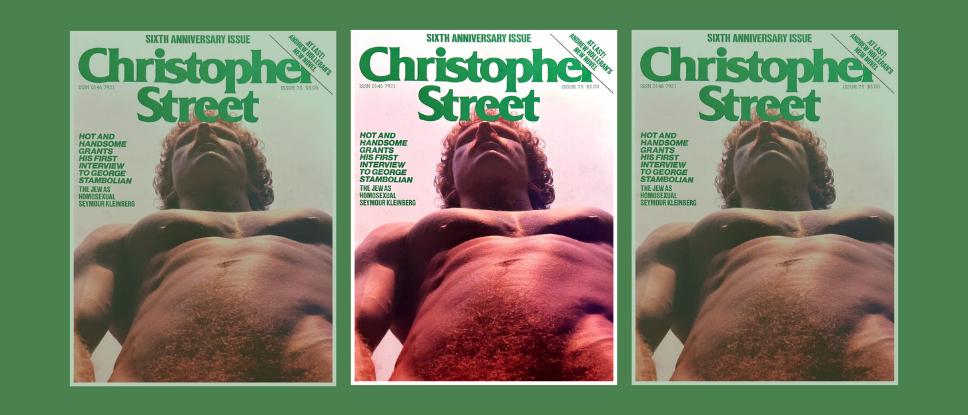
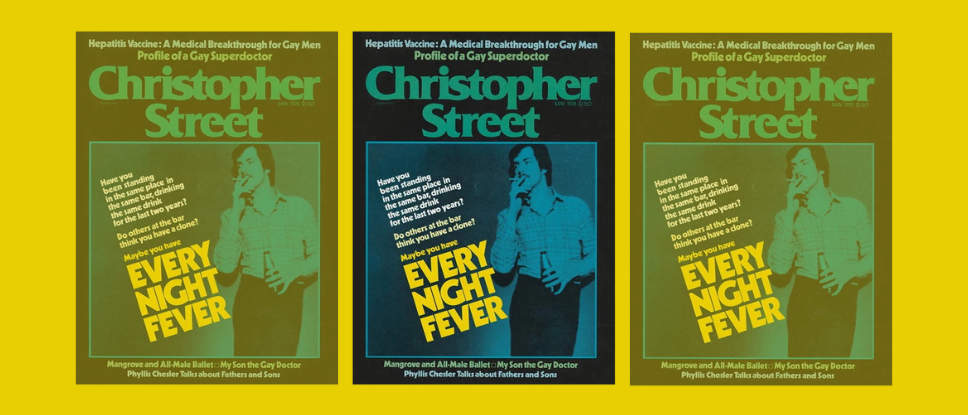

This article appeared in the May 1978 issue of Christopher Street, page 2.
Please! Not another article, not another line by Seymour Kleinberg! The poor man is so confused, and his “Where Have All the Sissies Gone?” in the March issue rambled on so contradictory that I couldn’t tell where he was entering a critical article on sexuality or one on aesthetics. One sentence absolutely stopped me in my tracks: “Ironically, to some extent [Knapp and] March have become extraordinary men if somewhat commonplace homosexuals.” Look! Miss Margrida has written it on the blackboard so everyone can see: two categories, two species—men and homosexuals.
Oh no! Absolutely no. No more schizoid articles by well-meaning academicians dabbling in New Journalism. One was enough. One was too much.
— John Mepworth, Montreal
Seymour Kleinberg’s “Where Have All the Sissies Gone?” (March) was … full of stupid gross generalizations, obscure logic, and a hatred of the macho scheme that must have some personal basis (his own insecurities?). … Whatever reasonable things he had to say (i.e., his view of women’s rights was overloaded with his constant [negative] value judgements of masculinity). Just about everything he says about the macho scene is contrary to my own experiences, which I seem to have survived fairly intact. The real crux is his claim that “Homosexuals who adopt images of masculinity . . . are er… criticizing the very values of straight society that have branded their own lives.” This is wrong in a number of ways. First, people do not “eroticize values” but find certain things erotic. We discover what turns us on; the patterns are already there, set at a pretty early age. … Should we ignore the allure of butchness for “moral” reasons and repress this sexuality, as Kleinberg seems to imply, or should we welcome it and explore all its different levels, complications, and contradictions?
Second, can’t there be a distinctly gay toughness, a gay masculinity that is not degrading? The cover of the March issue seems to illustrate it. … Women’s rights and masculinity, the right to sexual inversion (effeminacy) and masculinity—such “opposites” can be merged. There can be a masculinity that not only tolerates but encourages other forms of behavior, other styles. …
Kleinberg implies that power or a desire for power are entirely negative. Not so. The gay-rights movement is a struggle for power. Gays are finally discovering that they do have power, political power, and also power to determine their own lives, to make choices that until recently were unthinkable. It is the macho gay who kisses his lover in the street . . . who doesn’t hide his gay references in conversation. He expresses his personality aggressively and not in silence or behind the veil of “camp.” … Kleinberg glamorizes the fabulous ’30s, ’40s, and ’50s, when men were really – women? At least a girl knew where she stood, right? Hardly. … Remember that Kinsey’s study was done in the ’50s, and he always maintained that the majority of homosexual men are masculine and totally indiscernible in appearance from anyone else. Kleinberg confuses inversion with homosexuality; they really (according to C.A. Tripp) separate behavioral patterns that may or may not overlap. Camp as an outgrowth of sexual inversion still exists and it will always exist, but to say that it is the true voice of homosexuality (let alone the only voice) is hogwash. It was once the loudest voice because it belonged to the most visible (though minority) element of homosexuality, but now with more and more out-of-the-closet strong homosexuals coming out of their closets it is now known that the [dominant] voice has changed. … The majority of gay men are by nature masculine, and they are hiding nothing by their macho style but rather finally expressing themselves.
— Timothy K. Carroll, New York City
Seymour Kleinberg’s thesis seems to be that gays without limp wrists are unliberated. This kind of thinking could set gay liberation back twenty years. It implies quite a destructive contradiction. Kleinberg is saying that while gays shouldn’t have to conform to straight norms, to be truly gay and liberated we have to conform to some “gay norm.” He is intimidated by the new gay machine, which [most] gays understand for the fantasy it often is, or he is just trying to hang on to a lost age of uptight, put-down people who had to vent their frustrations by camping it up and laughing at themselves.
Some of us, maybe most of us, were never comfortable in the sissy stereotype. Its asexual lack of strength or self-control or self-affirmation was just another alienation. We were at home neither with dumb macho straight thugs nor with nelly gays. . . . It was a very sick world, a helpless one. … So let’s be careful about joining the marchers just because we have a few grievances in common with them. After all, gays like to sleep with men, and some of them are virtually in drag in our blue jeans, as they come quite naturally. I enjoy my manhood; it’s my means of being liberated. I don’t have to be straight, and I don’t have to be the “sissy” that both Kleinberg and the straight world would like me to be.
— Tom Xavier, New York City
Seymour Kleinberg replies: I am gratified that my article was provocative, since the subject certainly is. As these letters illustrate, sexual style is invariably a political issue, and in such an age as ours it is not rare. The interesting thing the critics of my article often fail to note is that masculinity currently popular among gay men. If the reader is prepared to confront his own attitude on the matter, so much the better: that sexuality means is hardly an answered question.
What these readers seem to have in common is an unquestioned assumption that “machohood” and “butchness” are terms of celebration, a truer, newer, more genuine homosexuality. I think they are mistaken, as careless gay men in 1978 as they are careless readers. Nowhere do I prescribe effeminacy for the properly gay male identity. But I gladly acknowledge I appreciate it, particularly for its deviation from the conventional heterosexual men. I’m rather disappointed that it so enrages some homosexual ones. ❡