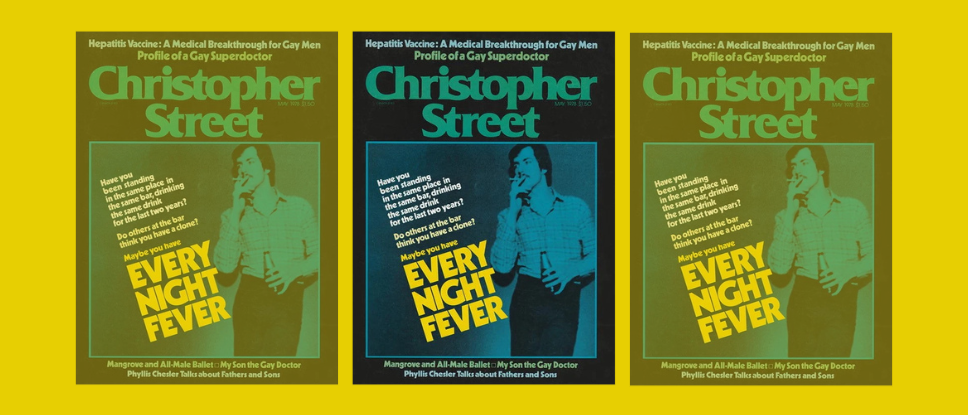
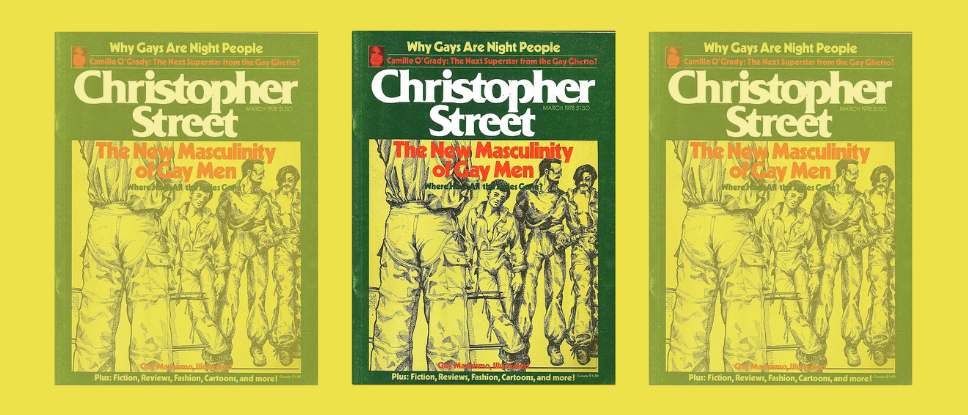
This article appeared in the March 1978 issue of Christopher Street.
ONE WEEK AFTER Labor Day 1977, I made a trip to the Anvil Bar, a gay club in New York City. For a long time I had wanted to know whether the legends of debauchery one heard with some skepticism were accurate. No one I knew was a member, and I had been told by those who claimed to be informed that I was not a likely type to crash successfully. I presumed they meant that my only leather jacket, tailored like a blazer, would not pass muster. Then a close friend became enamored of a go-go boy who danced there, joined the Anvil, and took me along to meet Daniel.
The bar nearly lived up to its fame. The boys do dance continually on top of the four-sided bar; they do strip naked, not counting construction shoes or cock rings. There is a back room where no-nonsense, hard-core porno films silently and continually flicker, shown by a mesmerized projectionist wearily perched on the ledge of the back wall. A small pitch-dark cubicle called the fuck room opens off the rear wall. In the middle of the front-room bar is a stage raised five feet where fist-fucking demonstrations used to be held at 3 a.m. if the crowd was enthusiastic, but those spontaneous shows were stopped when they began to draw tourists from the uptown discos. Now it is used by the dancers who take turns exhibiting their specialities in the limelight. The boys range from extraordinary to middling, from high-schoolers to forty-year-olds, from professionals (everything) to amateurs who move awkwardly but who are graceful and stunning when they don’t move at all. There are types for every taste and some for none. Hispanic and black, WASP and Italian, the boys dance three hours of a six-hour stint for $25 a night, three or four times a week. There are always new faces, and the management is liberal about letting anyone with a good body try out. Usually, there is one dancer who has had some ballet training and is naive enough to make that clear; he is invariably the least favored by the clientele.
My friend’s Daniel is unusual. He is one of the few boys who can use the trapeze bars bolted to the ceiling with real expertise. Without breaking the rhythm of his dance, he leaps for a trapeze and spends four or five minutes hanging on or swinging from one bar to another in the most daring manner. When he alights, it is with a sure flip back onto the bar where he continues to dance with an unbroken stride. Daniel has never fallen, as some of the boys have (a broken nose or a fractured arm is not unheard of ), nor has he crashed into a customer since he holds his drugs well.
His other speciality is his ability to grab with his buttocks the folded one- dollar or five-dollar tips the men at the bar hold between their teeth, a variation on the skill of the Cotton Club girls of Harlem in the twenties and thirties. His perfect behind descends in time to the music over the customer’s uplifted face, and there is a round of applause when the money disappears into those constricted rosy cheeks.
Like most of the clientele, Daniel looks like a college athlete or construction worker, two favored images these recent seasons. Clothed, he wears the uniform of the moment: cheap plaid flannel shirts and jeans, or if it is really warm just overalls, and boots or construction worker’s shoes no matter what the weather is. With the first signs of frost, boots and heavy leather bomber jackets are de rigueur.
Daniel is also typical of one type of club client in that he is a masochist, a “slave” who sleeps with other men only with the permission of his master (who instructs him to charge a hefty fee). While Daniel’s masochism has taken a pecuniary turn, he is not really a whore, for he is indifferent to money, keeping only what he needs for his uppers and poppers, his grass and coke. He dances frenetically four nights a week and does what he is told because he finds that exciting. There is little that he has not experienced sexually, and at twenty-two, his tastes are now as perverse as the possibilities Western civilization has devised.
To look at him, one would hardly suspect that this Irish kid from Queens with his hatch of reddish hair, cowlick and all, this sweet-faced tow built like a swimmer in his blue-collar uniform, lives a life more sexually extreme than anything described by the Marquis de Sade. When he discusses his life, it appears to be an endless dirty movie, but the anecdotes tend to leave his listeners in a moral vacuum. While it is possible to become erotically excited hearing his adventures, it is difficult to judge them without feeling prudish. Conventional moral standards are tangential, psychological ones almost as irrelevant. One is not really shocked; rather, he feels adrift, puzzled, perhaps bemused. Most of all, this nice boy seems very remote.
The values of his generation, acted out as theater of the absurd, are even more histrionic in Daniel’s life. Just as one does not view experimental theater or avant-garde art expecting it to live up to the standards of naturalism, one does not try to understand Daniel’s life from the lessons of one’s own experience: the collective sanity of the past is momentarily dumb.
What one struggled to learn and call “adult” as the final approbation now looks somewhat priggish. If one wanted to use such standards, why go to the Anvil at all? But once he is there, or at the Mine Shaft or any of a half-dozen bars just like them, what does one use to understand this spectacle of men? Some like myself are clearly audience at a drama where only the actors understand the play. Intuition is not trustworthy, and easy judgments make one feel like a tourist. But whether or not one wishes to refrain from judgment, one thing is clear, if not glaring. The universal stance is a studied masculinity. There are no limp wrists, no giggles, no indiscreet hips swaying. Walk, talk, voice, costume, grooming are just right: this is macho country. It is a rigorous place where one destroys himself in drugs and sexual humiliation.
The same impulses are evident in other scenes. Fire Island Pines is as besotted and extreme as the leather and Levi's world, and often they overlap, but the Pines is playful. Like its shabbier neighbor Cherry Grove, the Pines enjoys the long legacy of camp. It loves to dictate next year’s chic to café society; for novelty, flair, and sophistication are as paramount in this scene as testosterone is to the men’s fashion. For a time, the Pines seemed to veer toward egalitarianism; only youthful beauty was required if one were not rich. But with inflation, the freeloading beauty has to be spectacular indeed. The dance halls of the Pines and the Grove, like the waterfront bars, are filled with handsome men posing in careful costumes, and no matter how elegant or expensive, they are all butch.
As a matter of fact, young gay men seem to have abjured effeminacy with universal success. Muscular bodies laboriously cultivated all year round are standard; youthful athletic agility is everyone’s style. The volley-ball game on the beach is no longer a camp classic; now it takes itself as seriously as the San Francisco gay softball team. Hardness is in.
But talk to those men, sleep with them, befriend them, and the problems are the old familiar ones: misery when in love, loneliness when one is not, frustration and ambitiousness at work, and a monumental self-centeredness that exacerbates the rest. These have been the archetypes of unhappiness in homosexual America for as long as I can remember.
What is different from anything else I remember, however, is the relentless pursuit of masculinity. There are no limits; the most oppressive images of sexual violence and dominance are adopted unhesitatingly. Though the neo-Nazi adorations—fascinating fascism as Susan Sontag termed them—are more sinister than the innocuous ideals of the weight-lifting room, they are equally mindless. The offense is not aesthetic; it is entirely political. The homosexuals who adopt images of masculinity, conveying their desire for power and their belief in its beauty, are in fact eroticizing the very values of straight society that have tyrannized their own lives. It is the tension between this style and the content of their lives that demands the oblivion of drugs and sexual libertinism. In the past, the duplicity of closeted lives found relief in effeminate camping; now the suppression or denial of the moral issue in their choice is far more damaging. The perversity of imitating their oppressors guarantees that such blindness will work itself out as self-contempt.
❡
This is the central message of the macho bar world: manliness is the only real virtue; other values are contemptible. And manliness is not some philosophical notion or psychological state; it is not even morally related to behavior. It lies exclusively in the glamorization of physical strength.
This idea of masculinity is so conservative it is almost primitive. That homosexuals are attracted to it and find it gratifying is not a total surprise. Gay male sexual preference has always favored a butch boyish beauty, and only in artistic or intellectual circles has beauty been allowed a certain feyness. Butchness is always relative; the least swishy man in the room is the most butch. It usually meant one looked straight, one could pass. In the past, an over-enthusiasm for butchness translated itself into a taste for rough trade. Those who were too frightened or sane to pursue that particular quarry could always find a gay partner who would accommodatingly act the part.
There is a special eroticism in the experience of pretending to be degraded that is by no means rare in adult sexual behavior of whatever persuasion. The homosexual whose erotic feelings are enhanced by the illusion that his partner holds him in contempt, who is thrilled when told his ass or mouth is just like a cunt, is involved in a complicated self-deception. What appears to be happening is a homosexual variation of masochism: the contempt of the “straight” partner embraces gay self-contempt, which in turn is exploited as an aphrodisiac. Why this process works is less clear than how it does.
The complex tie between the need for degradation and sexual excitement has never been satisfactorily explored, though Freud began the effort over eighty years ago and writers and artists have always intuitively understood it. It seems to be prominent in societies that are advanced, where sexual mores are liberal or ambivalent, and where intellectual life is very sophisticated. In times like ours, when women are redefining their roles and images, men must also redefine theirs. As women forego in dress and appearance the style of their oppression (it is the easiest to abandon and thus one of the first aspects to go), and as glamour falls under a suspicious light, men, increasingly accused of being the symbol of sexism, are forced to confront their own ideas of masculinity.
While straight men define their ideas from a variety of sources (strength, achievement, success, money), two of those sources are always their attitudes toward women and toward paternity. It is no coincidence that the same decade that popularized liberation for women and announced that the nuclear family was a failure also saw men return to a long-haired, androgynous style. If straight men are confused about their maleness, what is the dilemma for gay men, who rarely did more than imitate these ideas?
It is no accident that the macho gesture is always prominent in those gay bars and resorts where women are entirely absent. Certain gay locales have always catered exclusively to one sex: porno movie houses and bookstores, baths, public toilets. The new bars are often private clubs as much for the sake of legally barring women as for screening male customers. Their atmosphere is eerily reminiscent of the locker room. And, of course, while they are there, the men live as if there were no women in the world. This is a useful illusion. It allows some of them to get gang-banged in the back rooms and still evade the self-reproach that derives from the world’s contempt for homosexual men who behave sexually like women. If there are no women in the world, some men simply must replace them. With women absent, whether one is sexually active or passive is no longer the great dividing issue.
In fact, some of the men who look most butch are the most liberated in bed, the least role-oriented. While there is still much role preference for passivity, it no longer has the clear quality it had in the past. Then, gay men made unmistakable announcements: those who liked to be fucked adopted effeminate mannerisms; those who were active tried to look respectable.
Quentin Crisp in his autobiography The Naked Civil Servant epitomized these attitudes. He documents the anger of an acquaintance railing over the misfortune of having picked up a young soldier who wanted to be fucked: “All of a sudden, he turned over. After all I’d done—flitting about the room in my wrap . . . camping myself silly. My dear, I was disgusted.” Today, to replace the usually reliable information that straight or campy behavior conveyed in the past, gay men at the leather bars have taken to elaborate clothing signals: key chains or handkerchiefs drooping from left or right pocket in blue or yellow or red all have coded meanings. Occasionally, some of the cognoscenti lie and misalliances occur. Of course, one could ask a prospective partner what his preferences are, but that is the least likely behavior between strangers.
If I am critical of the present style, it is not because I advocate a return to the denigrations of the past. Quentin Crisp’s rebelliousness testifies to the hourly misery of gay life when all the sexual roles are petrified. He considered all his friends “pseudo men in search of pseudo women.” That is not an improvement on pseudo men in search of nothing. Nor is his sense of inferiority: “I regard all heterosexuals, however low, as superior to any homosexual, however noble.” Such estimates were commonplace for men subjected to lifelong ridicule because they could not or would not disguise their effeminacy.
But camping for Crisp and for the entire homosexual world until the end of the 1950s was not just the expression of self-contempt as men pretending to be women and feeling pseudo as both. Camping also gave homosexual men an exclusive form of behavior that neither women nor straight men could adopt. Some women and straight men are camp, but that is another story.
Camping in the gay world did not mean simply behaving in a blatantly effeminate manner; that was camp only when performed in the presence of those it irritated or threatened or delighted. Swishing is effective only if someone else notices, preferably registering a sense of shock, ideally, outrage. In discreet bars like The Blue Parrot in 1950, men impeccably Brooks Brothers and as apparently WASP as one’s banker could, in a flicker, slide into limpness. They had available a persona that mixed ironic distance, close observation, and wit, all allies of sanity.
Camping did express self-denigration, but it was a complex criticism. For example, the women whose roles men imitated were themselves extraordinary; androgynous idols like Garbo or Dietrich symbolized an ambiguous and amoral sexuality. But more important, in their campy behavior, gay men revealed an empathic observation of women and feminine interests.
When camping also released for gay men some of their anger at their closeted lives, it became a weapon as well as a comment. The behavior chosen for imitation or ridicule was usually evidence of sexist attitudes, of positions women had taken or were forced to take that dehumanized them out of their humanity. It is for this reason that feminists object to drag queens who still try to resemble the slavish emblems of the past, and their criticism would be valid if the imitations were sincere. But men in drag are not swept up in the delusion that they are women; only insane men in drag believe that. The rest are committed to ambiguity: they are neither men nor women and are only rarely androgynous—the aura of drag is neuter.
When a gay man said, “Oh, Mary, come off it,” he was sneering at pretension, self-deceit, or prudery. That it took the form of reminding one’s fellow faggot that he was in reality no better than a woman, and often not as good with his “pseudo” sexual equipment, is not politically commendable; but why should gay men have had a special consciousness about sexism? At least they had a sure recognition of it: they imitated women because they understood that they were victims in sisterhood of the same masculine ideas about sexuality. Generations of women defined themselves entirely in men’s terms, and homosexual men often seemed to accept the same values.
But there was also a chagrined recognition that they just could not live up to expectations. They could not be men as heterosexuals defined manhood; most of all they could not be men because they did not sleep with women or beget children. No amount of manliness could counterbalance that. Between the values of virility that they did not question and their rage at having no apparent alternatives, gay men would camp out their frustration. It was not a particularly effective means of ending oppression, but it was a covert defiance of a society that humiliated them.
With the political and social changes of the sixties, a new androgyny seemed to be on the verge of life. Heterosexual and homosexual suddenly became less interesting than just sexual. Getting out of the closet was more than announcing one was gay; it was a pronouncement that one was free of sexual shame. The new mood fostered this: even straight boys looked prettier than girls. The relief at seeing male vanity in the open, surrendered to and accepted, made it possible for homosexuals to reconsider some of their attitudes toward themselves. It was no longer extraordinary to look effeminate in a world where most sexual men looked feminine and where sexually liberated women were the antithesis of the glamorous and fragile.
Sexual style had become a clear political issue. Conventional manliness was properly identified with reaction and repression. The enemy had a crewcut, was still posturing in outmoded chivalric stances, while his wife and daughter and son embraced the revolutionary notion of rolelessness. To some extent, this is where American society still is: searching for a sense of what roles, if any, are appropriate for adult men and women. Only the betrayed patriarch still refuses to acknowledge the permanence of these changes, since for him they are pure deprivations, erosions of his long, long privilege.
❡
“Feminist” is a term that increasing numbers of gay men apply to themselves as they come to recognize the common oppression of homosexuals and women. The empathy of gay men in the past is the foundation for this newer understanding, and it is heartening to discover that a mutual sense of victimization need not always lead to self-denigration. If in the past women were less likely to feel self-contempt at being women than gay men felt at being homosexual, it was partly because women were rewarded for their acquiescence and partly because they did not have to experience the sense of having betrayed their birthright. Homosexual men usually gave up paternity as well as other prerogatives for their gayness and too often felt gypped for what they got. They exchanged the simplicity of being phallic oppressors for advantages much more dubious, and the sense that they had betrayed their best interests was haunting. As more gays come to realize the bankruptcy of conventional ideas of masculinity, it is easier for them to forego the sexism they shared with heterosexual men. Unfortunately, heterosexuals cling to their sexual definitions with even greater tenacity. For example, the Save Our Children slogan is not as banal as it sounds; the phobic hostility behind it expresses a genuine fear that some children will be lost, lost to patriarchy, to the values of the past, to the perpetuation of conventional ideas of men and women. There is a fear of homosexuality that is far beyond what the surface can explain.
Many gays, especially apolitical ones, are dismissive of Anita Bryant and what she represents. Remarks like “Straights will just have to hope that heterosexuality can hold its own on the open market” express a contempt for the fears, but not much understanding of them. It is puzzling: where does this idea of the frailty of heterosexuality come from, the assumption that a mere knowledge that teachers or ordinary people are gay will automatically seduce children? It comes from the panic about new sexual ideas, but most of all, about the identity of women.
It often sounds absurd when conservatives accuse feminist women of attempting to destroy the family, though it does not stop them from making the accusation. It is easier to appear sensible talking about the seduction of children by homosexuals. I suggest that much of the recent vehemence about the children is deflected from a much more central rage against women who are redefining their ideas about childrearing. The political issue is always hottest when women and their connection with motherhood is raised. Thus, the issues of childrearing and anti-abortion garner a conservative support that puzzles liberal America. What these issues have in common is the attempt of women to free themselves from conventional roles, crucially their roles as mothers. That liberation is the first wave, the secondary one, far more perilous, lies beneath the surface: it demands that men liberate themselves from their notions as well, since the central ideas about masculinity have always been related to the unquestioned responsibilities of men as husbands and fathers.
Curiously, lesbians are never mentioned when child molestation is raised as an issue, and when lesbians are attacked, as they were at Houston, it is in relation to their militant feminism, not in relation to their being school teachers. Lesbians have usually been exempt from heterosexual fears about seduction, partly because they are women and, like all women, traditionally powerless. When they are attacked, when the press notices lesbian issues, it is often in connection with custody cases. There the issue of saving the children for heterosexuality and precisely for patriarchy is clear. These lesbians who once lived as straight women, who married and had children, are objects of the most extreme wrath, and one which has used the judicial system as an instrument to punish them.
But most lesbians are not mothers, and most lesbian mothers do not end up, thankfully, as victims in custody hearings. Lesbians are usually dismissed as unimportant, as nuisances. It is the lowest rung on the ladder of social contempt. But gay men who have abdicated their privileges, who have made sexual desire a higher priority than power over women, are indeed not men at all.
Bryant’s keynote is that homosexuals should return to the closet. That would solve the problem for straights, since it is visibility that is terrifying. To be openly gay without contrition or guilt or shame is to testify that there are viable alternative sexual styles. But the real alternatives for the children is not necessarily homosexuality; it is to reject the old verities of masculine and feminine.
Ironically, the men at the Anvil have not rejected those verities at all. Their new pseudo-masculinity is a precise response to the confusions of a society venturing toward sexual redefinition. But it is in its way as reactionary as the hysteria that Anita Bryant’s campaign consolidated.
The men of the macho bars will not buy Quentin Crisp’s book, or if they do, they will not read it sympathetically, whereas they are part of the audience that made David Kopay’s story a best seller. I do not want to belittle Kopay’s modest effort, but its success depends more on his image than on his courage. Effeminate men like Crisp who have the courage to defy society are eccentric; butch men are heroic. Of course, what is left unsaid is that Kopay could have passed: no one would have known if he hadn’t told them, and having once announced it, he can still pass. What could sissies like Crisp do even if they didn’t flaunt it? Quentin Crisp’s life is an act of courage.
Leonard Matlovich is also a respectable image. When media reporters treat him and Kopay just like the mainstream Americans they have always been, they make a point many gays approve of: homosexual men are really like everyone else. If beneath Matlovich’s conservative, bedmedalled chest beat aberrant yearnings, the public, if not the army, can accommodate them. What makes Kopay and Matlovich seem acceptable to gays and straights alike, while the Quentin Crisps remain pitiful?
Crisp was defiant and miserable, an acknowledged victim, and unrepentant; it was all agony, but it couldn’t have been any other way. Even more, Crisp made his sexuality the obsession of his life. His whole existence was devoted to proclaiming his homosexuality; it is the meaning of his life. Today, his heir is Daniel, who is as absorbed in the same singular definition of himself. Daniel’s life seems consecrated to pleasure while Crisp’s was miserable, and that is an enormous difference. But the source of his pleasures in sexuality is as extreme, as dangerous and defiant as the quest for pleasure in Crisp’s life. I may feel that Crisp is morally superior because he has suffered and Daniel refuses to, but that is only a sentimental notion. What is stunning in both their lives is the exclusivity of sexuality, and while Daniel is not heroic, his life demands that one refrain from easy judgment. The drama of such displays is filled with meaning for them and us. These lives are not like others:
Kopay and Matlovich are fighting to be like everyone else. They claim that they are just like other football players or professional soldiers, and I do not dispute them. Compared to their conventionality, their homosexuality is almost incidental. Neither of them has gotten off quite free, nor have they seemed to expect to. For reasons they articulate with unquestionable credibility, they could not tolerate the duplicity of being conservative, rather ordinary men and secret homosexuals. Ironically, to some extent they have now become extraordinary men of somewhat commonplace homosexuals.
The men in leather watching naked go-go boys and having sex in back-room bars are not like Crisp or Daniel whom they regard as a kind of erotic theater; they are much closer to Kopay and Matlovich with whom they can identify. The rock-bottom premise of such sympathy is that all forms of traditional masculinity are respectable; all symptoms of effeminacy are contemptible. Real sexual extremism, like Daniel’s, belongs to a netherworld; it is not regarded as liberated but as libertine. Daniel is the complete sexual object, and his presence makes the bar world the psychological equivalent of the brothel for the men who watch him. He turns them on, and then they can play whore or client or both.
Most men who are ardent for leather defend it as play. Dressing butch is another version of the gay uniform. What is the harm of walking through the world dressed like a construction worker? What does it matter what costume you wear to the ball? Go as Cinderella’s fairy godmother, and you may break the law. But go as Hell’s Angels, and you risk breaking your own spirit.
It is not coincidence that in the macho bar world and the libertine baths the incidence of impotence is so high that it is barely worth remarking, or that gay men increasingly rely on the toys and trappings of sadomasochism. It is not irrelevant that the new gay image of virility is most often illustrated in pornography.
Manly means hot, and hot is everything. Why then isn’t it working better? Men tell me that I do not appreciate this new celebration of masculinity, that I am overlooking the important “fact”: “We felt for masculinity when we were twelve; there must be something to it because it made us gay. Most of us didn’t become gay because we fell in love with sissies; we became sissies because we fell in love with men, usually jocks.”
It sounds familiar. And so what if one chooses to make one’s life pornographic? Isn’t that only the most recent version of sexual devotion, of incarnating Eros in one’s life? Besides, it’s too late to be a prig. Obviously, as soon as one sets up notions of propriety, no matter how well intended, they will be preempted by the worst, most coercive forces in our society. One is then forced to accept all choices of style, the alternative is to find oneself allied with oppression. In the arena of sexual politics, there is the left and the right. Those who think they are in the middle will ultimately discover that the center is the right.
But my feelings tell me that there is another version; that macho is somehow another closet, and not a new one—many have suspected that it’s the oldest closet in the house. Macho cultures have always had more covert homosexuality. Without belaboring the analogy, there is one consistency: In those cultures, homosexuality is not a sexual identity; it is defined as a role. Only the passive partner, which means anally passive or orally active, is homosexual; the other role is reserved for men, because one either is a man or he is not; that is, he is a woman, and a woman who cannot bear a child and attest to a man’s virility is beneath contempt, at best a whore.
The men in the macho bars are not like this. They have adopted a style and abandoned its psychic origin in sexual role playing. Apparently, they have rescued the best and discarded the worst. But it is an appearance that resonates with unexamined yearnings. It says I am strong and I am free, that gay no longer means the contemptibleness of being nelly, which is the old powerless reactiveness to oppression. In so far as it does that—strong is better than weak, free is always good—it is an improvement on the past. But it claims more: it says that this is a choice, a proper fulfillment of those initial desires that led us to love men, and even at its oddest, it is only playful.
But it is not free, not strong, and it is dangerous play. It is dangerous to dress up like one’s enemy, and worse, it can tie one to him as helplessly as ever. It still says that he, the powerful brute, is the definer, to which we then react. It is the other side of nelly, and more helpless because it denies that one is helpless at all. Effeminacy acknowledged the rage of being oppressed in defiance; macho denies that there is rage and oppression. The strength of those new bodies is a costume designed for sexual allure and for the discotheque. Passing for the enemy does not exempt one from the wrath. Men in leather are already the easiest marks for violent teenagers on a drunken rampage in Greenwich Village or on Mission Street on a Saturday night. Macho is another illusion. The lessons of Negroes who disliked blackness or Jews who insisted they were assimilated, really German, are ignored. To some whites, everything not white is black; to Nazis, Jews are Jews, sidelocks or no. Telling the enemy one is as good as he is because one is like him does not appease; often it makes him more vicious, furious because somehow his victim seems to approve his scorn. And the freedom—that too is illusory except as sexual taste. In that area alone, there has been real change. Compared to their counterparts in the past gay men today have found a freedom to act out their erotic tastes. But taste is not a choice; usually, it is a tyrant.
Homosexuals at their most oppressed have not been in love with men; they have been in love with masculinity. The politics of the New Left and the sexual aesthetics of androgyny have not lasted, but they seemed to be offering alternatives that were authentic, better choices than the ones we had. The new style seems both inauthentic and barely better than the old options. Sometimes it seems worse.
That is what is disturbing and enraging: to find it the growing choice in the 1980s. Does it seriously matter that some men choose to imitate their worst enemies? What is remarkable about such an old story? For one, it is so unnecessary. For the first time in modern history, there are real options for gays. The sissies in The Blue Parrot had little choice other than to stay home. They could only pretend their lives were ordinary. That pretense was survival, but one that led fatally to rage and self-contempt. The theatricality of camping helped keep some sanity and humanity because it was an awareness of one’s helplessness. Macho values are the aesthetics of deserted lives, and adopting that style is the opposite of awareness. Whatever its ironies, they are not critical ones.
Happily, gay men are less helpless than they have ever been before, and because of that they are more threatened. What is worth affirming is not bravura, but political alliance with women and with a whole liberal America that is dedicated to freedom of personal choice. That is worth celebrating. ❡