

In the late 1970s, gay writers often treated New York’s bar and club scene as both a magical realm where a new type of gay life was being invented, and also as an alluring trap. Andrew Holleran’s novel Dancer from the Dance portrayed a world of gay men devoting themselves to going out every night as devotees of a perpetual romantic quest. But Holleran’s depiction of late-1970s New York had a tragic side: its principal characters are “doomed queens” who “fall into degradation and sordidness” and (possibly) all die at the end, finally consumed by the terminal emptiness of the gay ghetto.
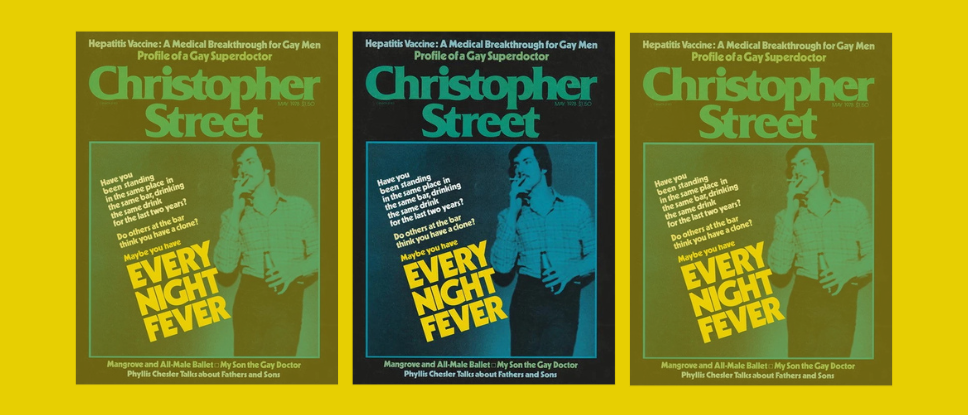
In this episode, we talk about “Every Night Fever,” a 1978 cultural trend story in Christopher Street about gays being addicted to going out. Written by then-23-year-old Michael Musto, who would go on to become a columnist for the Village Voice and a notable NYC nightlife personality, it gives voice to gay New Yorkers on both sides of Holleran’s imagined dichotomy:
The need to be in a group of people seems to be the main motivation for continually going out—whether it be specifically to meet new friends, to socialize with old ones, or to cruise for a pickup. Different people interpret the urge differently. To the people around them, the every-nighters are simply running away from themselves. To the every-nighters, they’ve made a realistic choice to spend their free time in a lively atmosphere rather than sit home alone.
It’s funny to recognize a genre of journalism that is still with us, in which one simultaneously names and constitutes a social phenomenon and invites participants to opine about its meaning. (See last year’s “peak gay sluttiness” article for a contemporary version.)
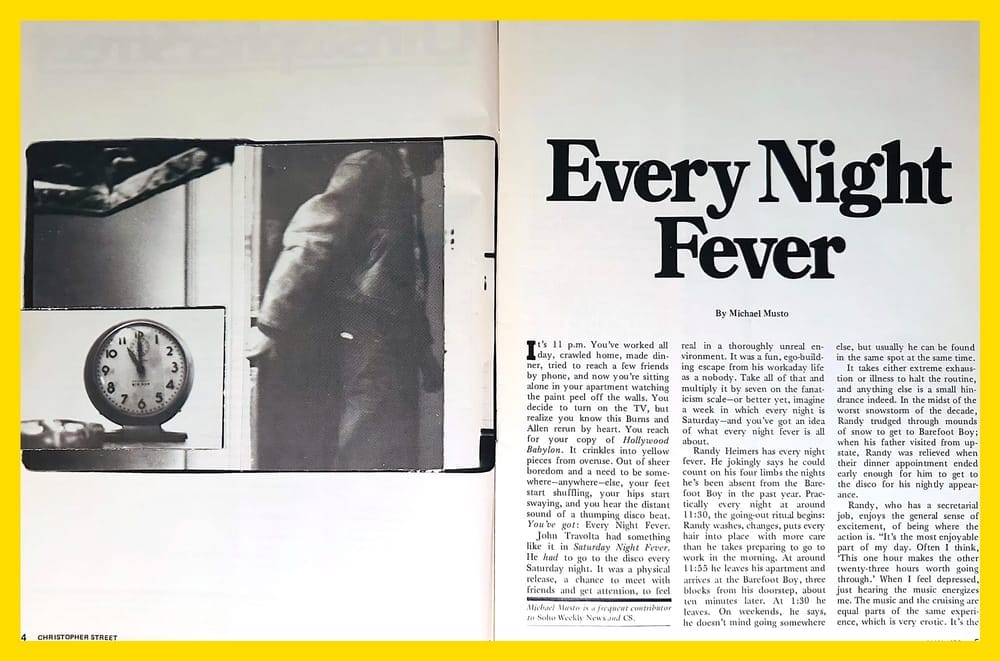
Some of Musto’s interviewees believe that going out is a form of self-evasion, as does the noted gay therapist Charles Silverstein, co-author (with Edmund White) of The Joy of Gay Sex, who paints “every night fever” in the grim hues of gay men “wasting their time in meaningless socializing and meaningless sex.” We talk about contemporary therapy language, and the temptation to interpret normal behavior as if it expresses some sort of pathological avoidance or maladaptation as opposed to a legitimate response to a genuine need:
BLAKE: People like Silverstein can always say, “you're doing X because you're unable to be alone, because you're not at peace with yourself.” There's some implicit ideal of the person who can meet all of their own emotional needs.
DAVID: I think this is a huge part of contemporary therapeutic ideology, especially the social media discourse around therapy. You have to be completely autonomous and self-sufficient and meet all your own needs, “be your own best friend” and all this shit.
BLAKE: Yeah. To the extent that therapy—like couple’s therapy, which I have found helpful—helps us get along in the relationships that we have to have in the world, okay, great. But if there's an unstated—because insane—ideal of satisfying all of my own emotional needs…Brad Gooch has that book from the nineties, Finding the Boyfriend Within. Okay, well, am I going to find my job within? Am I going to find my house within? Some things I actually need from the world, need from other people, from external inputs. “Oh, are you just having dinner because you're hungry? You're seeing friends because you're lonely?” Yeah! I'm seeing my friends because I’m lonely.
Also discussed in this episode:
- Saturday Night Fever, its origins in a fabricated New York article and its heterosexualization of disco
- Our different experiences of going out as bookish intellectual types
- Our COVID meltdowns and divorces
- Why we hate Hinge
- Why gay incels should go out rather than pitying themselves on Reddit
- Whether or not Gen Z has lost the art of going out
You can also listen—and subscribe!—to Off Christopher Street on Spotify, Apple Podcasts, and YouTube. If you listen on one of those platforms, please take a moment to give us a rating and a review, which helps other listeners find us.